Iran, US involved in Hormuz clashes with deal response awaited
Published in News & Features
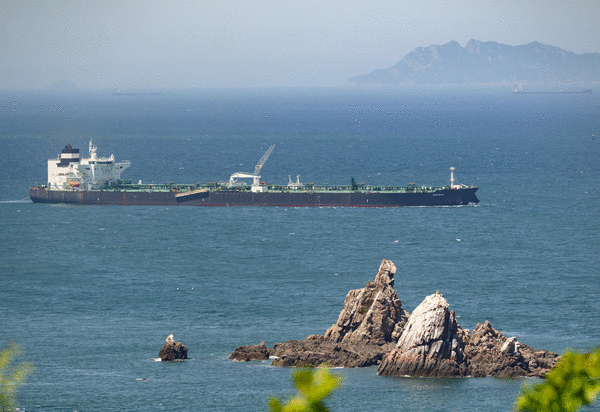
The U.S. and Iran clashed overnight near the Strait of Hormuz, an escalation that threatens to further fracture a fragile ceasefire as the two sides discuss a permanent end to the war.
U.S. forces targeted missile and drone launch sites and other military assets in Islamic Republic that they said were responsible for attacking three U.S. warships transiting the strait. No vessels were hit, U.S. Central Command said. A monthlong ceasefire remains in effect, President Donald Trump said.
The Iranian army seized an oil tanker for “attempting to disrupt oil exports and the interests of the Iranian nation,” the semi-official Tasnim news agency reported Friday. The vessel was carrying a cargo of Iran’s oil and was trying to harm and disrupt exports, Iran’s state-run Islamic Republic News Agency reported, without elaborating.
The clashes risk undermining talks over a U.S.-proposed deal to end the war that began at the end of February. Iran is expected to send a response via Pakistan, acting as a mediator, within days, a person familiar with the matter said on Wednesday. Trump threatened more intense strikes if Iran refuses his terms, raising the risk of a longer war that has already killed thousands and sparked a global energy crisis.
Iran has still given no indication whether it will accept Trump’s plan, which proposes Tehran reopen the strait and the U.S. ends a blockade on Iranian ports.
“Just like we knocked them out again today, we’ll knock them out a lot harder, and a lot more violently, in the future, if they don’t get their Deal signed, FAST,” Trump said in a social media post on Thursday evening. “It might not happen, but it could happen any day,” Trump told reporters later, referring to a possible agreement.
Brent crude-oil futures rose slightly to around $100 a barrel. U.S. stocks futures edged higher, with key indexes set to test fresh records, though benchmarks in Europe and Asia fell.
The war, which began when the U.S. and Israel launched attacks on Iran, effectively shut the Strait of Hormuz, through which about a fifth of the world’s oil and liquefied natural gas typically flows.
Before the clashes near Hormuz were announced, Iran said the U.S. had targeted two of its oil tankers in the area, according to a Press TV report citing the country’s joint military command. It also accused the U.S. of striking civilian areas along its southern coast and on Qeshm Island “with the cooperation of some regional countries,” the report said.
The United Arab Emirates, which has borne the brunt of Iran’s retaliatory strikes on U.S. allies in the region, said Friday morning that its air defenses were intercepting missiles and drones targeting the country.
The U.S. “does not seek escalation but remains positioned and ready to protect American forces,” Centcom said.
The U.S. “eliminated inbound threats and targeted Iranian military facilities responsible for attacking U.S. forces including missile and drone launch sites,” according to the statement. USS Truxtun, USS Rafael Peralta, and USS Mason transited Hormuz and reached the Gulf of Oman without any U.S. assets being struck, it said.
Iran’s leaders haven’t indicated whether they will accept the terms of the U.S. offer, though they have shown little sign of yielding on their nuclear program or accepting a moratorium on enriching uranium — both top U.S. demands.
Saudi Arabia and Kuwait have lifted restrictions on the U.S. military’s ability to use regional bases, the Wall Street Journal reported Thursday, a move that could allow the Trump administration to restart the effort to ease traffic through the strait.
A Central Command official referred questions about the reporting on the bases to the Saudi and Kuwaiti governments. The Kuwaiti and Saudi embassies did not respond to requests for comment.
Here’s more related to the war:
•Washington relayed a one-page memo to the Islamic Republic that could reopen the strategic Strait of Hormuz and lift the U.S. blockade, according to the person familiar with the matter. That would set the stage for a month of talks aimed at securing a final agreement to bring the 10-week conflict to a close.
•Gasoline prices breached $4.50 a gallon for the first time since July 2022, according to the American Automobile Association. This adds pressure on Trump, six months from midterm elections in which energy costs will be a central focus.
•Trump is set to meet Chinese President Xi Jinping May 14-15 in a rescheduled summit in Beijing. There is unease among Chinese officials about holding the high-stakes meeting before the war in Iran is resolved, people familiar with the matter said.
•Trump is due to deliver remarks Friday, the White House said, without providing details about the topic.
•Israel said it killed a Hezbollah commander in a southern suburb of Beirut, its first strike on the city since a ceasefire began in Lebanon last month.
--------
—With assistance from Yasufumi Saito.
©2026 Bloomberg L.P. Visit bloomberg.com. Distributed by Tribune Content Agency, LLC.





Comments