Chavista hardliners turn on Delcy Rodríguez amid growing ties to Trump
Published in News & Features
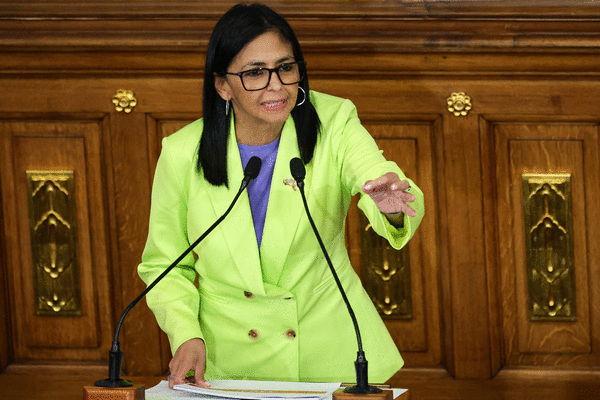
The political transition that followed the dramatic capture of Nicolás Maduro earlier this year was always expected to fracture Venezuela’s ruling movement. But few anticipated how quickly criticism from within Chavismo, the political movement named after deceased strongman Hugo Chávez, itself would become one of the biggest threats facing interim President Delcy Rodríguez.
Rodríguez, Maduro’s former vice president, assumed power after the strongman’s dramatic detention during January’s U.S. operation in Caracas. Since then, she has spent recent months trying to stabilize a collapsing economy, reopen Venezuela to international markets and normalize relations with Washington. Those efforts have earned her repeated praise from President Donald Trump, who has described her as a “terrific person” doing a “great job.”
Inside the ruling socialist movement, however, those same efforts have unleashed growing accusations of betrayal.
The loudest attacks have come from figures once considered ideological pillars of the Bolivarian revolution, exposing widening fractures between pragmatic officials seeking economic survival and hardline loyalists who view the rapprochement with the United States as an abandonment of Chávez’s anti-imperialist legacy.
Among the most vocal critics is Mario Silva, the longtime host of the state-aligned television program La Hojilla, Spanish for razor blade. Silva, a staunch Maduro ally who was pushed out in March from the state-run network Venezolana de Televisión, has emerged as perhaps the most visible public face of discontent within the so-called “chavismo duro” — hardline Chavismo.
Silva has used his broadcasts to accuse segments of the current leadership of “cowardice” and “treason,” charging that a small inner circle around Rodríguez is negotiating Venezuela’s future with Washington behind the backs of the movement’s grassroots.
On Tuesday night, Silva escalated his criticism during his program, warning against what he described as decisions being made by a petit comitéd, a small committee willing to hand Venezuela’s resources over to the same foreign power that carried out the Jan. 3 military operation that led to Maduro’s capture.
Silva decried what he called decisions that continue to be made by the small committee “that hands over our resources, which belong to the people, to those who criminally bombed us on Jan. 3,” Silva said during the broadcast. “Imperialism is the enemy.”
He also issued a direct appeal to the ruling PSUV party and to Interior Minister Diosdado Cabello to “return power to the people” so Venezuelans could decide “the destiny of our sovereignty, our independence and our freedom in defense of Chávez’s legacy.”
The comments reflected mounting frustration among hardline Chavistas who increasingly see Rodríguez’s government as moving too quickly toward accommodation with Washington and foreign investors.
Silva has repeatedly denounced the accelerated opening of Venezuela’s oil sector to U.S. companies, describing it as the delivery of national resources to “imperialism.” He has also attacked the government’s economic policies, arguing that Rodríguez has abandoned the revolution’s socialist foundations by tolerating the country’s de facto dollarization and relying on opaque bonus systems instead of meaningful salary increases for workers.
In recent broadcasts, Silva has also lashed out at officials he describes as cipayos — a term used in Latin America for subservient collaborators with foreign powers — accusing them of trying to ingratiate themselves with the Trump administration in order to preserve their hold on power.
Tuesday’s remarks went even further, with Silva warning unnamed figures inside the political establishment that he would publicly expose anyone attempting to “take advantage” of the Bolivarian movement for personal gain.
“While I’m alive, I will not allow internal or external enemies, profiteers and leeches, thieves who continue financing the overthrow of the revolution, to benefit from the legitimate struggle of our Bolivarian, Chavista and revolutionary people,” he said.
The criticism reflects deeper anxieties spreading through Venezuela’s ruling movement as Rodríguez advances negotiations tied to sanctions relief, debt restructuring and new investment frameworks authorized through expanded U.S. Treasury Department licenses.
For years, anti-American rhetoric served as one of the central ideological pillars holding Chavismo together. Now many of the same officials who built their careers denouncing Washington are overseeing the reopening of diplomatic relations, facilitating meetings with U.S. energy executives and quietly pushing reforms designed to attract foreign capital.
The backlash is not limited to television personalities.
The Venezuelan Communist Party, which had already distanced itself from Maduro before his downfall, has become another major source of criticism against Rodríguez’s administration.
Óscar Figuera, the party’s secretary general, has publicly accused the interim government of accepting “tutelage without resistance” and operating under “subordination and colonial dependency” to the Trump administration.
In unusually blunt language, Figuera described the government as “prostrated” before Washington and accused it of imposing an economic path designed around Wall Street’s interests rather than those of Venezuelan workers.
Other leftist figures have focused their criticism on the expanding role of U.S. companies in Venezuela’s energy and mining sectors.
Jackeline López, a prominent party militant, condemned recent visits by senior U.S. officials to Caracas and warned that Washington views Venezuela as little more than a “backyard” for resource extraction. She criticized what she described as the opaque handling of new oil and gold concessions.
“Every new American ‘tutor’ who arrives in Venezuela seems to bring a mandate to modify our laws and facilitate control over the country’s resources,” López said in a press release.
Compounding Rodríguez’s political problems is the fact that she remains deeply unpopular with the broader Venezuelan public despite the easing of international isolation and the modest economic stabilization seen in recent months.
According to a recent poll by Meganálisis, Rodríguez’s approval numbers remain mired in deeply negative territory, reflecting persistent distrust toward the ruling movement even after Maduro’s removal. The survey found that a large majority of Venezuelans continue to associate the interim administration with the corruption, repression and economic collapse that marked the later years of Chavista rule.
Those numbers pose a major challenge as Rodríguez increasingly positions herself for what many inside the transitional government expect will eventually become a presidential campaign. While no election date has been formally announced, mounting domestic and international pressure for democratic normalization has fueled expectations that Venezuelans could head to the polls sooner rather than later.
Yet polling data suggests Rodríguez would enter any competitive race as a severe underdog against opposition leader María Corina Machado, who continues to dominate national surveys and remains by far the country’s most popular political figure. According to Meganálisis, if Machado and Rodríguez were to face each other in an election held this week, the opposition leader would capture 76% of the vote compared with just 4% for the interim president.
The growing dissent underscores the delicate balancing act Rodríguez now faces.
While Rodríguez’s administration has sought to project stability and pragmatism abroad, it must simultaneously prevent a rupture inside the political coalition that governed Venezuela for more than two decades.
That challenge has become especially complicated among radical grassroots sectors and pro-government colectivos that still embrace the movement’s traditional anti-U.S. discourse.
In parts of Caracas and several interior regions, hardline Chavista groups have publicly denounced the government’s energy agreements with American firms and accused the leadership of capitulating to foreign interests.
Though security forces and the military high command have largely remained disciplined following the transition pact that accompanied Maduro’s removal, analysts say frustration among ideological loyalists continues to simmer beneath the surface.
Rodríguez herself has increasingly tried to navigate those contradictions through carefully calibrated rhetoric.
Even while overseeing reforms demanded by Washington and pursuing foreign investment, she has continued publicly criticizing sectors of the opposition that celebrated the U.S. military operation that led to Maduro’s capture. According to critics and allies alike, those statements are aimed at reassuring Chavista loyalists that the movement has not entirely abandoned its nationalist identity.
But for many hardliners, the symbolism is no longer enough.
To them, the reopening of Venezuela’s oil fields to American corporations, the growing presence of U.S. officials in Caracas and the broader economic liberalization underway represent not temporary concessions but the collapse of the ideological project Chávez built.
And as Venezuela moves deeper into its post-Maduro transition, Rodríguez may increasingly find that her greatest political challenge no longer comes from the opposition, but from the revolution’s own disillusioned base.
©2026 Miami Herald. Visit at miamiherald.com. Distributed by Tribune Content Agency, LLC.




Comments