China urges opening of Hormuz in Iran talks before Xi-Trump meet
Published in News & Features
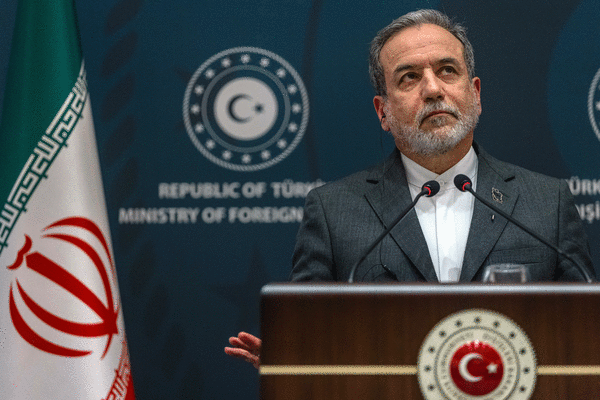
China’s top diplomat called for the swift reopening of the Strait of Hormuz in a meeting with his Iranian counterpart, signaling Beijing’s urgency to resolve a global energy crisis just days before President Xi Jinping is set to meet with Donald Trump.
“The international community shares a common concern for the restoration of normal and safe passage of the strait,” Foreign Minister Wang Yi told Iran’s Abbas Araghchi on Wednesday in their first sitdown after the war started, according to an official Chinese statement. “China hopes that the parties concerned will respond to the strong appeal of the international community as soon as possible.”
The exchange took place against the backdrop of a potential breakthrough between Washington and Tehran. Iran is evaluating a one-page memorandum of understanding that, if accepted, will lead to the gradual reopening of the Strait of Hormuz and lifting of the American blockade on Iranian ports. Oil plunged on news of the plan, earlier reported by Axios.
Helping bring an end to the crisis would address a vulnerability for the world’s second-largest economy, with the Middle East accounting for some 40% of China’s oil imports. Beyond the immediate economic relief, the ability to facilitate a de-escalation would allow Xi to arrive at next week’s summit as a peacemaker, potentially strengthening his hand in negotiations.
“China likes to present itself as a great stabilizing force in the world, but imagine if they had a genuine diplomatic achievement, such as brokering the opening of the Strait of Hormuz, as proof of that,” said Richard McGregor, senior fellow at the Lowy Institute. He suggested some in Beijing would advocate for using the moment to “squeeze some concessions out of the U.S.” on issues such as Taiwan.
The key question is what role China is willing to play to end the conflict and what kind of pressure it’s prepared to put on Tehran. China has portrayed itself as a neutral mediator in the war, while seeking to balance strategic ties with Iran and its vast economic interests in the Gulf.
During the meeting, Wang largely repeated China’s earlier call for a ceasefire and a peaceful resolution. “A resumption of hostilities is inadvisable, and persisting with negotiations is particularly important,” Wang told Araghchi, according to a Chinese statement.
Araghchi expressed both Iran’s resolve to defend itself and a willingness to pursue dialogue, according to the Iranian readout. “Just as Iran appeared in the field of self-defense with strength and remains fully prepared to confront any kind of evil, it is also serious and constant in the field of diplomacy,” Araghchi said.
The diplomats discussed issues including “how the war will end, matters related to Iran’s peaceful nuclear program, sanctions, the Strait of Hormuz and the negotiations currently underway,” Araghchi said in a TV interview with the Iranian state broadcaster.
The meeting suggests the two strategic partners are stepping up coordination before Trump’s expected summit with Xi on May 14-15, where the Iran war is expected to be high on the agenda. Wang and Araghchi have spoken by phone at least three times since the start of the conflict.
Underscoring the intense diplomacy, Araghchi held a call with Saudi Foreign Minister Faisal bin Farhan on Wednesday afternoon directly from Beijing after his meeting with Wang. The Iranian and Saudi diplomats “emphasized the continuation of diplomacy and cooperation among regional countries to prevent the occurrence and escalation of tensions,” Iran’s Foreign Ministry said in a statement.
As talks intensify with Tehran, Beijing is maintaining close contacts with Moscow. Russian President Vladimir Putin will likely travel to China in May, according to a Russian business daily, Vedomosti, for what would be his first trip abroad this year.
Araghchi’s visit highlights China’s status as one of the few geopolitical heavyweights with leverage over both Tehran and Washington. Beijing is a key diplomatic and economic backer of Tehran, buying most of Iran’s oil exports.
However, that relationship has become a flashpoint. The U.S. Treasury has sanctioned Chinese private oil refiners for processing Iranian crude, including Hengli Petrochemical (Dalian) Refinery Co., one of the country’s largest. China responded by ordering companies to defy U.S. sanctions in an unprecedented step that raised tensions before the Trump-Xi summit.
Araghchi’s trip will be scrutinized in Washington, as the U.S. comes under increasing pressure to end the war. The shuttering of the Strait of Hormuz — through which a fifth of global oil and gas flows passed before the conflict — triggered a surge in U.S. gasoline prices and piled pressure on the Republican Party ahead of Midterm elections this November.
“I hope the Chinese tell him what he needs to be told, and that is that what you are doing in the straits is causing you to be globally isolated,” Secretary of State Marco Rubio said at a White House press briefing on Tuesday. “It is in China’s interest that Iran stopped closing the straits. It’s harming China as well.”
--------
—With assistance from Patrick Sykes, Golnar Motevalli and Rebecca Choong Wilkins.
©2026 Bloomberg L.P. Visit bloomberg.com. Distributed by Tribune Content Agency, LLC.






Comments