Record ocean heat off California coast echoes 'Blob,' killing seabirds and reshaping weather outlook
Published in News & Features
Over the past several months, an intense marine heat wave has developed in the Pacific from Washington to Baja Mexico, with a particularly extreme hot spot between the Bay Area and San Diego. Ocean temperatures have spiked to as much as 7 degrees hotter than average, with many places breaking records for this time of year.
The heatwave off the California coast is already causing starving birds to wash ashore and could increase the risk of thunderstorms and dry lightning that could worsen the wildfire season, scientists say.
Researchers at the Scripps Institution of Oceanography at UC San Diego have recorded 38 days since Jan. 1 when the surface temperature off their La Jolla pier in San Diego broke records going as far back as 1916. On March 20, the ocean there reached 71 degrees, the hottest ever recorded in March and a level normally seen in August.
“It’s extreme,” said Melissa Carter, a Scripps oceanographer. “We have had heat waves in the past. But this is a record event for the duration and the intensity.”
Farther north, ocean temperatures also have broken records on 31 days this year off Newport Beach; 38 off Santa Barbara; 22 at Pacific Grove near Monterey; 9 days at the Farallon Islands off San Francisco; and 14 at Trinidad in Humboldt County.
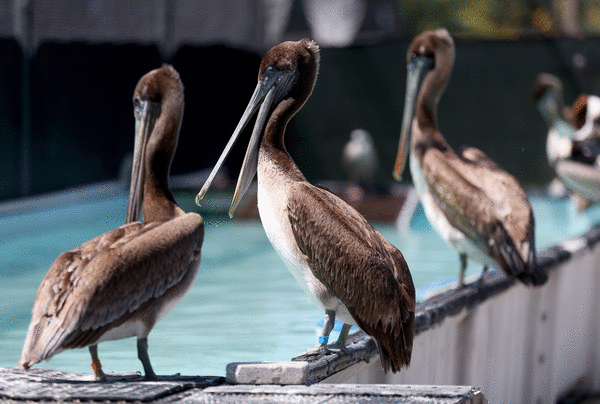
Biologists are reporting an increase in the number of seabirds that are being found dead or emaciated on beaches from Monterey Bay to the Mexican border, including brown pelicans, cormorants and common murres. The birds feed on sardines, anchovies and other small fish that may be temporarily moving deeper and farther north to find cooler waters, making it harder for the birds to eat.
“We’ve had hundreds of reports of dead birds all along the California coast,” said J.D. Bergeron, CEO of International Bird Rescue, a nonprofit group. “People are seeing them on the beach. It’s heartbreaking.”
Bergeron’s organization is treating some of the emaciated birds at its facilities in Fairfield and San Pedro.
“Brown pelicans can only dive 6 feet,” he said. “Any deeper than 6 feet, they can’t reach. The fish could be lower down in the water and be inaccessible. We’re the canary in the coal mine. We are seeing the seabirds that show something is not well.”
Scientists say the heat wave, which appears to be related to changes in wind patterns that limit the extent cold water in the deeper depths can move to the surface, and the intense high-pressure system that caused record hot, dry temperatures over the land in March, could bring hotter, more humid temperatures to California this summer.
Also possible is an increased risk of thunderstorms and dry lightning that could worsen the wildfire season. Tropical cyclones, like the remnants of Hurricane Hilary, which hit Southern California in 2023, causing flooding that closed Death Valley National Park for two months, are also possible this year, experts say.
“California is going to be affected by this now record-breaking marine heat wave for months to come,” said Daniel Swain, a climate scientist with the University of California Agriculture and Natural Resources division. “It’s likely this is going to be with us probably the rest of the year. And it’s significantly going to influence weather in California and the Southwestern U.S. during that time.”
A similar marine heat wave, which became known as “The Blob,” affected California ocean temperatures in 2014 and 2015.
During that event, normally chilly waters were balmy for beachgoers, swimmers and surfers. There were fewer foggy days at the beach. Humpback whales began feeding much closer to the coast, affording people amazing views of the animals — but also putting the whales in greater danger of collisions with ships and entanglement with fishing gear.
Huge blooms of algae emerged, shutting down crab and clam fishing for months.
Salmon runs crashed. Ocean species normally seen in tropical waters began showing up much farther north along California, Oregon and Washington, including thresher sharks, hammerhead sharks, blue marlin and mahi mahi.
Tuna crabs, small reddish crustaceans typically found in Mexican waters, washed up in huge piles along California beaches. Bluefin tuna appeared in record numbers in California waters.
Closer to the shore, however, seabirds and young sea lions, who couldn’t get enough to eat because of changes in local fish patterns, began washing up by the thousands, malnourished and dead, along beaches. Wildlife rescue centers were overwhelmed.
“Sea lion pups were just starving,” said Dr. Cara Field, staff veterinarian at the Marine Mammal Center in Sausalito, which treated 1,800 distressed seals and sea lions in 2015, triple the normal number. “At 6 months of age, they were at their birth weight. They were completely emaciated. Many of them were dying despite our best efforts. It was very difficult to keep up with.”
The Blob also did significant damage to California’s kelp forests. And although the sea lions and other species have since recovered, kelp forests in many places, including off the Sonoma and Mendocino coasts, are still struggling.
“We’re concerned that it could happen again,” said Anita Giraldo Ospina, a marine scientist with the Monterey Bay Aquarium. “Many of our kelp forests have not recovered.”
The 2014-15 marine heat wave also worsened California’s severe drought, which stretched from 2012 to 2016.
After about a year, wind patterns changed, the resilient ridge of high pressure broke down and the Blob dissipated.
Scientists say they are watching the current trends now with nervousness. The good news, Field said, is that there have not been reports yet of starving sea lions. But the emaciated pelicans and other seabirds are a troubling sign, she added.
“The pattern is not exactly the same, but the water temperatures and what is happening in the ocean is very reminiscent of that previous event, which was so devastating,” Field said. “We’re keeping a really close eye on it. I think we should expect this is going to be a bad year and be ready for it.”
The scientist who coined the term “The Blob” in 2014 said he sees similarities, too.
“It’s definitely a major one in the size and the magnitude of the temperature anomalies,” said Nick Bond, a former research meteorologist at the University of Washington and the Washington state climatologist emeritus.
Bond noted that the 2014 Blob, whose name he took from a campy 1958 sci-fi movie starring a young Steve McQueen, began as a huge mass of warm water hundreds of miles across off the Pacific Northwest. Over time, the marine heat wave, like a heat wave on land, spread across the West Coast.
Climate change doesn’t cause marine heat waves, he said, but it makes them worse, particularly since much of the heat that has built up over recent decades has been absorbed by the oceans.
“The ocean is warming,” he said. “It doesn’t take as much of an unusual event for temperatures to get to places where they haven’t been before.”
The current marine heat wave could get hotter and broaden later in the year, he said, if strong El Niño conditions develop. During El Niño events, wind patterns change, causing waters to warm along the equator off Peru. During very strong El Niño years, when the waters are significantly warmer than average, the chances of a wet winter can increase in California, particularly in Southern California.
“The warm waters we’re seeing now are probably going to help make the El Niño that is brewing that much stronger,” Bond said.
There’s currently a 61% chance that an El Niño will emerge by July and a 90% chance by November, according to the most recent forecast from the National Oceanic and Atmospheric Administration, with a 50% chance it will be strong or very strong.
There have been three very strong El Niño winters in recent history — 1982-83, 1997-98 and 2015-16. In the first two, there were ferocious winter storms and flooding, major mudslides and other damage across California, including devastating flooding in the Bay Area. In the most recent one, however, rainfall statewide was 99% of the historical average.
Although it won’t be clear for months how the current marine heat wave will play out, scientists say they are becoming more commonplace. Another occurred in 2019 off the coast of California.
“Get used to it,” Bond said. “The oceans are warming. These events, unfortunately, are going to come along more often. And this one, I think, is going to have legs.”
_____
©2026 MediaNews Group, Inc. Visit at mercurynews.com. Distributed by Tribune Content Agency, LLC.





Comments