Illinois school district faces controversy over multiyear attempt to add Arabic language curriculum
Published in News & Features
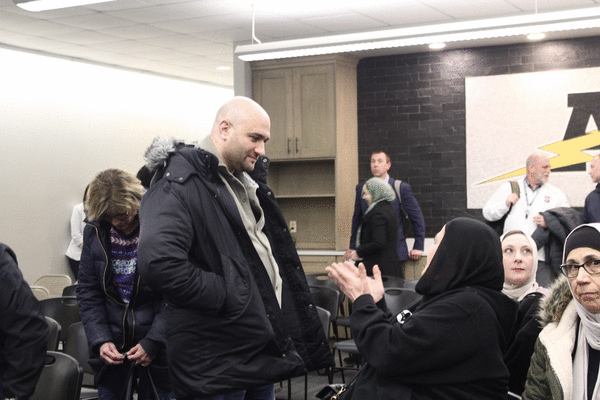
Father of two Waleed Atawneh has urged his southwest suburban high school district to add Arabic to its world language program, contending it would boost job prospects for students, serve a national interest and provide an opportunity for many children — including his own — to identify with the subject matter they’re studying.
“It would allow the students to see themselves in the curriculum,” said Atawneh, a second-generation Arab American who hopes his young kids will one day have the option to take Arabic language classes at their public high school. “If the Arab American students saw their language, their culture, being taught as part of the mainstream curriculum … it would allow them to be seen.”
But the argument has not gone smoothly. Despite a sizable population of Arab American students and groundswell of support from many parents, Orland Park-based High School District 230 is facing controversy over a proposal to create an Arabic language program.
Many proponents expressed frustration with the school board and administration as multiyear efforts to bring Arabic language instruction to District 230 appeared to stall, culminating with the recent resignation of the only Arab American member of the school board.
Local educator Mohammed Jaber — who first proposed adding Arabic language instruction to the district’s curriculum in 2023 — stepped down from the school board in late March, citing frustration with district resistance and delays to the proposal.
“I asked once, twice, I thought we could discuss it earlier on,” Jaber said during a recent interview with the Tribune. “When I got to the point where it was year three and I got to the, I think sixth time, seventh time inquiring about it, it was kind of like OK, where is this going?”
Jaber added that he felt “just burnt-out, tired and exhausted.”
The school district serves a swath of the southwest suburbs that includes a large Arabic-speaking contingent as well as a thriving collection of Arab American businesses.
Nearly 13% of the district’s student population identifies as being of Middle Eastern or North African descent, far above the 0.3% of students statewide, according to 2025 Illinois Report Card data. Of roughly 12,500 parents or guardians in the district’s ParentSquare communications platform, a little over 10% have asked to receive their district communications in Arabic, according to district records.
But the area’s Arab and Muslim communities have also endured a painful history of discrimination, from severe backlash following the Sept. 11, 2001, attacks to disputes over proposed mosques to more recent political contention surrounding an Orland Park resolution calling for a Gaza ceasefire.
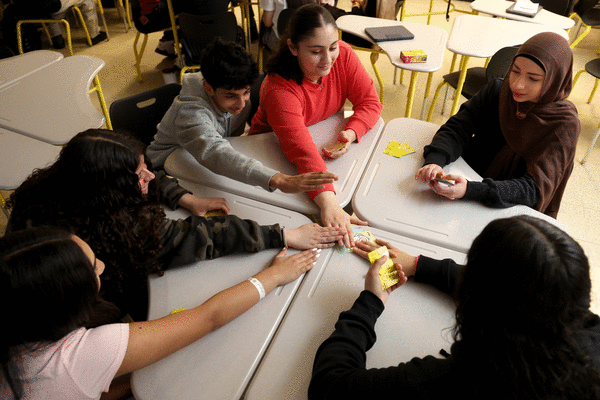
Some proponents of adding Arabic language instruction say the curriculum would help cultivate a sense of inclusion, identity and belonging for students of Arab descent in the district.
An online petition titled “Stop Attacks on Arabic Language in Orland Schools” states that “heated attacks” rooted in misinformation and fear have targeted the proposal to add an Arabic language program to the district’s course offerings.
“District 230 prides itself on preparing students for the future. But the future cannot be built on exclusion,” the petition posted in August says. “Just as Spanish, French, and German are taught without controversy, Arabic deserves a place in the classroom — free from stigma or political fights.”
The petition, which garnered more than 800 signatures, also calls on the school board and district Superintendent Robert Nolting to “stand firm in supporting the Arabic curriculum.”
In a statement to the Tribune, Nolting said the district is “currently evaluating the addition of a World Language Arabic course,” but the process of adding any course to the curriculum “involves multiple steps including development, review and research.”
During a February school board meeting, a district official gave an hourlong presentation on the timeline, process, staffing challenges, sequence considerations and next steps.
“While it might be frustrating that the process doesn’t move faster, District 230 is committed to offering relevant, rigorous, sustainable curricula to our students,” the statement said. “The process of proposing, reviewing, researching, staffing, and implementing any course is purposefully designed to be methodical and rigorous.”
But ex-school board member Jaber criticized the board for delaying a January vote on the proposed Arabic language curriculum and failing to foster better dialogue on the matter.
At the same time, he believes the district will eventually add a curriculum in Arabic — an official United Nations language spoken by some 400 million people around the globe.
He added that there’s great demand in the district for Arabic language instruction, noting it’s already offered at other local districts including Chicago Public Schools and neighboring Oak Lawn Community High School District 229.
“I think it’s going to happen,” he said. “The foundation is there. And I set that foundation.”
The Orland Park resident said the surrounding community has grown much more inclusive and welcoming of folks of all backgrounds over the years.
He said that two or three decades ago, it’s unlikely anyone would have even raised the possibility of adding Arabic language instruction at District 230, which serves nearly 7,500 students from the southwest suburbs of Orland Park, Palos Hills, Tinley Park, Bridgeview, Palos Park, Palos Heights, Orland Hills, Oak Forest, Willow Springs, Hickory Hills and Worth.
Today, the local schools, libraries and other community institutions often strive to embrace diversity, including recognizing Arab culture and Muslim holidays like Eid al-Fitr, which marks the end of Ramadan, he noted.
“It’s more community-friendly,” added Jaber, a CPS teacher who serves on the Orland Fire Protection District Board of Fire Commissioners. “Of the whole community.”
History of marginalization
Arab American cafes and stores abound in and around District 230’s boundaries, from Middle Eastern restaurants to Mediterranean grocery stores to a litany of coffee shops dotting the area.
Illinois lawmakers recently designated a 5-mile strip of Harlem Avenue in the southwest suburbs as “Little Palestine,” a recognition of the more than 200 Arab American-owned businesses in and near the flourishing corridor.
A sign celebrating the honorary title was unveiled on April 7 — dubbed “Little Palestine Day” — at Harlem Avenue and 83rd Street in Bridgeview, which was spearheaded by the Palos Heights-based Arab American Business and Professional Association.
“In the early 20th century, many Arab families began migrating to southwestern Cook County seeking a better life and the opportunity to build a supportive community in the United States,” an Illinois Senate resolution on the neighborhood designation states. “These families have contributed to the rich cultural landscape of Little Palestine, transforming it into a beacon of hope and resilience.”
The surrounding southwest Cook County region boasts the largest Palestinian American community and fourth largest Arab American population in the nation, according to the resolution.
Yet these local Arab and Muslim communities have also faced intense backlash over the past few decades.
Post-9/11, pervasive anti-Arab sentiment spurred a wave of threats, harassment and hate crimes against those of Middle Eastern and North African descent throughout the Chicago area, with a high concentration of incidents in the southwest suburbs.
Almost a decade ago, a Palos Township trustee came under fire for Facebook comments insinuating that local schools were full of undocumented Middle Eastern students.
Proposed mosques in the southwest suburbs have also encountered opposition in the past.
In 2016, anonymous flyers titled “Save Palos” targeted plans to turn a former Palos Park church into a mosque; while many local Muslims found the hostility disheartening, the mayor at the time called the leaflets cowardly and the Palos Islamic Center ultimately opened as planned.
In a case that drew national headlines, a 2000 proposal for a mosque in Palos Heights was met with so much community dissent that the City Council offered the mosque $200,000 to walk away from the deal. The mayor at the time, Dean Koldenhoven, vetoed the buyout, calling it insulting to Muslims.
Koldenhoven was honored with the John F. Kennedy Profile in Courage Award in 2002 for standing up for the mosque.
But he also lost his 2001 reelection bid, which many attributed to the fight over the house of worship. And the mosque never did open there.
In contrast, recent controversy in neighboring Orland Park over a proposed resolution calling for a ceasefire in war-torn Gaza ignited a change of leadership many say favored the local Arab and Muslim communities, indicating a new momentum of political power among those minority groups.
Former Orland Park Mayor Keith Pekau in 2024 suggested that Arab Americans who favored the ceasefire measure could “go to another country” if they disagreed with U.S. policy.
But Pekau lost reelection in April 2025 to challenger Jim Dodge. In September, Orland Park passed the ceasefire resolution, which had been proposed by resident Yousef Zegar.
Zegar now chairs All United PAC, which was founded in 2024 “in response to a sense of deep marginalization and alienation felt by Arab, Muslim and other minority communities from a handful of divisive elected officials,” according to its website.
Zegar said Arab American candidates have made great recent gains in the southwest suburbs on local school boards, suburban commissions and township elected positions.
Last year, the first Arab American trustee was elected to serve on Moraine Valley Community College’s board, he added.
Zegar said he’s met with District 230 board members to encourage them to launch an Arabic world language program.
“We’ve talked to the board, a few members on the board. Obviously, we are supportive of the Arabic language being taught,” he said. “I do believe they are willing to work with us.”
‘Beautifully diverse’
Reaction to the proposed District 230 Arabic language curriculum during school board public comment sessions as well as on social media has been mixed.
During a March school board meeting, Nicky Smit — a staff member at Sandburg High School — extolled the virtues of foreign language learning and pressed the district to add Arabic language courses.
“It has been brought to my attention that members of our community have repeatedly brought to this school board the topic of adding Arabic to our world languages curriculum, and (this) has been repeatedly met with deferral or obfuscation about the complexity of learning or teaching this language,” said Smit, who is also a Sandburg alum.
He lamented that the district’s world language program has not been “diversified or broadened” in recent history.
“But our student body and surrounding community has and our curriculum ought to reflect that,” he told the board. “With so many Arabic-speaking neighbors, local restaurants and coffee houses we now more than ever have the perfect opportunity for our students to apply what could be taught in the class in their lives.”
But it needs to be taught in the classroom first, he stressed.
“At this stage any further tabling of this discussion without seeing progress is a result of either negligence or prejudice, but I know better. I know District 230. It made me,” Smit said. “We are neither negligent nor prejudiced. We are capable. We are committed. And we are beautifully diverse.”
But another community member, who declined to give the Tribune his name, countered that there are also “large groups of Polish, Irish, Greek and other wonderful ethnicities in this district.”
“And I feel if one of those wants from a certain community is met, then every want from every other community is met,” he said.
If one ethnicity or community group’s language is going to be offered, “they all should be offered,” the man stipulated.
“Furthermore, I would hope that if all of those languages are offered and certain groups get their wants, and all their wants are met from them, I would hope it does not take from the wonderful curriculum and education of District 230,” he added.
On the Tribune’s Facebook page, many readers expressed support for the proposed Arabic language program in comments on previous stories on the topic.
“As an elective (it) would be great,” one reader posted. “Kids going into the military or becoming teachers who want to travel … gives them a step up.”
“Arabic is the springboard language of civilization,” another Facebook user commented, followed by a long list of Arabic influences and achievements throughout history.
But the social media posts also included many detractors, with some devolving into Islamophobic and xenophobic rhetoric.
“English!! English!! English!! You are in America now so speak our language,” one person commented.
“This isn’t Arabia, why not assimilate into the country in which you live?” a commenter asked, to which another Facebook user replied, “They’re not here to assimilate. They’re here to conquer.”
District 230 officials say there are “several distinct components and challenges” to adding Arabic language instruction.
“Several key decisions need to be evaluated — such as a four-year or two-year option, access to a single building or all three schools, enrollment caps and impact on existing staff and programs — all of which are multifaceted and complex,” school board President Lynn Zeder had said during a previous meeting.
Another barrier previously cited by board members has been difficulty finding qualified instructors with an Arabic certification endorsement having passed the Arabic world language test, particularly those who can also commit to a four-year program covering a wide range of skill sets.
While 50 educators in Illinois hold the necessary World Language Arabic endorsement, only seven are currently teaching the subject, according to the superintendent’s statement.
The district has taken several steps including posting three English Learner Bilingual Arabic positions to assess the local candidate pool; individuals who have expressed interest in teaching Arabic have been contacted by the district to discuss credentials, licensure and steps to become certified to teach Arabic as a world language, the superintendent’s statement said.
The district has a course proposal form and a written procedure for adding to the curriculum, said Jennifer Waterman, district communications director.
Waterman said the last time District 230 added a new course was in the 2024-25 school year, and it was a class in international cuisine; no courses were added in the current school year, she said.
Chicago Public Schools officials say they’ve had great success with their Arabic world language program, which serves more than 3,000 students at four high schools and six elementary schools citywide.
While Illinois suffers from a teacher shortage, “there’s a wealth of individuals who are Arabic native language speakers who are also credentialed teachers in foreign language or bilingual,” said Christine Murphy Judson, executive director of talent acquisition at CPS.
CPS officials say there have been no known controversies or resistance to its Arabic language curriculum.
“Arabic is a critical language in the United States because we don’t have enough citizens who speak it. It is a global language of great importance,” said Fabiola Fadda-Ginski, CPS world language programs director. “And it fosters a sense of belonging for our Arab American students — and we have a substantial population. We’ve seen the culture reflected in the prestige of the classroom setting.”
As for Jaber, he hopes his successor will support the Arabic language proposal. His replacement will serve until the April 2027 election. Jaber would also like to see another Arab American serving on the school board, which has seen multiple resignations and replacements in the past few years.
“I think Arab representation is really important to have,” he said. “We’re a voice for everyone. But sometimes having an Arab American on the board can be a voice for that (specific) community as well.”
____
©2026 Chicago Tribune. Visit at chicagotribune.com. Distributed by Tribune Content Agency, LLC.






Comments