Disneyland becomes more reliant on facial recognition despite privacy concerns
Published in News & Features
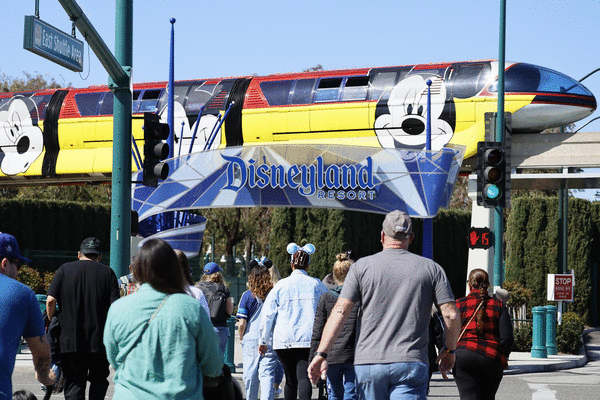
Photos are an expected part of almost any visit to Disneyland.
Whether it’s first-time international visitors or longtime returnees, just about everyone is clicking photos at some point.
That everyone, however, is extending more and more to Disneyland personnel.
My colleague Hannah Fry documented the growing use of facial recognition technology at the Happiest Place on Earth.
Privacy experts are sounding the alarm, while some patrons are trying their best to avoid the technology.
Let’s dive into her reporting to see what’s going on.
Under the mouse’s eye
Photographs of guests’ faces taken at the entrances to Disneyland and sister park California Adventure are run through biometric technology to convert the images into unique numerical values.
The images can then be compared with pictures taken when a customer first used the ticket or annual pass.
“Pretty much every other place is doing the same thing,” said John LeSchofs, 73, who visits the park roughly every six weeks with his wife. “The police, the government, they’re all using facial recognition. I don’t think it’s going to stop.”
Disney officials say the technology helps make entering and reentering the park easier and prevents fraud.
Sounding the alarm
The rapid growth of facial recognition over the last decade has raised concerns among privacy experts who caution that such data can easily be turned over to law enforcement entities or make companies hacking targets.
“The normalization of facial surveillance is really problematic,” said Ari Waldman, a professor of law at UC Irvine. “We can’t go around life hiding our faces, so this isn’t just [the] next step in surveillance; it’s qualitatively different. In a world of facial recognition, when people leave their house, it automatically means they’re identified.”
Following a familiar pattern
Venues over the last decade have increasingly relied on facial recognition to speed up entry and purchases for guests.
At Intuit Dome, visitors can use “GameFaceID” to more quickly enter the stadium for Clippers games or live entertainment. To use it, the guest just needs to upload a selfie, and the technology generates face recognition data to identify them at the arena. The venue’s privacy policy states they “may also infer whether you are over 21 from your selfie photo.”
Dodger Stadium also employs facial recognition technology for guests who want to use the “Go Ahead Entry” at certain gates into the ballpark. The technology allows parkgoers to enter without having to produce a physical or digital ticket.
How to avoid Disney’s facial recognition
Guests who don’t want to run their face through the technology can enter through a separate entrance marked with a silhouette of a head and shoulders with a slash through it.
Of the dozens of lines to enter Disneyland and California Adventure, there were only four on Friday that didn’t use facial recognition.
Guests in those lines still had their photos taken, but the company said biometric technology wasn’t used. Instead, an employee was seen manually validating tickets.
Fry, a breaking news reporter who has covered surveillance, said she wasn’t surprised by Disneyland’s usage of facial recognition technology.
“But it’s truly eye-opening just how much information private companies collect about their customers and what can be done with that data,” she said. “It’s outlined in these companies’ privacy policies, but most people, understandably, don’t pore over those documents and really weigh the benefits and risks.”
She added that she hoped the story helped provide readers “a moment” to think about how their private data are being shared.
“It’s truly up to consumers to determine which technologies they’re OK with using and just how much of their data they want to share,” she said. “I also hope the story provided a sense of agency so people know they can opt out when they go to Disneyland or other venues like sports stadiums that use this facial recognition technology.”
_____
©2026 Los Angeles Times. Visit at latimes.com. Distributed by Tribune Content Agency, LLC.






Comments