Judge orders some fundraising records released to probe conflict-of-interest claim against DA in Stanford vandalism case
Published in News & Features
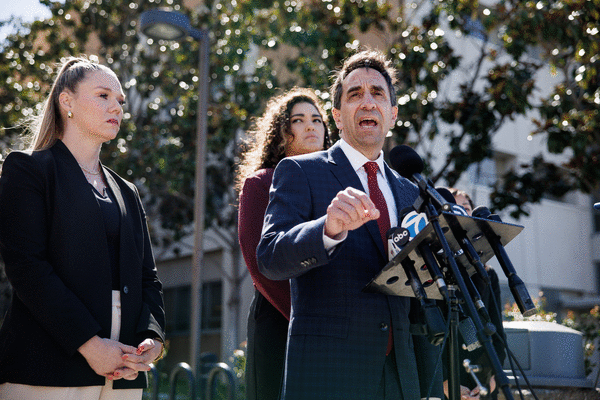
SAN JOSE, Calif. — A Santa Clara County judge Monday ordered District Attorney Jeff Rosen’s fundraising records to be turned over to defense attorneys, citing the documents as necessary to determine whether the prosecutor has a conflict of interest that should bar him and his entire office from retrying a felony vandalism case against five pro-Palestinian activists.
The orders were part of a recusal motion seeking to bar Rosen and his entire office from retrying five defendants — known as the “Stanford 5.” The defendants are facing felony charges after a June 2024 demonstration in which protesters briefly occupied Stanford University’s executive offices, calling on the school to divest from companies linked to Israel over the war in Gaza. University officials accused demonstrators of causing at least $300,000 in damage.
The recusal motion centers on allegations that Rosen used the high-profile prosecution to raise campaign funds. Deputy Public Defender Avi Singh, who represents defendant German Gonzalez, argued last month that Rosen was “monetizing criminal prosecution” — highlighting the case on his campaign website alongside donation buttons and on a page titled “DA Rosen Fighting Anti-Semitism.”
The defense is seeking records from Rosen’s campaign. Some records are being subpoenaed from third parties after Rosen said he does not have them.
Superior Court Judge Kelley Paul said she found several defense requests legally valid and that “documents could lead to admissible evidence and have bearing on statutory and due process rights.”
Paul declined to release personal identifying information about Rosen’s supporters — including membership lists, home addresses and employer names for the hundreds who confirmed attendance at the fundraiser. She also withheld financial receipts from fundraising platform Anedot Inc. pending a private review to determine their relevance.
Without signaling where she leaned, Paul said the disclosure was about determining whether Rosen had blurred the line between his roles as district attorney and political candidate.
Both sides are expected to return to court next week to argue the recusal motion. Paul could then subsequently issue a ruling.
Among the documents ordered released were materials regarding the creation of a Dec. 5 email blast, which allegedly referenced the Stanford prosecution, including Rosen’s drafts and notes on its content and structure — as well as speech drafts and talking points for a Dec. 14 fundraiser.
The judge also ordered the disclosure of digital media from that event, provided that all attendee faces are blurred, except for Rosen’s.
Paul ordered the materials released by Friday under a gag order initially — to prevent the case from “being litigated in the media,” she said. But the records will likely become public when attorneys argue the recusal motion, with privacy protections for any third parties whose data appears in the subpoenaed materials.
Lawyers for Rosen’s campaign argued the subpoenas should be quashed, calling them a “fishing expedition” that lacked justification and violated the District Attorney’s supporters’ “constitutional rights of freedom of association and privacy.”
Beyond privacy concerns, attorneys Imran Dar and Sarah Goldwasser argued that releasing the documents posed a direct threat, citing the nature of the charges against the defendants. They characterized Gonzalez as someone who “engages in criminal activities” and led a “hostile occupation” that caused significant damage — and suggested the defense might use donor information to harass “an ethnoreligious minority.”
Gonzalez has not been convicted of any crime.
Co-defense attorney Margaret Trask called the characterization offensive and destructive.
“Requests are done in good faith — we just want to make sure our clients are respected here,” she said. Paul agreed, saying the court would not entertain arguments that assume bad faith on the part of defendants or opposing counsel.
In an interview with the Bay Area News Group’s editorial board Monday, Rosen said the case is one of multiple issues he campaigned on, arguing that publicizing prosecutions is standard practice for elected DAs.
“Everything that every elected official does, they inform people. This is what we’re doing. And if you like it, support us,” Rosen said. “I’m against domestic violence. And I’ve said that and I highlight our domestic violence prosecutions. Does that mean that I should be recused from domestic violence?”
Rosen grew visibly heated when asked about the “monetizing” accusation, arguing he has faced no similar challenges in other prosecutions — attributing the difference to his identity.
“But in this case, because it’s about antisemitism, and it’s because I’m a Jew, it’s the oldest f***ing antisemitic trope. And that’s exactly what the defense attorney is doing in this case,” he said. Rosen added that the case has resulted in increased threats and a heightened security detail.
The prosecution is among the most serious criminal cases brought nationwide tied to the wave of pro-Palestinian campus protests that swept the country in 2024. Similar cases at Columbia University, the University of Michigan and UCLA were either dismissed or never pursued criminally.
The five who went to trial are Gonzalez, Maya Burke, Taylor McCann, Hunter Taylor Black and Amy Zhai. The remaining defendants either accepted plea deals or entered diversion programs that could allow charges to be dismissed if they complete certain requirements.
A mistrial was declared Feb. 13 after jurors split 8-4 in favor of guilt on the conspiracy charge and 9-3 on the vandalism charge, falling short of the unanimous verdict required for conviction. If convicted upon retrial, the five defendants could face up to three years in prison and possible restitution.
Stanford has become a flashpoint for pro-Palestinian expression and accusations of antisemitism on campus. Separate subcommittees in 2024 found a basis for alleged antisemitism and anti-Israel bias, as well as documented cases of Islamophobia and discrimination against Muslim, Arab and Palestinian students.
Outside the campus, the case has highlighted how deeply divided views over the war in Gaza have complicated court proceedings, with attorneys clashing over whether political views should influence jury selection, defense arguments or witness testimony.
If granted, the recusal motion would be among the rare instances in Santa Clara County in which an entire district attorney’s office is removed from a case. The attorney general would then decide whether to take over the prosecution or drop the charges.
©2026 MediaNews Group, Inc. Visit at mercurynews.com. Distributed by Tribune Content Agency, LLC.






Comments