Why a Haitian police officer's request for ammunition, assault rifles raises eyebrows
Published in News & Features
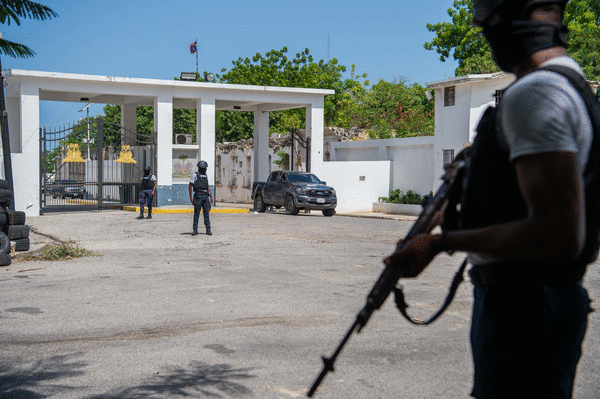
On the surface, it appeared to be a reasonable security proposal: extend the perimeter around Haiti’s National Palace grounds, replace aging weapons and add more officers to guard against gang attacks.
But the acquisition request submitted late last year by the police officer charged with overseeing Haiti’s elite presidential security units has raised a far more troubling concern.
The documents, reviewed by multiple sources who spoke to the Miami Herald, called for a stockpile large enough to outfit a small army: 10 billion rounds of high-powered, 7.62 millimeter ammunition; 5 billion rounds of 5.56 millimeter ammunition, 2,300 assault rifles and sniper units, along with thousands of police uniforms. The requisition also included 12 armored vehicles; a 12-seat armored transport “to evacuate dignitaries in case of an emergency,” and a convoy of 23 additional tactical vehicles — including three armored Toyota Land Cruisers designated for the police commander’s personal use.
Issued by Pierre-Louis Cangé shortly after he was appointed in November as the Haiti National Police’s presidential security coordinator, the request — later amended to 10 million and 5 million rounds of the combat ammunitions — also included a request for a monthly cash allowance of $23,000 in ”working capital” and another $76,400 for “intelligence gathering,” according to the sources who have seen the written requests and asked to remain anonymous to speak freely.
In his request, Cangé said the reinforcements were necessary to prevent a crisis ahead of Feb. 7 — the constitutional end of presidential mandates in Haiti, and the date the country’s Transitional Presidential Council is expected to relinquish power.
But in the days since the requests have come to light, politicians and foreign diplomats have been wondering: Was this just a fanciful wishlist of an overzealous palace security chief seeking to bolster defenses and win favor with allies in the transition, or the opening move in a bid to seize control of the national palace, the symbol of power?
“I don’t know his real intentions,” said a government official who described the saga as an administrative matter that suddenly turned political after some of the members of the ruling presidential panel inserted themselves. They offered to accompany Cangé to the Police Inspector General office after his boss, Haitian National Police Chief André Jonas Vladimir Paraison, summoned him to explain his actions.
“But it seems that he wants to be able to control who comes and goes inside the palace on Feb. 7,” the government official said.
Though Haiti’s presidential palace collapsed in the Jan. 12, 2010, earthquake, and gang control of downtown Port-au-Prince has forced the nine-member presidential council to work out of the old prime minister’s office, the palace offices and grounds remains a potent symbol of state authority. Its possible seizure by gangs or political spoilers would be widely viewed as a sign of total state collapse.
Haitian ‘Game of Thrones’
For weeks, foreign diplomats, political party leaders and members of the political transition have been shuttling between meetings, attempting to broker consensus on who should lead the next phase of Haiti’s fragile transition — and how those currently in power should exit.
Behind the scenes, however, intrigue, divisions, accusations of power grabs and coup d’etats, along with profanity-laden confrontations between presidential advisers, have multiplied, in what some insiders describe as a modern-day Haitian “Game of Thrones.”
Members of the presidential transition, who came to power in April 2024, have been accused of maneuvering against one another, and attempting to force out the prime minister, Alix Didier Fils-Aimé, in December. The effort failed after council president Laurent Saint-Cyr refused to support it, but then a group of council members attempted to remove Saint-Cyr as well.
“Their goal is to change the prime minister, the secretary general of the palace so that they can take over the security and the state because they want to stay after Feb. 7,” a source inside the transition said. Two other sources confirmed to the Herald that council members are once more working on removing Fils-Aimé through a vote in the coming days.
Though council members face a barrage of serious accusations, from ties to the country’s powerful gangs to corruption — and there is overwhelming sentiment that they need to go — critics accuse them of wanting to stay in power to have influence on elections, scheduled for later this year, and possibly to protect themselves from possible U.S. sanctions or even arrests once they leave office.
“They want to push the transition to a year or two,” said the source, who noted that despite a recent public declaration by presidential adviser and former council head Leslie Voltaire that the members are leaving office on Feb. 7, “these guys are all over the place campaigning” to remain.
The request for ammo
Police didn’t learn about Cangé’s weapons and ammunition request until this month, when he was summoned to appear before the Inspector General’s office to answer why he had removed two senior officers and their deputies from the palace without permission. But soon the police matter became entangled in the council’s high-stakes politicking, after two presidential advisers stepped into the fray and offered to accompany Cangé to respond to the summons.
So far, Cangé has been dismissive of what he described in a letter as “an administrative follow-up.” In requesting a postponement after a Jan. 6 invitation, he wrote that he was “fully mobilized in the development of an operations plan” for Feb. 7. A second invite, this one from Vladimir Paraison, Haiti’s police chief, was sent on Jan. 13 — and again ignored.
Sources close to Cangé, who was promoted to his job without going through the normal police leadership channels, claim that he was informed by his supporters on the presidential council that the summons had been canceled. A police source said that on the contrary, the investigation remains open.
Cangé did not respond to a Herald request for comment.
At a minimum, Cangé, who has since obtained a lawyer, is suspected of trying to destabilize presidential security on Feb. 7 — a day many Haitians fear could plunge the country deeper into political uncertainty. At worst, critics fear, he was acting on behalf of allies within the presidential council.
Jean Elysée Céliscar, a member of one of many organizations proposing a solution for Feb. 7, said the involvement of presidential advisers in what is essentially a police matter raises reinforces his belief that council members are seeking ways to prolong their expiring mandate.
“Something suspicious is going on,” Céliscar, a member of the Initiative Group, said during an interview Monday on Port-au-Prince based Magik 9 about the efforts to get consensus on the next transition. “They involved themselves to show that they are the ones behind it.”
Cangé, he added, needs to explain his intentions about the weapons requisition.
Moise’s assassination
Haitians have reasons to be wary of an overzealous security chief. Recent history helps explain why the secretary general of the palace pushed back on Cangé’s unusual request.
President Jovenel Moise was assassinated in his home in the middle of the night in July 2021 despite the presence of multiple members of his security detail.
A police investigative report and subsequent judicial inquiry concluded that he was an easy target because of his guards’ conduct. During the attack, they displayed such passivity “that they showed no intention of defending the Head of State, let alone the presidential family,” the judicial police said.
“By their attitude, they facilitated the access of the attackers to the residence of the president,“ the police report said.
Among the more than 40 palace police officers jailed in connection with the still-unsolved slaying were Divisional Commissioner Jean Laguel Civil, the coordinator of presidential security, and Dimitri Hérard, head of the General Security Unit of the National Palace.
Both men escaped from prison during a gang assault in 2024 on the Port-au-Prince National Penitentiary. Civil’s lawyers said his arrest was politically motivated. Hérard, who was under a U.S. arms-trafficking investigatio at the time, has also denied wrongdoing.
Push back on demands
Cangé was appointed to his current role when members of the presidential council selected him to replace Paraison, who was promoted to police chief.
At the time, the palace was not under attack. Months earlier Paraison got a bullet in a foot as he and his men repelled a gang assault The palace was still off limits to the presidential advisers, who like Cangé worked out of the old prime minister’s office.
After assuming command of about 800 police officers, Cangé concluded that the palace troops were ill-equipped to defend the structure and their numbers “insufficient.” He called for “immediate reinforcements” with another 200 officers; the unstable political climate in Haiti, he argued, meant anything could affect the security of dignitaries and the palace.
Cangé’s demands, however, met with swift resistance from palace Secretary General Régine Haddad, who after Moise’s assassination decided that no security coordinator would be allowed unfettered authority to appoint police personnel.
In a Jan. 6 letter to Justice Minister Patrick Pélissier, who oversees the Haiti National Police, Haddad complained that Cangé treated her as a subordinate even though she outranks him under the organizational chart, and he must route all requests through her office.
Despite meetings explaining the chain of command inside the National Palace, Cangé he persisted in bypassing her, she said, and wrote directly to the head of the presidential council, Saint-Cyr. In some cases, he failed to copy the secretary general of the presidency altogether, Haddad added.
As part of her complaint, Haddad included a copy of Cangé’s weapons request.
Because of the disarray caused by Cangé’s actions, a police source said, during Haiti’s official Independence Day ceremony on Jan. 1 at the National Palace the national anthem was delayed because of the absence of the police band, and the ceremony was more than an hour late because there was no one to give orders for officers to be present.
©2026 Miami Herald. Visit at miamiherald.com. Distributed by Tribune Content Agency, LLC.





Comments