Zillow settles with FTC, eliminates key part of $100M deal with Redfin
Published in Business News
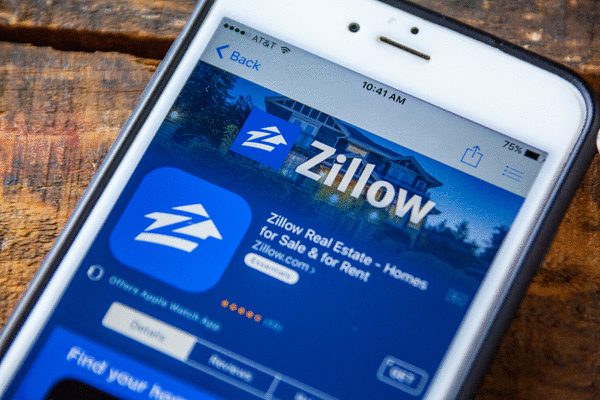
Zillow settled with the Federal Trade Commission just hours before trial on Monday, agreeing to unwind part of a controversial deal with Redfin.
The FTC sued the two Seattle-based companies months after they struck a $100 million deal last February requiring Redfin to exclusively repost apartment listings provided by Zillow, transition its customers to Zillow and stay out of the rental internet listing services market for up to nine years.
Five states, including Washington, joined the FTC's lawsuit claiming the deal illegally suppressed competition in the rental market.
Just before the lawsuit's trial scheduled to start Monday, the parties announced they had reached a settlement that allowed most of the deal to go forward except for one key piece: Redfin's agreement to not compete on rental listings.
The FTC said in a news release on Monday that it will file a stipulated order eliminating the part of Zillow’s agreement with Redfin that requires the latter to shut down its rental listing business. The order also requires Redfin to reenter the market with “far more apartment listings and commit to investing millions of dollars in its rentals advertising business “to ensure Redfin will be a far stronger competitor” than it was before the 2025 agreement.
Although Zillow will lose the benefit of keeping Redfin out of the market, the settlement allows Zillow to remain the exclusive distributor of rental listings on Redfin. That means Zillow will continue to benefit from Redfin’s audience, even though Redfin will remain a competitor in the rental advertising business.
Both companies are major players in the online rental listing market. Redfin, now owned by Rocket Companies, operates Rent.com, Rentals.com and ApartmentGuide.com.
Regulators argued that a lack of competition in the rental advertising market would lessen rental owners' negotiating power, potentially making advertising costs more expensive. Landlords could then pass on those additional costs to renters, the FTC and states argued.
Daniel Guarnera, Director of the FTC’s Bureau of Competition, said in the news release that the settlement “delivers better, quicker, more certain results” for both renters and property management companies than the FTC would have been able to achieve after prevailing at trial.
Guarnera said the FTC expects the order to drive down costs for renters and property management companies.
Washington Attorney General Nick Brown said in a statement on Monday that the settlement will restore competition between the two companies by making Redfin a stronger competitor.
“Most importantly, consumers will have more choices and won’t be subjected to illegally manipulated prices," he said.
Despite having to eliminate a key part of their agreement, Zillow and Redfin described the settlement as a win on Monday.
Zillow and Redfin have argued since their $100 million deal's inception that the partnership benefit renters, rather than harming them, by giving them access to a larger pool of available apartments.
In a news release on Monday, Zillow claimed Redfin's rental inventory has nearly quadrupled since the agreement to show Zillow’s listings, while Zillow's inventory grew by almost 40% as Redfin referred customers to Zillow.
Michael Sherman, general manager and senior vice president of Zillow Rentals, doubled down on the company's stance that the deal with Redfin was not anti-competitive, calling the partnership with Redfin "pro-consumer and procompetitive" in the news release.
"This positive resolution enables us to keep our energy on innovating for renters and property managers, and ultimately making renting easier, more affordable and better for everyone," he said.
In an emailed statement on Monday, a Redfin spokesperson said the settlement will allow the company to maintain a partnership with Zillow at least through 2030 while it builds a standalone rentals business.
"Consumers will continue to have access to the rental inventory they rely on today, while we build a stronger Redfin that can meet them at any stage — from their first rental to their first home and beyond, the spokesperson said.
Some investor analysts saw the settlement as an incremental positive for Zillow on Monday. While some previously worried the courts would require Zillow and Redfin to unwind the deal completely, the settlement provides surety that Zillow can continue benefitting from the deal — at least in part.
©2026 The Seattle Times. Visit seattletimes.com. Distributed by Tribune Content Agency, LLC.










Comments