Boeing's contract offer 'just not enough,' some SPEEA workers say
Published in Business News
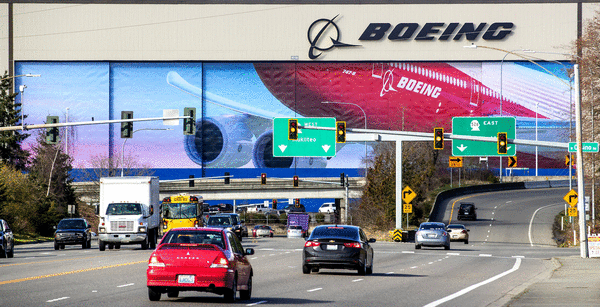
Boeing had hoped for smooth negotiations with its white-collar union members, aiming to avoid the type of tense impasse that resulted in financially crippling strikes in the past.
But after an early endorsement of Boeing's final contract offer from the union's negotiating team last month, there are indications of trouble ahead, as the deadline to vote on the contract nears.
Boeing began negotiations with its white-collar union on July 1, the first full contract negotiations in nearly 14 years. The union, the Society of Professional Engineering Employees in Aerospace, or SPEEA, represents 17,000 workers in Washington and nearby states.
The negotiations will result in two collective bargaining agreements for SPEEA’s two largest units: Its professional unit represents about 13,000 engineers and scientists, and the technical unit represents about 4,000 analysts, technicians, planners and specialists.
Earlier this month, following an internal SPEEA process, a group of union leaders representing the tech unit rebuked the contract offer, voting to recommend rank-and-file members reject the deal.
A similar group representing the professional unit could not reach the 60% threshold to recommend a yes-or-no vote. But the group was just a few votes short of recommending members reject the deal, as well, according to a person familiar with the discussions who asked to be anonymous for fear of retaliation.
Both groups called for a strike authorization vote to be added to the ballot. That doesn’t mean a strike is imminent but, if approved, would allow the union's negotiating team to call for a strike. It would not begin until the current contract expires on Oct. 6.
SPEEA's negotiating team told The Seattle Times this contract offer responds to members' requests shared in surveys leading up to the start of negotiations. The union's bargaining team was focused on a contract that would reset its relationship with the company after years of tension related to pay and job security, rather than seeking retribution to make up for past damage, the negotiating team said.
“In general, the goal was to build a foundation for the future,” said Kevin Boyd, a member of SPEEA’s negotiating team and a production engineering tool designer in Auburn. “I believe that we did our best to achieve that at this current time.”
The company similarly hoped for a collaborative approach to bargaining, looking at the problems facing the workforce and finding solutions with SPEEA, said Ben Nimmergut, a member of Boeing’s bargaining team and vice president and functional chief engineer for production engineering.
That means the contract offer SPEEA is now voting on is the contract," Nimmergut said. "It's not one of many."
The offer includes "early incentives" that Boeing can afford if it doesn't have to fund a strike contingency plan, he continued. If SPEEA members do not approve this contract, Boeing may have to start putting such a plan in action, Nimmergut said.
SPEEA members began casting electronic ballots Thursday and polls close on Friday, August 21. It's hard to know how the vote will shake out. But workers who spoke to The Seattle Times, most of whom asked to remain anonymous due to the sensitivity of union negotiations and for fear of retaliation, said they will vote no, citing wages as the most pressing concern.
The proposed wage increases don't offset the rising cost of living, after years of raises that didn't keep up with inflation, and don't compare to what their blue-collar peers last received, half a dozen workers who spoke to The Seattle Times said. The contract also falls short on a commitment to keep union work in the region, the workers said.
"The money's not there," said a manufacturing engineer based in Everett who has been at Boeing for 15 years. "It's just not enough."
The wage structure
When they first released a summary of the tentative contract agreement, Boeing and SPEEA said the deal would offer a 31.9% compounded salary increase over the length of the contract.
But, digging into the contract shared publicly this month, SPEEA members said the text of the deal doesn’t match the headlines. That wage increase is far from guaranteed, the workers said.
The proposed contract outlines a 3% general wage increase upon ratification, retroactive to Feb. 20, 2026. If ratified, that part is set in stone.
But the next four years are much more variable. Each year includes a percentage increase to a “salary adjustment fund," which is split into two buckets: one tied to inflation and one tied to an individual’s performance “and other metrics as determined by the company,” the contract reads.
The bump for inflation is capped at 3%. If the cost of living decreases, the entire salary adjustment fund will be distributed based on performance, according to the contract.
The salary adjustment funds would increase 6% in December, effective March 2027, and then another 5% annually through March 2030. There’s an additional 1% increase tacked on each year for performance adjustment funds.
That’s a change from the previous SPEEA agreement, which set a 2% minimum raise for the last four years of the contract.
The new structure, workers said, makes the process to determine their pay too subjective. An engineer who works in Auburn said it feels as if everything is up to whether your boss likes you.
A quality assurance investigator who works in Everett echoed the same sentiment but said, in their experience, high performers aren’t getting their fair share of the pool. They didn’t trust Boeing managers to ensure the pay was distributed fairly.
“The last four years, if you’re a high performer, you’ve been getting the same raise as a low performer,” the worker said. “We have no confidence that Boeing is going to change that.”
Alex Phillips, a product security engineer and part of SPEEA's negotiating team, said the group is aware members have concerns about leaving raises up to the discretion of managers. He has heard, for example, that high manager turnover has led to changing expectations for employees, making it harder to secure a performance-based raise.
But, both SPEEA's and Boeing's negotiating teams told The Seattle Times, union members indicated they wanted a hybrid pay structure, with a pool of money dedicated to merit raises. They also stressed that Boeing must spend all of the money allocated in the wage pool increases.
Nimmergut, from Boeing's team, said the company has oversight of how managers choose to distribute the wage pools and that, historically, high performance ratings have correlated with salary increases.
Asked to respond to members’ concerns that past wages haven’t kept up with inflation, SPEEA's Boyd said, “this is where Boeing was willing to negotiate from at this point in time.”
Boeing wants its employees to “understand the value of a yes vote,” Nimmergut said, pointing to "early incentives" tied to this contract, like a 2% additional payout from the 2025 bonus plan and another 2% increase from the 2026 plan. Those are valued at roughly $32,700, on average and over the length of the contract, for the workers in the professional unit and $25,800 for workers in the tech unit, Boeing calculated.
“The early incentives are our way that we are saying thank you to our team,” Nimmergut said.
Blue-collar and white-collar tension
After a nearly two-month strike in the fall of 2024, Boeing’s blue-collar union workers in the Puget Sound area secured a 38% general wage increase, which compounds to roughly 43% over the length of the four-year contract.
That contract flipped the narrative for some of Boeing’s workforce.
Suddenly, some blue-collar workers could make more than their white-collar peers, setting an expectation among SPEEA members that Boeing’s contract offer would offer a similar raise, the workers who spoke to The Seattle Times said.
This deal wouldn’t do so, the workers said. Several pointed out that their colleagues in Boeing’s other union, the International Association of Machinists and Aerospace workers, are set to receive another 9% pay increase this fall.
The Everett engineer, who works with both SPEEA and IAM union members, said Machinists used to strive to switch to SPEEA-represented roles to secure a pay bump. Now, those who have made the switch might consider switching back. If the company loses that pipeline, “it would basically cut our feet out from under us,” the engineer said.
They also pointed to a discrepancy in the overtime pay the two unions see. While Machinists' make time and a half or double time when working on weekends, SPEEA members make their usual rate plus $6.50 per hour.
Internally, workers joke that overtime pay is equal to “time plus Taco Time,” referring to the fast food chain, the engineer said.
The contract offer on the table now increases that premium to $8.50 per hour and capped mandatory overtime at 112 hours per quarter, a decrease from 144 hours.
But that pay bump is still far short of a meaningful increase and less than their IAM peers, the Everett engineer said. For SPEEA members, “that’s a hard sell.
The quality assurance investigator based in Everett put the blame for the current tension squarely on Boeing.
Because of the stagnant wages in the last contract, SPEEA is now “falling further and further behind,” they said.
Boeing's next new plane
Outside of the economic factors, SPEEA members told The Seattle Times they’d like to see more of a guarantee that Boeing will keep work in the Puget Sound region.
The deal outlines a process for Boeing to follow when it's considering outsourcing work but, the SPEEA members said, it doesn’t prevent Boeing from choosing to do so.
“It just gives the union more visibility,” said the manufacturing engineer from Everett. “The intent is that the union can then fight it. But if the company has already decided to move labor, it’s too late.”
Boyd, from SPEEA, said the team considered asking for a detailed commitment but instead opted for a “flexible framework” that could adjust with changing dynamics of the company and industry.
The team discussed a commitment from Boeing to keep the engineering and design work for its next new plane in the Puget Sound region, considering a similar commitment Boeing made to its Machinists union in 2024, Boyd said. But the contract offer does not include such an agreement.
At the table, Boeing told SPEEA’s negotiating team that “they were not ready to discuss … future endeavors with the new market airplane or when they were going to start it officially,” Boyd said.
Boeing’s Nimmergut said the commitment in the contract is meant to focus on the production programs already in the region.
Asked about the discussion of the new plane, Nimmergut said the commitment in the Machinists’ contract focuses on a very different scope of work. The Machinists are the ones “touching the product,” while the engineering team works with “great teammates around the world,” he said.
Strike funds and burn barrels
After watching the Machinists strike in 2024, SPEEA members started preparing for their own work stoppage, in case it came to that, multiple workers told The Seattle Times.
Kerrie Puchar, a 21-year Boeing employee who works on designing propulsion systems, said her and her husband, who also works at Boeing and is a SPEEA member, began preparing for a strike about a year ago.
After seeing Boeing's contract offer, they began putting those preparations into action, like taking out a 401(k) loan to have extra cash on hand, downgrading their internet package and dining out less frequently.
The family is financially prepared to strike for about four months, Puchar estimated. But she's hopeful she won't have to do so.
“I don’t think anyone wants to go on strike … A lot of us are really excited about the momentum the company is building,” Puchar said. “We really like (Boeing CEO) Kelly Ortberg and we want to keep working. ... We got a lot of work to do and we’re excited for the first time in a couple years.”
With both their incomes tied to the company, Puchar said, “we know the strike is going to hurt us … but we know it's important.”
The Everett-based engineer started their own strike fund two years ago and even began gathering kindling for a “burn barrel,” steel drums filled with firewood meant to keep union members warm on the picket lines. The worker recently relocated within Boeing to move back to the Puget Sound area and saved the crate that the company used to ship a 3D printer. It's drying out in the garage, in case it needs to be put to use.
The worker said they'd like to see more from Ortberg, backing up the new CEO’s claims that the company wants to regain the trust of its workforce.
“He talked up a big game when he took over,” the Everett engineer said. “I want him to prove it. I want him to prove that he respects us.”
©2026 The Seattle Times. Visit seattletimes.com. Distributed by Tribune Content Agency, LLC.










Comments