Harrowing Ryanair Boeing flight showed signs of a bird strike, NTSB says
Published in Business News
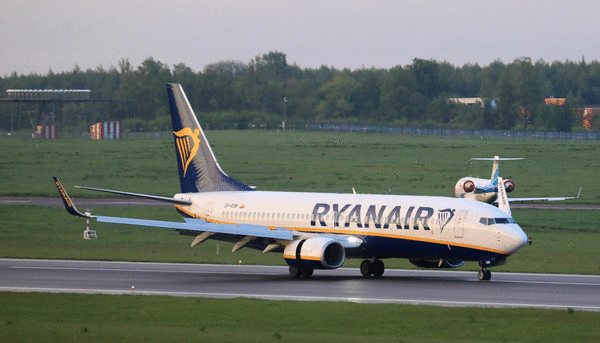
Federal investigators found evidence of a bird strike during a harrowing Ryanair Boeing 737-8 flight in Greece last month that saw one passenger temporarily hanging out of a broken window.
In a preliminary report released Thursday, the National Transportation Safety Board said it found evidence of bird remains, including feathers, in several parts of the engine structure.
The plane had not yet been updated to incorporate mandatory directives from the Federal Aviation Administration meant to prevent parts of the engine from breaking off and catastrophically damaging the plane, the NTSB said.
The directives, issued in 2025, required Boeing to develop modifications for parts of its engine structure and operators to incorporate the changes by July 2028, according to the FAA's registry.
Leading up to the accident flight, Ryanair had followed the required inspection timeline outlined by engine maker CFM International, the NTSB said, and had not found any evidence of cracking in the engine and its structures.
CFM, a joint venture between GE Aerospace and French company Safran, outlined those inspections in a service bulletin to airlines after a fatal incident in 2018.
In that case, a passenger on a Southwest Airlines Boeing 737 died after the plane’s left engine exploded and shrapnel penetrated the fuselage, breaking a window in the passenger cabin. Both the Southwest and Ryanair incidents occurred on Boeing’s 737 NG, the predecessor to its MAX family. The NTSB has not said if that Southwest flight is similar to the Ryanair incident, or if the two events had the same cause.
In the incident last month, a flight operated by Malta Air, a subsidiary of Ryanair, had to turn back for an emergency landing after pieces of the engine broke off and penetrated the fuselage, causing one passenger window to shatter and depressurizing the cabin.
A passenger seated in 11F was partially hanging out of the plane and the entire window was missing, the NTSB said in its report. Other passengers pulled the passenger back inside the cabin and, later, flight attendants covered the hole with a metal box. The passenger sustained serious injuries, according to the NTSB.
The July 10 flight had been headed from Thessaloniki, Greece, to Memmingen, Germany, and had 155 people on board, including two pilots and four flight attendants.
The flight crew said it received a high engine vibration indication around 16,000 feet in the air, as it was near the border between Greece and Northern Macedonia, according to the NTSB’s report. The engine vibrations decreased after the crew reduced engine power, and then picked up again.
The crew heard a loud bang and the plane’s autopilot disengaged. The flight crew then declared an emergency and began an immediate descent back to Thessaloniki.
It found one of the engine’s two dozen fan blades had fractured and separated, while two other fan blade tips had broken off. The remaining fan blades showed “varying levels of … deformation,” the report said.
The engine inlet cowl, which sits ahead of the engine fan case, had been punctured. The inboard fan cowl had been damaged and the exhaust nozzle had cracked. Several of the aft bulkhead splice fasteners had failed, the NTSB said, and investigators found loose rivet tails along the bottom of the engine’s inner barrel.
In three directives issued in 2025, the FAA ordered enhancements for the fan cowl and exhaust nozzle hardware. The FAA issued those directives after two incidents where parts of a plane’s engine fan blades broke, leading the engine’s inlet cowl and fan cowl to separate from the plane.
If left unaddressed, that could result in a loss of control of the airplane and could be hazardous to passengers in the window seats behind the wing, the FAA said in its directives.
In its preliminary report, the NTSB said the investigative team is aware of previous events involving similar engine models where the engine’s fan blades broke and damaged the inlets or cowlings and the plane’s fuselage. It is still investigating any “relevant similarities or details” between the Ryanair incident and earlier events.
The NTSB said it also found features “consistent with fatigue” in one of the fractured fan blades.
Federal investigators said the engine had undergone “ultrasonic inspections” in November and again in May, about 250 flight cycles before the incident. Those inspections, meant to check for any developing cracks, did not produce any findings.
In a statement Thursday, a spokesperson for Boeing said the plane-maker continues to support the NTSB’s investigation and is working with its customers Ryanair and Malta Air.
A spokesperson for CFM said the engine maker is supporting its customers and assisting with the investigation.
“Safety is our top priority,” the spokesperson said.
Ryanair could not be reached for comment.
The NTSB’s investigation is ongoing. The safety board will produce a final report with a probable cause at the end of its investigation.
©2026 The Seattle Times. Visit seattletimes.com. Distributed by Tribune Content Agency, LLC.







Comments