Small farms in Silicon Valley fight to keep the area's agricultural legacy alive
Published in Business News
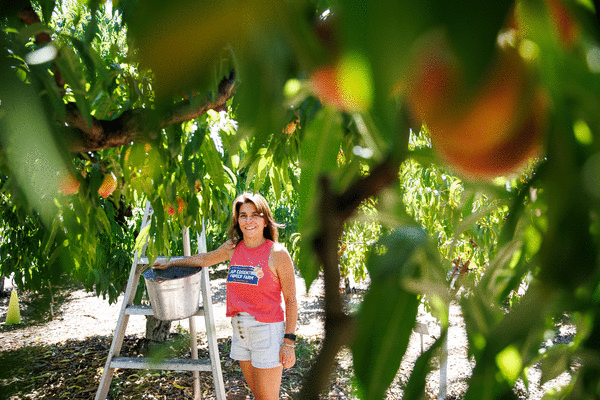
Mary and Kari Cosentino didn’t have a typical San Jose childhood.
While other children were taking out the trash or washing the dishes, they were knee-deep in mud moving irrigation pipes along the sections of their small family orchard or getting their hands covered in the sugary guts of fruit as they packed peaches.
“You’re sticky and it’s awful,” recalls Mary, laughing at the memories. “At the time, you don’t appreciate it, but in hindsight, it’s awesome. The farm was our playground.”
Now, Mary and Kari run the farm where they grew up, J&P Cosentino Family Farm, becoming the third generation to work the earth in Santa Clara Valley. Together, they operate the last orchard in San Jose, tending to a tiny island of green surrounded by single family homes and hemmed in by Highway 85.
Once, there were thousands of farms that covered the region famed for its world-class fruit and christened “The Valley of Heart’s Delight.” While Santa Clara Valley is no longer the agricultural mecca it once was, some like the Cosentinos have fought to preserve the small farms that still exist — making them the torch-bearers for the agricultural legacy that defined the region and the lives of those who work the land.
“I think of us as the current stewards of the land. There is this gift presented to us: carrying a legacy forward, being a part of a tradition,” said Kari Cosentino. “We both view the farm as a part of our family, and letting it go … that would be like selling one of our kids.”
The Valley of Heart’s Delight
The agricultural history of the valley began thousands of years ago, as the shifting earth formed Santa Clara Valley and the Diablo and Santa Cruz Mountain ranges. Loam running off the mountains collected in the valley, forming a 10-foot layer of rich soil.
Paired with the moderate climate and (at least in the 1800s) abundant water, the valley created a unique environment where food could grow year-round.
“We had all the elements to have a rich agricultural area,” says Ken Middlebrook, curator of collections at History San Jose.
While the indigenous Ohlone were largely hunter-gatherers, the Spanish began to grow around their missions in Santa Clara and San Jose in the late 1700s. Still, it wasn’t until the 1800s that the agricultural industry that would define the area was truly set into motion by French brothers Louis and Pierre Pellier.
Pierre, lured to California in 1847 by the Gold Rush, found little success in mining, but upon noticing the high cost of fruit in the area, decided to start a nursery in San Jose. A member of a farming family, he sent his brother Louis back to Europe to retrieve cuttings of French plum trees.
After some experimentation, the Pelliers developed “California plums” and unwittingly kickstarted another rush, this time for agriculture. Many who failed in the Gold Rush followed their path and tried their hands at farming. Then the completion of the transcontinental railroad expanded the market to the rest of the nation.
Agriculture in the valley exploded. Within decades, orchards of plums, apricots, peaches, cherries and more began to dominate the valley. The blooming of the orchards in spring was so extensive that it became the subject of poetry and prose.
“It is during the blossoming season that (the valley) presents its greatest charm … The white blossoms cover it almost like a mantle of snow,” described California historian Harry L. Wells in 1904. “It is a hopeless task to convey an impression of the beauty of this scene to one whose eyes have not beheld it.”
John Muir, on his famous 1868 voyage from San Francisco through to the Yosemite Valley recalled that the spring air here was “sweet and heavy with the scent of flowers,” that “the whole valley was a lake of light” and “the hills were so covered with flowers that they seemed to be painted.”
The stunning beauty and agricultural productivity earned the valley its most enduring nickname, The Valley of Heart’s Delight, likely first used in 1905 when the San Jose Mercury Herald (the precursor to the San Jose Mercury News) held a competition for a name to help market the valley’s fruit.
The success of agriculture changed the face of the valley, creating a network of industries that rose and fell with harvests, drove the economy and marked the culture and the rhythm of the area. In many cases, school wouldn’t start until the prune harvest was over, since children were a key part of the labor on the family farms.
Middlebrook, the history museum curator, grew up in Cupertino in the 60s and recalls that during packing season, the city itself would be covered with the scents of the canneries. “You would have all of these different smells from the valley … one week it might smell like tomatoes, another it might smell like apricots,” he recalls.
But even as the agricultural hub rose to its peak, the seeds were already being sown for the industry that would supplant the Valley of Heart’s Delight.
From apricots to Apple
After World War II, a confluence of forces saw the population skyrocket, with former farming cities like Sunnyvale seeing ten-fold increases to their numbers. Over the next few decades, orchards and farms were replaced by defense and tech companies, housing and office parks.
“High tech doesn’t depend on the weather or the amount of rain you get in the winter,” says Laura Babcock, the founder and director of Sunnyvale Heritage Museum. “Lockheed had totally replaced Libby’s (cannery) as the largest employer in the city of Sunnyvale.”
Many farmers found that they could make more money by selling their land to developers than by growing fruit, and the influx of cash could allow them to retire. As “Silicon Valley” grew, agriculture, and the host of businesses that supported it, began to wane.
“Instead of growing fruit, you were growing housing,” said Middlebrook. “Farmers were cash poor but land rich, so they were incentivized to sell.”
That much is true for the family of farm owner Peter Van Dyke. In the early 1920s, Peter’s great-grandfather — a Croatian immigrant who had made money off the Alaskan gold rush — bought five acres of land in Cupertino and began to grow apricots. The farm grew to some 45 acres scattered throughout subdivisions, but rising property taxes and the pressure to sell became too much, and by 1960, the family opted to sell the land and buy 108 acres in Gilroy to re-establish the farm.
Van Dyke says that with ever-expanding development, many more farmers were driven out of the business or to other regions like the Central Valley.
The change was stark. While in the 1920s, some 7,000 farms covered the valley, that number has dropped to about 280 vegetable farms and 60 orchards in Santa Clara County in the present day, according to Ericka Mora, the county’s deputy agricultural commissioner.
“Agriculture right now is at a huge turning point,” says Van Dyke. “We’re all working hard to save ag land … but everything‘s working against us here.”
Innovating from the ground up
For the remaining farms, survival takes creativity, innovation and often, collaboration.
Van Dyke and his mother, Betty, bought the orchard from his grandfather in the ‘70s, and in the ‘80s they became certified organic. But even as they soldiered on, many of the plants that canned and dried fruit began to close as demand shrank, meaning the remaining fruit processors could charge more or be more demanding. That meant they had to bring a lot of the processing home, collaborating with other nearby farms like Christopher Ranch — the garlic farm which helped kickstart the Gilroy Garlic Festival — and doing their own packing and fresh fruit sales, even shipping fresh fruit to Japan and Taiwan. Now, Van Dyke leases the land to an organic farm called Spade and Plow, which has introduced vegetables to the farm along with the fruit harvest.
“How most farmers survive is that they get more diverse,” says Van Dyke.
The Cosentinos, who also once ran a small chain of supermarkets in the area, are a prime example of that. The family farm, once 10 acres, now stands on a bit over 2 acres, with an adjacent farmstand where they sell produce.
“We’re not getting more land, but we’re going to use every square inch of this dirt,” says Kari.
The relatively small farm now houses 600 trees and a mind-boggling 200 varieties of fruit: apricots, peaches, bushberries, persimmons, pomegranates, grapes, citrus and more. That means that they are constantly harvesting and constantly replanting trees. Every variety usually lasts a mere three weeks on the shelves of their farmstand.
“We like to drive ourselves a little crazy,” jokes Kari.
The variety not only helps preserve heirloom strains of fruits that once defined the valley — like Santa Rosa plums and Blenheim apricots, but also helps the farm adapt to another threat: a changing climate. Many stone fruit trees require cool winters to produce fruit in the summer; as winters shorten and get warmer, the Cosentinos have begun to plant hardier strains that don’t require the same cool weather.
Survival also requires a fair bit of collaboration. The Cosentinos will buy from other local farms — including Spade and Plow — to fill out their farm stand and ensure that those who come have plenty of fruits and vegetables available. They also have to innovate when it comes to their offerings and even how they make sure not to waste any product — whether that means picking up pallets of strawberries that other vendors couldn’t sell and turning them into strawberry margarita mix, providing fruit for small bakeries or selling peaches to Eataly at Westfield Valley Fair mall for its gelato.
“If we can support another small farm, of course we will,” says Kari. “We keep it local and we keep it small.”
They’re part of a network of small businesses and farms that work together, sell with and to each other, and help each other succeed.
Fighting for the future of farming
For the Cosentinos and others, San Martin farmer Joe Raineri is a key part of that network.
“The farming community, they’re a great group of people. Even though we’re all growing and in some ways competing, it’s a really tight-knit community,” says Raineri.
Under the hot June sun, Raineri walks among the rows of tomato plants, his three dogs traipsing in and out of the rows as they follow him. He leans down to one plant, grabbing a striated purple fruit that grows on the vine, turning it in his hand. While it looks more like an exotic berry to the untrained eye, he holds in his hand one of the 60 varieties of tomato that he grows on the farm. This one sports a particularly colorful name: Brad’s Atomic Grape.
Ten years ago, Raineri and his wife bought land in San Martin with the money they had made building and selling furniture. Both foodies, they began to garden heirloom tomato varieties and realized they produced way too much for themselves. Free giveaways led to an unmanned cart where they sold their tomatoes on the honor system. Now their farm, Terra Amico, grows on three acres and supplies heirloom tomatoes to high end restaurants and collaborates with other local businesses like the Cosentinos.
But beyond his work as owner of Terra Amico, Raineri has taken on another role as advocate for small farms, becoming part of a growing number of people who collaborate between farmers, nonprofits and government agencies to preserve farming.
Raineri interviewed scores of farmers from across the region and around the world to understand how different farmers were struggling or thriving. He founded the advocacy group the South County Small Farms Association. In his travels and here at home, he has seen farmers face a panoply of pressures: rising costs of labor and materials, property tax laws making it more and more difficult to pass on farms from generation to generation, changing regulations, and — like many others in the Bay Area — the region’s exorbitant cost of living.
Together, the advocacy has gotten the ear and support of some local politicians, including county Supervisor Sylvia Arenas, herself the daughter of a farmworker.
Since she began her tenure in 2023, she has advocated for more farmworker housing, given grants to agricultural and agritourism projects — including the small farms association — and stepped in to block zoning regulations that local farmers said would put them at risk.
Arenas sees it all as a “commitment to preserving South County’s agricultural heritage and ensuring that our agricultural community continues to thrive for generations to come,” she says.
Beyond political advocacy, Raineri hopes to create a hub for farmers to sell and thrive, Fattoria Public Market. The Market is an expansive vision for a 40,000-square-foot indoor farmers market and working farm that not only creates a space where farmers can sell their products, but has the equipment for cold storage, food processing, events, a beer wine and cider garden and a venue where chefs can take the fresh produce and create “farm to fork” dining.
He hopes to create a destination for foodies that would attract a larger market while making a year-round, all-week venue where farmers can rent a stall at an inexpensive rate and take home a bigger cut than they would at traditional farmers markets. Raineri is in the process of securing the funding for the market, and says he expects the project to break ground in 2027.
“These (small farmers) are hardworking folks who just want to do something great. They’re the ones who care about the food, they’re the ones who care about the land,” says Raineri. “I wanted to do something to keep ag alive. I want to give back.”
Even if farmers make enough to stay afloat, they continue to face the pressures of development and the push to sell their land. Now, a handful of organizations — from Peninsula Open Space Trust to the Santa Clara Valley Open Space Authority — are working with farmers to buy natural and agricultural land and preserve it for future generations. Having leased his farm, Van Dyke has now joined several organizations focused on conservation and open spaces.
“I have this weird respect and this passion for preserving this beautiful land,” says Van Dyke. “I’m getting deeply involved in trying to save what’s left.”
For farmers like Van Dyke, preserving and cultivating the land isn’t just about history, politics or business, it’s personal.
Like the Cosentinos, Van Dyke grew up on the farm, going out in the fields with his family since he was a toddler. Under the watch of the rolling foothills of the Diablo mountains, he would pick apricots off the ground and cut them to dry on blazing 100-degree days. He says it was the “hardest job I ever had.”
Six decades later, he has dedicated his life to agriculture and just hopes that farms like his can survive, preserving the land and sustaining the soul of The Valley of Heart’s Delight.
“I love the land, it’s beautiful,” he says. “The land gave to me all my life, so my duty is to give back to it the best I can.”
©2026 MediaNews Group, Inc. Visit at mercurynews.com. Distributed by Tribune Content Agency, LLC.









Comments