How the Haiti TPS crisis has hit South Florida hotels and an airport
Published in Business News
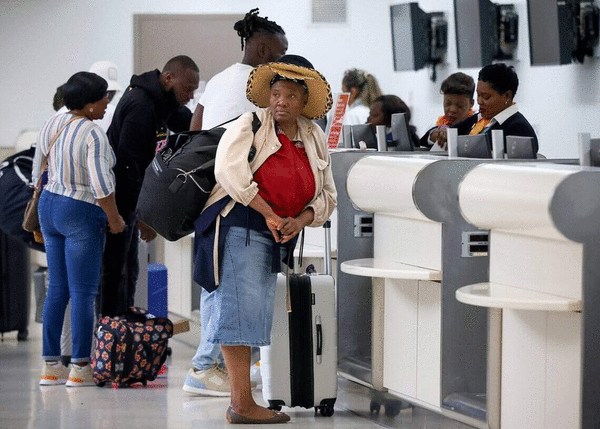
Travelers at Fort Lauderdale-Hollywood International Airport may not have known his name, but they relied on his work. Few things at airports irritate customers like filthy toilets or water on the restroom floor.
His work could be tough and thankless, but he always showed up and gave 100%.
For over 19 years, this 70-year-old, native of Port-au-Prince cleaned restrooms in Terminal 1 at FLL. Most of that time, he worked the grueling night shift, from 10 p.m. to 6 a.m., cleaning and waxing floors five days a week.
That was until July when his badge was voided and security clearance disappeared. He lost his work permit due to the revocation of TPS. For the first time as an adult, he found himself not working.
“I did my job very well,” said the former FLL worker. He was considered one of the best, he said in an interview with the Miami Herald. He asked that his name not be published because he fears for his life.
His life until losing TPS status wasn’t perfect, and he had struggles, but he was relatively much better off.
“Life was OK, but it’s become more difficult after TPS ended,” he said.
Temporary Protected Status was created to help immigrants escape dangerous conditions. After Haiti’s 2010 earthquake, many Haitians received the status, allowing them to obtain work permits and jobs.
But in July, U.S. Citizenship and Immigration Services, an agency in the Department of Homeland Security that oversees legal immigration, announced that work permits for TSA holders wouldn’t be valid after July 27, potentially creating a new group of undocumented workers.
Since Florida follows e-verify, where employers agree to check employees’ immigration status, they told employees they are no longer allowed to work and deactivated their badges.
The changes have affected Haitian workers and South Florida’s tourism industry. Many of the people losing their work permits and status worked for area airports and hotels.
About 52,000 Haitian TPS holders were in the workforce in Miami-Dade, Broward and Palm Beach counties, according to an estimate by Phillip Connor, research fellow at Princeton University’s Center for Migration and Development. Of those, a significant number worked in tourism-related jobs: 6,000 were cooks and servers, 4,000 stockers and packers, 2,000 maids and housekeepers, and 2,000 were security guards.
Connor’s research comes from analysis by immigration support groups FWD.us, Haitian Bridge Alliance and the UndocuBlack Network. The numbers reflect data from the 2024 American Community Survey, part of the U.S. Census, but use a population level from early 2025 before the Trump administration began terminating TPS designations.
FLL has been among the harder hit. The Broward airport had 132 employees holding Temporary Protective Status for Haiti as of July 27, airport spokesperson Arlene Satchell, told the Miami Herald. They were not directly employed by Broward County but by vendors with contracts at the airport.
Haitians with TPS working at FLL had a variety of roles, and often ones directly affecting the public’s experience, according to Aldo Muirragui, field coordinator for airports in Florida for the union 32BJSEIU. His group represents at least 50 people who lost their jobs.
Think of when you get on a flight and find your seat pocket with someone else’s chewed gum or an old water bottle? Haitians on TPS rush onto airplanes as soon as they deplane and clean before the next flight. Have you traveled with an elderly family member who needed a wheelchair to make it to the gate? Haitians on TPS are wheelchair attendants, too.
They’re also baggage handlers, passenger service agents, security officers and concession workers, according to Muirragui.
At Miami International Airport, 33 employees had Haitian Temporary Protective Status and were affected. None were employed directly by Miami-Dade County.
Hotels are also likely to feel the pain of losing experienced workers, said Wendi Walsh, secretary-treasurer of Unite Here - Local 365, a union that represents hotel and airport workers.
A 61-year-old Haitian man who has lived in Miami for 17 years has worked as a dishwasher at the Fontainebleau hotel in Miami Beach for five years. In late July, he was no longer allowed to work.
“I felt good because I was working hard,” he told the Miami Herald. “I did everything that was asked of me.”
Monday through Friday he worked in multiple kitchens in the high-end hotel. Guests would notice if he wasn’t doing a stellar job. Now, he is worried about how he’ll get by financially and worried about ICE, he said. He plans to stay at home and lie low.
“Now I can’t do anything.”
Both of those fears, economic and security, run deep among the Haitian workers who lost their jobs and status.
The former FLL worker has been sharing an apartment in Fort Lauderdale with a church friend but doesn’t know how he’ll keep up with rent or other expenses.
“It’s tough. The bills don’t care about your status,” he said.
He’s also frightened about his safety.
“You don’t know when ICE is going to get you,” he said.
He avoids going into the streets, mostly staying at home.
“They’re yanking people out of cars,” he said. They’re tying people up.”
He obtained TPS in 2010 after Haiti’s devastating earthquake. But he’s been left in limbo since. He had a home in Port-au-Prince, but gangs took it over. His son, a police officer in Haiti, watched his partner killed right in front of him.
He said he’s an immigrant in the U.S. and South Florida because of the danger in his home country. He worked hard and played by the rules.
“You can go to a police station now and see that I have a clean record.”
Union leaders, meanwhile, have their own concerns. One is that many of the Haitians with TPS who are being let go were among the most experienced workers South Florida airports and hotels had, and they often took newer colleagues under their wing.
“There are so many experienced people that have been at the airport for decades,” said Aldo Muirragui, the field coordinator at 32BJSEIU. “It’s going to take a lot more time to replace the knowledge.”
As an example, he cited several wheelchair attendants who formed such close relationships with travelers that they always requested the same workers to help. Additionally, they “have gone through a very stringent process of security and background checks,” the union leader said.
They have backgrounds as squeaky clean as the halls and floors right after they mopped them.
Walsh, the Unite Here - Local 365 official, concurs, and says that’s also true at hotels.
“The impact of this isn’t just on the workers terminated, but the workers left behind,” she said.
“You’re terminating employees with lots of experience,” she said while noting that South Florida’s labor pool is shrinking.
“All that’s going to do is put pressure on the workers left behind.”
The local economy will miss the workers’ income, too.
According to estimates by Connor, the Princeton research fellow, Haitians on TPS in the tri-county area provided $1.5 billion in annual economic contributions, $174 million in annual federal and payroll taxes and $176 million in annual state and local taxes.
The former FLL janitor said he doesn’t eat at restaurants often, but spends a good amount on groceries. He likes to cook. He was also hoping to make his apartment nicer this year by doing renovations. That’s on hold now, as are the regular remittances he was sending to his family in Haiti.
The faithful may suffer, too.
“A lot of my money,” he said, “went to church.”
©2026 Miami Herald. Visit at miamiherald.com. Distributed by Tribune Content Agency, LLC.









Comments