Trump's homegrown solar push risks widening green energy divide
Published in Business News
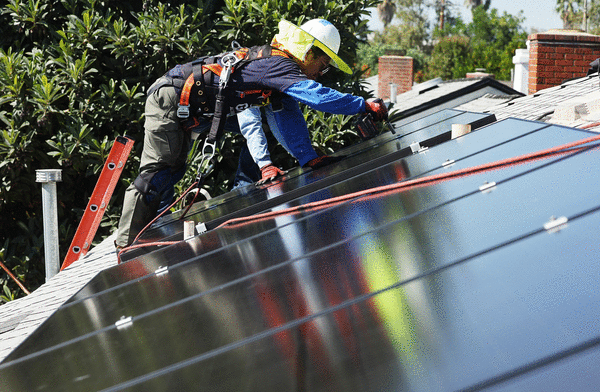
President Donald Trump’s latest move to shun foreign solar power equipment is part of his effort to rebuild U.S. manufacturing clout. It may simultaneously exacerbate the fast-widening green technology split between the U.S. and the rest of the world.
Trump announced a plan to impose tariffs and minimum prices on imported polysilicon used in semicondictors and solar panels. The levy comes a week after the Federal Communications Commission tightened curbs on inverters, another vital component of solar-powered energy.
Such protections can encourage the growth of domestic manufacturing — but as multiple economies have found over decades, restrictions often come at a financial and technological cost.
In the near term, curbs will drive up the price of solar panels in the U.S., a country that already pays more than double the global level thanks to years of tariffs on imports - and where Trump has pursued an anti-renewables policy during his second term.
If domestic manufacturing doesn’t establish a foothold quickly, it could put the U.S. further behind in technological and power terms as the rest of the world presses ahead with cheap Chinese alternatives.
“The U.S. is limiting this source of energy when the country so desperately needs more electricity to scale up high tech and AI,” said Li Shuo, director of the China Climate Hub at the Asia Society Policy Institute in Washington DC. “It looks so different from solar markets you’ll see anywhere else in the world.”
Trump’s directive, which takes effect Dec. 4, subjects derivatives including silicon wafers, photovoltaic cells and solar modules to 15% tariffs, and sets minimum price floors for each product that are higher than current costs in the U.S.
For example, the new minimum price for imported solar modules will be 38 cents per watt. That compares to 27 cents per watt for modules currently shipped to the U.S., according to BloombergNEF, while the global average is 11 cents.
Trump, who has pushed the revival of U.S. industry since his first term in office, is also offering a carrot, however. If companies commit to starting construction of U.S. factories to build the solar products by Jan. 20, 2029, they can avoid the higher costs.
“America cannot be reliant on foreign countries for the polysilicon that’s the key base material underpinning semiconductor and solar-power supply chains,” White House spokesman Kush Desai said in a statement.
“President Trump pledged to safeguard our national and economic security, and in addition to reshoring critical manufacturing back to the United States, the Trump administration remains focused on unleashing America’s already-abundant sources of reliable and affordable energy for families and businesses, from natural gas to coal,” Desai said.
Advocates for reshoring — effectively bringing home U.S. manufacturing capability — have feted the news. According to Jon Toomey, president of the Coalition for a Prosperous America, global import barriers can put an end to circumvention, when companies set up facilities in third-party countries to avoid tariffs.
The directive also applies all parts of the supply chain, which should help solve the problem of investing in downstream assembly plants only to find they are still dependent on other countries for upstream inputs.
“For the first time, the United States is protecting the entire solar supply chain with a single action,” Toomey said.
In the solar supply chain, ultra-refined polysilicon is shaped into rectangular ingots, which are in turn sliced into ultra-thin squares known as wafers. Those wafers are wired into cells and pieced together to form solar panels.
Building a complete chain from the ground up could have enormous benefits for the U.S., JPMorgan analysts including Mark Strouse said in a research note. It could “reduce pricing, reduce geopolitical risks, and improve long-term investor sentiment for the space.”
Green technology has been at the heart of global efforts to boost industrialization, including in the U.S. But the clean-energy race, accelerating along with the scramble for computing power, has increased the divide between the U.S. and economies open to using Chinese technology — with one side benefiting from rock-bottom prices and existing, advanced technology, and the other seeking to build its own.
As recently as 2012, the U.S. was the world’s largest producer of polysilicon. That year, President Barack Obama kicked off a tariff war over solar products that saw Beijing slap duties on U.S. production. China revved up its domestic industry in response and now controls more than 95% of global output of the material.
The U.S. has made some strides in recent years, and the country now has the world’s third-largest capacity for assembling solar modules. Still, it remains reliant on overseas suppliers for cells, wafers and polysilicon, meaning it could struggle to catch up even if U.S. solar manufacturing gains a foothold, according to Youru Tan, a BloombergNEF solar analyst in Hong Kong.
“U.S. production is much more expensive than China,” Tan said. “Plus, most U.S. factories rely on equipment from China.”
Investors in new factories will have to weigh the support offered from Trump’s new directive against messages that have created uncertainty around long-term appetite for clean energy.
So far in his second term, Trump’s policy moves also including ending tax credits for solar installations, eroding federal policies encouraging emission-free power and green energy permitting delays have done more to hold back the deployment of U.S. renewables.
And if the manufacturing boom fails to materialize, U.S. solar developers will be hit by a steep hike in module prices, which will amount to about a 12% hike to the overall cost of solar systems, according to Guggenheim Securities analysts. The question of who ends up absorbing the increased costs, whether it’s developer profit margins or higher power tariffs, remains open.
The AI boom should help users cope with short-term risks. Rising demand and higher-than-normal prices for competing sources of power will counter the extra cost, according to JPMorgan. Even while paying more than the rest of the world, solar remains among the cheapest options for electricity in the U.S., according to BloombergNEF data.
That doesn’t account for the opportunity cost of not embracing cut-price modules. Countries from Nigeria to Pakistan have taken advantage to radically reshape their undersupplied power grids in a matter of months. Sales of solar panels to the Philippines are booming. Even Europe, which is battling Chinese trade negotiators over other areas of clean tech like EVs and wind power, has all but waved the white flag when it comes to solar.
“Solar is arguably the fastest energy you can deploy, and in a free and open market it’s one of cheapest power sources,” said Asia Society Policy Institute’s Li. “The U.S. is not going to enjoy those two advantages.”
©2026 Bloomberg L.P. Visit bloomberg.com. Distributed by Tribune Content Agency, LLC.









Comments