UnitedHealth blasts health care providers' 'egregious' awards under No Surprises Act
Published in Business News
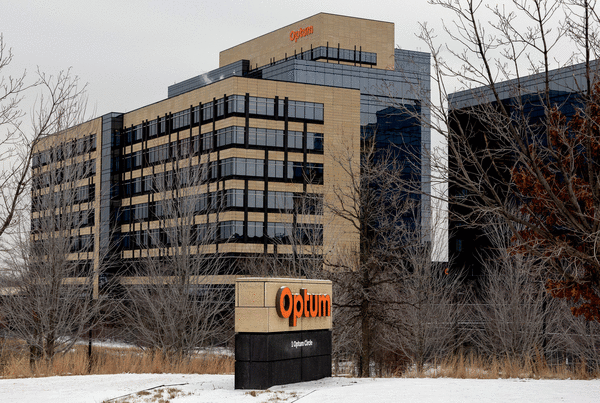
A neurosurgeon was recently paid $4,485 to remove a brain tumor, but the doctor’s surgical assistant received a fee from Minnesota’s UnitedHealthcare that was more than 10 times larger — $55,000.
The reason?
Arbitration rulings under the federal No Surprises Act, which protects patients from high out-of-network bills, are socking health insurers with grossly inflated fees, executives at parent company UnitedHealth Group alleged Thursday.
The commentary came as the Eden Prairie-based health care giant reported second-quarter financial results showing a financial turnaround with staying power under chief executive Stephen Hemsley.
Improved profits are coming despite sky-high arbitration awards that are bloating overall costs in employer health plans, said Dan Kueter, CEO for UnitedHealthcare’s employer and individual benefits business.
The No Surprises Act took effect in 2022 to prevent patients from being hit with unexpected medical bills from providers not covered by their insurance. It also requires out-of-court dispute resolution for providers and insurers.
But UnitedHealth Group argues the dispute resolution process is being exploited by certain providers and “corrupted” by private equity firms with ownership interests in the organizations that help resolve billing disputes. These parties have added at least $5 billion to overall health system costs, the company says, without bringing health benefits to patients.
"The [dispute resolution] process is not working — certainly not as Congress intended it — and it needs to be reformed," Kueter said during a Thursday call with investors.
Health care providers suggest an alternate interpretation: They’re winning most disputes under the law because arbitrators believe the insurers have been underpaying.
“If insurers want to argue that the independent arbitrators are ‘corrupt,’ they better have compelling evidence to support it,” said David Glaser, an attorney with Fredrickson & Byron in Minneapolis who represents doctors and hospitals, and specializes in No Surprises Act compliance.
“If a company keeps losing cases across the country,” Glaser said, “is it more likely that a bunch of different judges was bribed, or that the company’s position is wrong?”
Congress passed the No Surprises Act amid growing concerns that consumers were getting hit with large bills for out-of-network medical services that they couldn’t reasonably have avoided while hospitalized.
For example, patients would go to an in-network surgery center or hospital for a procedure and later learn that an anesthesiologist or radiologist or pathologist they’d never met was part of the care team.
When those doctors were out-of-network with the patient’s health plan, there could be disputes between the insurer and the physician about what reimbursement was adequate — and patients could be asked to make up the difference.
The No Surprises Act removed patients from these disputes, sending insurers and health care providers to argue through an independent dispute resolution process. The volume of these arbitration cases has been much higher than expected, UnitedHealth says, and health care providers are winning more than 80% of cases.
Average awards to providers are about four times higher than market rates, UnitedHealth Group says, and even higher in outlier cases.
The company on Thursday highlighted another example: It paid about $4,880 for an in-network orthopedic surgeon to perform spine surgery. The doctor brought in a surgical assistant — typically a physician assistant or nurse practitioner — who submitted a charge of $31,765.
UnitedHealthcare’s standard payment for the service was $701, but the arbitrator awarded the assistant surgeon $92,146.
“This award was nearly three times the assistant’s original billed charges,” the company said in a statement. A fact sheet from United carried the title: “Egregious Examples of Arbitration Outcomes.” None of the examples named the care providers, so it was not immediately possible to verify the details of the cases.
UnitedHealth Group is blaming not just health care providers, but the organizations handling cases that seem biased toward health care providers, the company says, frequently offering awards well beyond payment benchmarks.
For 2025, the company expects to pay $100 million in payments above billed charges because of the arbitration process under the No Surprises Act.
Tim Noel, the UnitedHealthcare chief executive, said Thursday awards under the No Surprises Act are one of the primary reasons that employer-sponsored health plans “are not yet seeing evidence of cost trend moderation.”
Medicare cost trends, by contrast, are coming in slightly better than expected, Noel said.
UnitedHealth Group says it’s calling on federal regulators and legislators to make changes to the arbitration program.
Other health insurers are doing the same, yet their arguments overstate the number of bad actors who are gaming the system, argued Wendell Potter, a former health insurance executive turned industry critic.
“The vast majority of physicians who go through this process are not running a racket,” Potter wrote earlier this month. “They are simply doctors and small practices who, after caring for patients, received a payment offer well below fair value and used the process Congress gave them to make their case in front of an independent arbiter — and won.”
For the second quarter earnings report, UnitedHealth Group posted adjusted profit of $5.48 billion on $112 billion in revenue, better than adjusted earnings of $3.41 billion during the same period last year. The adjustments exclude one-time factors.
The profit, on a per-share basis, was $6.38 — stronger than $4.85 expected by analysts. The company increased its financial guidance, as a result, saying it now expects full year adjusted net profit between $19.50 and $20 per share.
©2026 The Minnesota Star Tribune. Visit at startribune.com. Distributed by Tribune Content Agency, LLC.



Comments