Measure to overhaul California's powerful environmental law draws 73% support in new poll
Published in Business News
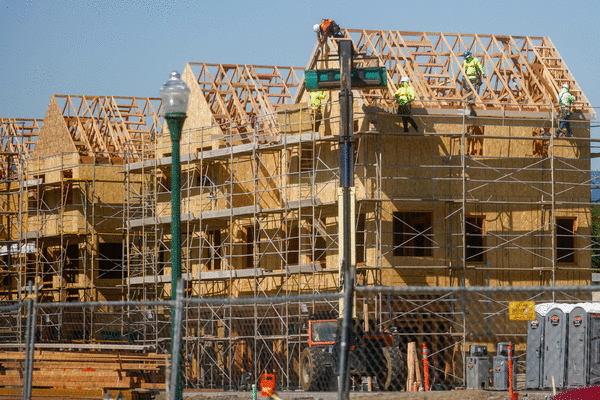
A ballot measure that would overhaul one of California’s most powerful and controversial environmental laws has a commanding lead less than three months before voters begin casting ballots in the statewide November election.
Proposition 45, which would make substantial changes to the California Environmental Quality Act, has the support 73% of likely voters, with 24% opposed and 4% undecided, according to a poll released Wednesday evening by the Public Policy Institute of California, a nonpartisan research group in San Francisco.
If approved by a majority of voters, the measure would set a 365-day limit on environmental reviews for a range of projects, including new reservoirs, desalination plants, forest thinning to reduce wildfire risk, apartments, housing subdivisions, roads, bridges, public transit, hospitals, solar farms, wind farms and battery storage facilities. It would also require courts to rule within 270 days on lawsuits related to the act, known as CEQA.
The law currently requires state and local agencies to study how significant projects could affect wildlife, noise, air pollution, greenhouse gas emissions, traffic and other conditions. The studies create an environmental impact report, and developers must offset or reduce impacts.
Proposition 45 would be the largest overhaul of CEQA since Gov. Ronald Reagan signed it into law in 1970. Supporters argue that the changes would lower housing, energy and water costs by cutting regulations, making it easier to build everything from homes to water infrastructure.
The California Chamber of Commerce sponsored the measure and placed it on the ballot after a signature-gathering campaign.
Wednesday’s poll found support across all demographic and partisan groups, with 80% of Democrats, 61% of Republicans and 73% of independents saying they would vote yes. Support was strongest among renters, people younger than 45 and voters earning less than $40,000 a year.
Mark Baldassare, PPIC’s survey director, said the cost of living was a major issue throughout the poll. People struggling most to afford a home or rent may see the measure as a way to accelerate housing construction, he said.
“There’s a view that government permitting could use some streamlining,” he said. “That general concept is viewed with some favor, especially in the context of housing affordability and the cost of housing and cost of living in California.”
But opponents, including dozens of environmental groups from the Sierra Club to the Defenders of Wildlife, and actor and activist Jane Fonda, argue that the deadlines would weaken public oversight and environmental protections. They launched a campaign against the measure last month and said Wednesday that voters have not yet received enough information about it.
“We’re confident that when voters see Proposition 45 for what it is, they will reject it,” said Mabel Tsang, political director for the California Environmental Justice Alliance, in Los Angeles.
Tsang said Proposition 45 would allow developers to build massive data centers and other industrial projects with little or no public input. She said the opposition’s research shows support falling below 50% once voters receive more information about the proposal.
Supporters disputed that characterization, saying the measure would include broadband internet projects but not data centers.
“This measure does not apply to data centers,” said Yes on Prop 45 spokeswoman Amelia Matier. “Full stop.”
The poll showed voters are skeptical of data centers. Overall, 77% of likely voters said they would oppose the construction of a data center in their area to support artificial intelligence technology.
The ballot measure has been endorsed by business groups, including the Bay Area Council and California Business Roundtable; clean energy organizations, including the California Wind Energy Association and Large-Scale Solar Association; and several social justice groups such as the California-Hawaii NAACP and the California League of United Latin American Citizens.
Those groups cheered the poll findings Wednesday.
“The message from California voters is unmistakable: The status quo isn’t working, and we’re all paying the price,” said Jennifer Barrera, president and CEO of the California Chamber of Commerce. “Prop 45 is about making California more affordable by cutting unnecessary delays to deliver the essential projects our communities need faster and more affordably.”
Beyond Proposition 45, the survey offered a snapshot of a heavily Democratic electorate.
Democrat Xavier Becerra is leading Republican Steve Hilton in the governor’s race 61% to 36% among likely voters, the poll found. No Republican has won statewide office in California since Arnold Schwarzenegger was reelected governor and Steve Poizner won the insurance commissioner’s race in 2006.
In the last governor’s race, Gavin Newsom won reelection in 2022 over Republican Brian Dahle by 19 percentage points. Two years later, Democrat Kamala Harris beat President Trump in California by 20 points.
“Becerra has a double-digit lead,” said Baldassare, the survey director. “This reflects the fact that registered Democrats outnumber Republicans by about 20 points in California and many independents lean Democratic. The results are looking very favorable for Becerra.”
The survey also found that Californians continue to oppose new offshore oil drilling, with only 35% in favor of new rigs off the California coast, as Trump is proposing. Meanwhile, 73% support offshore wind turbines, a technology Trump opposes.
Energy costs emerged in the survey as a widespread concern, with 96% of California residents calling the cost of gasoline, natural gas and utility bills a problem. The share calling energy costs “a big problem” increased 9 percentage points, from 54% in July 2025 to 63% now.
At the same time, 62% of residents said they support California’s law requiring all of the state’s electricity to come from renewable or carbon-free sources by 2045. But 60% said they were unwilling to pay more for renewable energy, compared with 38% who said they were willing.
Two out of three residents — 66% — also said they oppose a law Newsom signed that will ban the sale of new gasoline-burning passenger vehicles in California by 2035. Trump has tried to overturn the law, which is the subject of a lawsuit.
“For 20 years, our polls have shown that people in California think climate change has begun, and that the state should be doing more than the federal government, and they support renewable energy,” Baldassare said. “But they aren’t willing to pay more for it. Affordability is a major factor right now.”
Wednesday’s survey was based on responses from 1,578 California adults and has a margin of error of 3.1 percentage points. Interviews were conducted from June 29 through July 6, 2026.
©2026 MediaNews Group, Inc. Visit at mercurynews.com. Distributed by Tribune Content Agency, LLC.







Comments