Here's why it feels like Pittsburgh is at the center of the grocery wars
Published in Business News
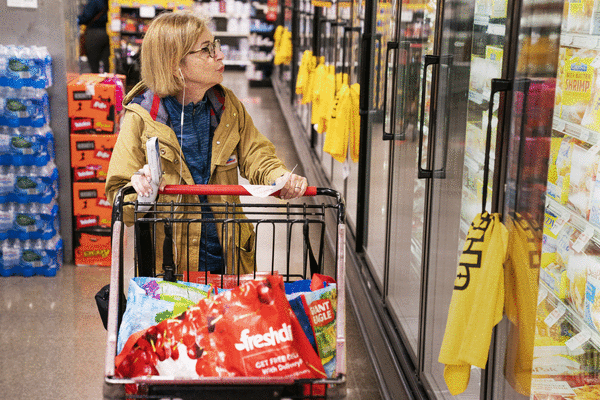
Pittsburgh may be a sports town, but the grocery market is a league to watch in its own right.
Among the recent highlights:
Ohio-based Kroger announced Wednesday that it plans to acquire Pittsburgh’s longtime grocery leader Giant Eagle for $1.65 billion.
Wegmans is entering Western Pennsylvania for the first time in the next year or so. Meijer from Michigan is following right behind.
And Aldi is discounting its way closer to the top with low prices and intense expansion.
The next few years of grocery shopping could become a savings obstacle course as local and national brands jockey for territory in Pittsburgh. And the shake-up of a family-owned, Pittsburgh staple may be a harbinger of the future of grocery — here and across the nation.
“Pittsburgh’s kind of an example of what we’re seeing in the retail industry,” said Jeff Inman, a marketing professor who specializes in consumer behavior at the University of Pittsburgh.
“There’s more consolidation. ... “Kroger tried to buy Albertsons (in 2024) and the Biden administration blocked it. Albertsons is a lot bigger than Giant Eagle, (which) was why they blocked it. I think that they’ll probably let this one go through. Kroger is looking for — all of retailers are looking for — more geography and bigger footprints and larger customer bases to serve.”
So, while the trend is national, Pittsburgh feels like the center of the grocery wars “because it’s happening here, to us,” Inman said.
And people don’t like change.
“I think that’s why you’re seeing Kroger being very clear that they don’t plan on making any major changes to allay any fears that shoppers might have — because to the extent that people get worried, that decreases the value of the asset of acquiring Giant Eagle.”
A lucrative region of the country
Vanitha Swaminathan, a professor of marketing at Pitt who specializes in brand competition, said she was surprised a deal like Kroger’s hadn’t happened sooner.
“National chains, like Kroger or Wegmans, are using mergers to solidify their position and generate some economies of scale and scope,” Swaminathan said.
“It’s actually surprising that Pittsburgh hasn’t seen this previously. It’s just reflecting the national trends in terms of increased competition and large grocery chains trying to consolidate their position.”
With pressure from mass merchandisers such as Walmart, online retailers such as Amazon, high-end retail such as Whole Foods or Wegmans — and fast deliveries from them all — she said traditional grocers are likely “feeling the pinch of competition” and acting to secure power.
Then Kroger “saw a really nice, well-run retailer, Giant Eagle, in a very lucrative region of the country, and probably decided that this would be a good time for them to make the acquisition,” she said.
Kroger’s own corporate strategy seems to confirm that move.
“Competitors have continued to grow their footprint while we stepped back,” Kroger CEO Greg Foran said during the company’s earnings call last month. “Our existing footprint is one of our strongest assets, but standing still in store growth means standing still in market share.”
Acquisitions tend to bring generic benefits, Swaminathan said, including knowledge of other markets, analytics and data that can inform progress, and the leverage a national chain brings in buying power to get better deals from suppliers, translating to better prices for consumers.
But that’s not always how these things go.
“There’s also some research, and some of my own research, that says that customer satisfaction could go down because the larger entities often have more ability to get away with higher prices,” she said. “So, in that sense, it’ll be very interesting to see if other groceries enter the Pittsburgh market, will that have a way of rebalancing the equation in favor of the customer?”
The National Grocers Association raised concerns about the proposed acquisition being bad for customers.
“NGA urges regulators to conduct a robust review of this proposed acquisition, with particular attention to its impact on competition in those specific local markets,” the association said in a statement Wednesday.
“With 69% of U.S. grocery sales controlled by just four national chains, strong antitrust enforcement is more important than ever to protect consumer choice, preserve competitive markets, and maintain a level playing field for independent grocers, farmers, suppliers, and the communities they serve.”
Kroger, Giant Eagle ‘share a lot of DNA’
Inman sees the Kroger-Giant Eagle deal benefitting Pittsburgh shoppers.
“Prices are going to go down,” he said. “Because of [Kroger’s] scale, they should be able to cut better deals with suppliers and get lower prices.
“Kroger is really good at analysis of their sales data, so they’re going to be looking at what sells and what doesn’t, and they’ll probably start experimenting, bringing in some of their Kroger brands that Giant Eagle doesn’t carry, and they’ll see how those do. At the end of the day, it’ll be a better assortment of products for Pittsburgh shoppers.”
Giant Eagle and Kroger have much in common, according to Jeff Wells, the lead editor of industry publication Grocery Dive.
“Both grocers share a lot of DNA, from their deep investments in pharmacy, private label and retail media to the fact that both operate alternative supermarket models — Giant Eagle’s Market District and Kroger’s Marketplace stores,” Wells wrote Thursday. “These assets will probably integrate nicely with Kroger’s.”
Pharmacy in particular appears to be a priority.
Rite Aid declared bankruptcy for the second time in May 2025 and closed all of its U.S. locations. Giant Eagle then leveraged its $1.6 billion sale of the GetGo fuel business to Canadian firm Alimentation Couche-Tard Inc. to invest in its pharmacy arm — acquiring an additional 6 million prescriptions from Rite Aid on top of its 25 million existing prescriptions.
A focus on pharmacies makes sense, Inman said, in part because of consumer behavior.
If customers are already in the store, it’s more likely that they will shop around while waiting for their prescriptions.
“People tend to have their habits,” Inman said. “They like to shop at a store a particular way, and buy particular things, but then they also leave themselves open to make a lot of in-store decisions — like half their decisions are in-store.”
With the grocery scene getting more crowded, Pittsburgh shoppers will soon have more store options in which to make those decisions.
©2026 PG Publishing Co. Visit at post-gazette.com. Distributed by Tribune Content Agency, LLC.






Comments