This Iron Range mine is one of Minnesota's biggest economic development projects ever
Published in Business News

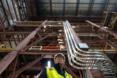
Minnesota’s first new mine in half a century is just weeks away from its expected opening on what may be one of the last great ore deposits on the Iron Range.
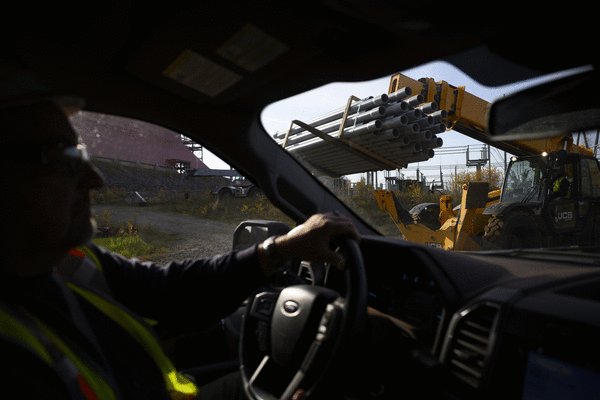
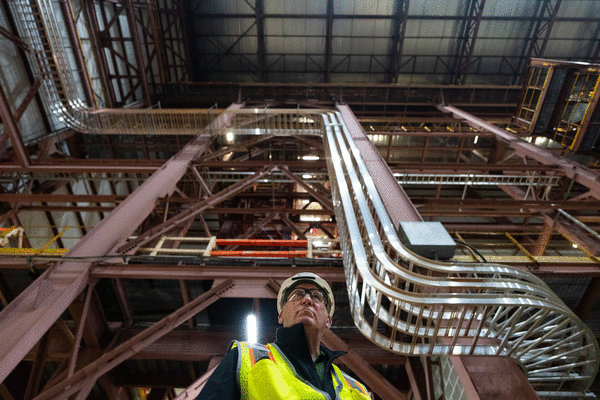
The site, concealed beneath work vehicles and a forest floor, is aflutter with activity. About 1,500 contractors are passing through a security checkpoint each day to meet the deadline, job applications are being processed, the major permits are in hand and financial backing is secured to launch the Mesabi Metallics mine and taconite facility complex.
At a cost of $2.5 billion, it is one of the biggest economic investments in Minnesota’s history.
It rivals the $2.6 billion pipeline Enbridge completed in northern Minnesota in 2021, and is more than twice as costly as U.S. Bank Stadium’s construction.
The mine’s opening will conclude a 20-year saga that included a bankruptcy, lost leases and spurned state investments.
Iron ore mining is a large part of the region’s identity, but has taken a hit in the past two years with idlings and layoffs at facilities owned by Cleveland-Cliffs and U.S. Steel.
A new mine — coming at a time when President Donald Trump and legislators are promoting domestic steel manufacturing and extraction of natural resources — has economic boosters and officials on the Range feeling cautiously optimistic.
For many, the moment feels like vindication — like a Michigan automobile city that can still produce a new line of hybrid trucks — yet unease lingers.
Casey Venema still nurses reservations from the first time India conglomerate Essar Group tried opening the mine. Essar broke ground in 2008, but faced years of delays and required state subsidies, only for the project to ultimately go bankrupt in 2016.
Venema worked seven years for Essar Steel Minnesota before its bankruptcy. The company accumulated $1 billion in debt during that time.
Now, after emerging from Chapter 11 bankruptcy and being passed between a few different ownership groups, Essar is back in control of the project, now called Mesabi Metallics.
“Are we a little cautious? Of course. It’s been a long road,” said Venema, an Itasca County commissioner whose district encompasses the mine. “But every day it gets better.”
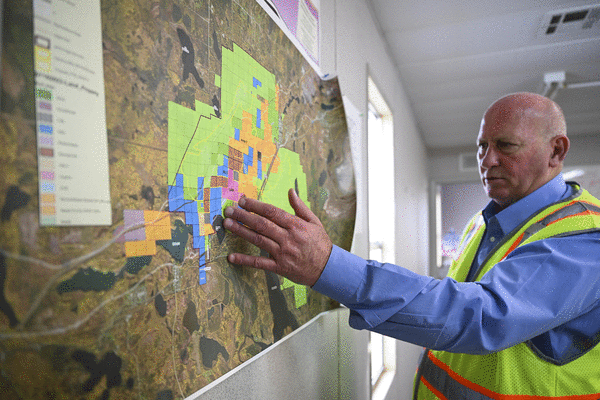
The 16,000-acre Mesabi Metallics mining complex — with the help of duplex-sized Komatsu trucks and 70-foot-tall shovels — is set to produce 7 million tons of direct-reduction grade iron ore pellets each year.
The mine will open as the appetite for big American industrial projects has grown but continue to face red tape and public opposition, especially from environmental interest groups.
After Essar resumed spending on the project in 2023, it started building a resource almost as critical as the ore: local trust.
“When (Essar) came back to the project, nobody really wanted to trust them,” said Nashwauk Mayor Greg Heyblom, who attended a golden shovel event for the mine back in 2007. “This time around, the attitude and respect and consideration is completely different.”
Over the past two years, Mesabi has engaged in a campaign that reached supper clubs and city halls across the region to convince people the mining complex would open.
The company started paying $30,000 a month to the city of Nashwauk to help pay for the town’s services and roads, as well as $15,000 for projects.
It hired local contractors as much as it could to build out the mining complex.
Slowly, but surely, public opinion started to shift.
“Unanimously, we voted to support them,” said Venema, of the 2023 vote voicing support for returning some leases to Mesabi. “It’ll help support the whole county.”
The new jobs are needed. The Range’s ore industry is in one of its down cycles, with hundreds of people out of work after Cleveland-Cliffs idled its Minorca mine in Virginia and the Hibbing Taconite, jointly owned by Cliffs and U.S. Steel, slowed.
In June, the company started accepting applications for 200 operational jobs. Mesabi CEO Joe Broking said managers are already hired and the other positions are being reviewed.
“There are applications as far east as Hoyt Lakes and as far west as the Brainerd Lakes and Bemidji area,” he said.
The anxiety has not completely faded, though.
At a council meeting in May, some Nashwauk councilors expressed frustration at the timing of payments from Mesabi that they intended to use for improvements to a city building.
“I don’t know why they’re making such a big deal about paying this money they owe us,” Councilor Tom Martire said at the May meeting.
Councilor Sheila Jensen was frustrated, too, at the time but said she learned Mesabi is up to date on its payments to the city.
The Mesabi money is paying for several projects, Heyblom said.
“They paid for a sliding hill for kids. We’ve put several months of project money towards a new public works building,” Heyblom said. “For a little community, we have to go out and find funding.”
Mesabi also is on time in paying down $49 million in state subsidies Essar Minnesota defaulted on, according to the Minnesota Department of Employment and Economic Development.
The state Department of Natural Resources said the only permits left for the current project are small ones and should not postpone any opening.
In Washington D.C., Mesabi has hired both Akin Gump Strauss Hauer & Feld, a K Street lobby shop, as well as Jason Miller, a longtime political adviser to Trump, as the company seeks federal critical mineral status for high-grade iron ore.
Traditionally, iron ore has not been listed as a critical mineral, because of the mineral’s historic prevalence and relative profitability, said Ian Lange, an economics professor at the Colorado School of Mines. The building blocks of skyscrapers and ships and tanks hasn’t needed incentive from government tax policy to flourish.
But the industry argues that steel, and thus ore, is a key component to both the nation’s economy and its security.
The list of critical minerals is overseen by the U.S. Geological Survey and the latest additions were published in November. Iron ore was not among them.
Federal lobbying disclosures show Mesabi spent $140,000 in the fourth quarter of 2025, petitioning various governmental agencies including the Export-Import Bank of the United States.
In March, the Trump administration signaled support of the Mesabi project, with $10 billion in investment from the Export-Import Bank of the United States. Mesabi this spring also secured royalty and credit agreements worth nearly $1 billion.
On Capitol Hill, Republicans are seeking to clear away hurdles for mining projects, including the controversial Twin Metals project near Ely, which would sit near the border of the protected Boundary Waters Canoe Area on the Minnesota-Canadian border. Another copper-nickel mine and helium projects are in the works.
But the economics and a lot of northern Minnesota’s politics is built on the ore industry. Unlike Twin Metals, which faced fierce partisan division, Mesabi has seen a bipartisan parade of politicians stopping by for recent tours.
Heyblom said the community and its workforce is energized by Mesabi’s momentum.
Dustyn Smith — a native of Taconite, Minnesota, and current resident of Grand Rapids — was part of the tranche of workers laid off by Hibbing Taconite over the winter.
He tried finding a construction job. He picked up odd jobs. But nothing was working out.
Then Smith got a call from Mesabi, which hired him a job as a mechanical planner.
“We have a rare opportunity,” Smith said in an email, to be in on a mine from the beginning. “There are many familiar faces out here that have gotten jobs with Mesabi Metallics.”
©2026 The Minnesota Star Tribune. Visit at startribune.com. Distributed by Tribune Content Agency, LLC.








Comments