Chip industry urges US to avoid moves that distort memory market
Published in Business News
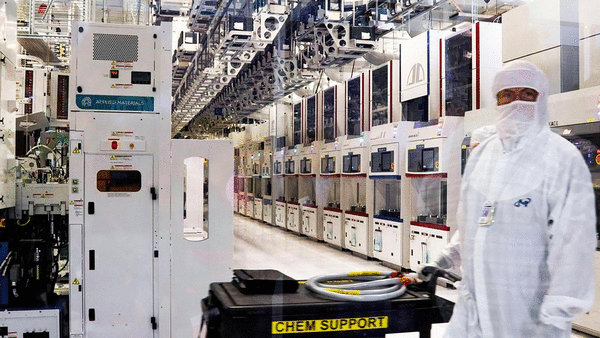
Government attempts to address the global memory chip shortage by influencing prices or production capacity would worsen a historic squeeze on supply driven by the artificial intelligence boom, a semiconductor industry group warned the Trump administration.
In a letter to senior administration officials, the SEMI industry association urged the U.S. instead to allow companies to continue striking long-term agreements with customers and extend tax breaks aimed at increasing output in the U.S. The top three memory chipmakers — Idaho-based Micron Technology Inc. as well as SK Hynix Inc. and Samsung Electronics Co. of South Korea — are members of the SEMI group.
“While targeted policies can support accelerating domestic supply resilience, interventions that distort pricing or capacity decisions risk prolonging the demand downturn,” SEMI said in its letter, according to a copy seen by Bloomberg News.
“Current market conditions are being addressed through investments in American manufacturing and an increasing focus on long-term purchase agreements,” the organization added.
Industries ranging from automobile manufacturing to consumer electronics are coping with an unprecedented squeeze on the supply of memory chips, which are in record demand for use in the high-end processors that power AI data centers. Apple Inc. is now seeking the Trump administration’s blessing to purchase memory components from two Chinese companies on a Pentagon blacklist.
Dated July 1, the letter is addressed to Treasury Secretary Scott Bessent, one of the officials Apple’s outgoing chief executive, Tim Cook, has been lobbying about Chinese memory, along with Defense Secretary Pete Hegseth, Commerce Secretary Howard Lutnick and Secretary of State Marco Rubio.
SEMI’s letter makes no mention of the Chinese suppliers, yet it adds to a growing sense in Washington that the memory shortage is becoming a political challenge. While investors cheer memory makers’ surging stock valuations, policymakers concerned about voters’ pocketbooks are eyeing the impact on consumers, highlighted by decisions by Apple and Microsoft Corp. to raise prices on popular goods.
To help ease the pinch of rising costs for electronics, SEMI offered a different solution than the one Apple is pitching. It called on the administration to work with Congress on policies that would offset rising prices of phones and laptops by developing consumer-focused tax deductions or credits.
The group, overall, expressed its appreciation for the administration’s support of the chip industry.
“SEMI and our members appreciate the Trump administration’s proactive efforts to bolster memory capacity in support of advancing AI and data center infrastructure in pursuit of U.S. technology leadership,” Royal Kastens, the group’s vice president of global public policy and advocacy, said in a statement.
The shortage has led to policy questions beyond whether to allow American firms to purchase from blacklisted Chinese memory makers. At least one lawmaker in Washington has already expressed interest in a market intervention that could force memory makers to give American customers first dibs on supply.
Senator Bernie Moreno, an Ohio Republican, sent a letter to Lutnick in April warning that a memory chip shortfall could lead to auto industry impacts similar to the supply disruptions and price hikes seen during the Coronavirus pandemic. The letter ended by encouraging Lutnick to set a priority of domestic demand for memory chip components.
While SEMI said in its letter that memory capacity is expected to grow about 19% per year, citing industry data, it added that exploding demand from AI infrastructure would eclipse supply, constraining availability for everything from laptops to cars and appliances.
Though all the major memory makers have plans to expand, that build-out will take years, while a supply-demand mismatch is already leading to price increases.
©2026 Bloomberg L.P. Visit bloomberg.com. Distributed by Tribune Content Agency, LLC.









Comments