Tech firms and feds push to block Minnesota's strict new law on prediction markets
Published in Business News
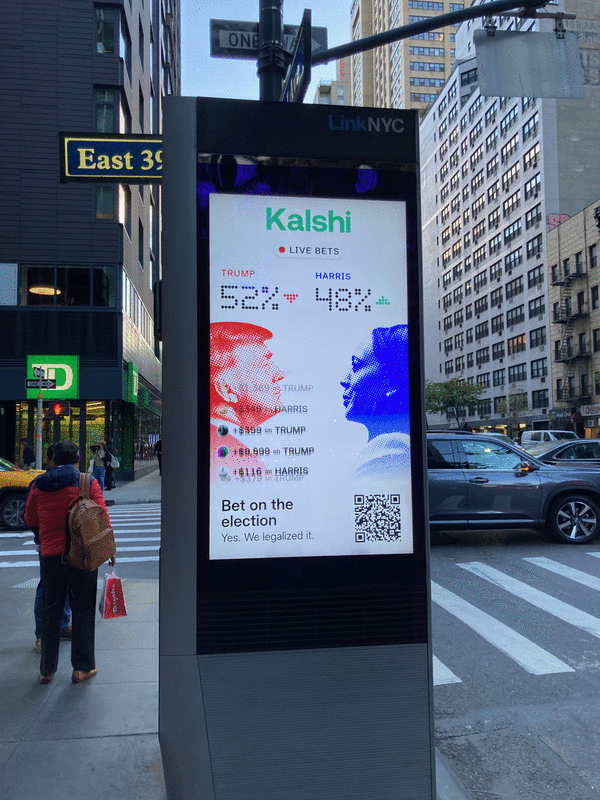
Shut down operations in Minnesota or get hit with a felony.
Those are the stakes the makers of popular prediction market apps Kalshi and Polymarket will face in four weeks, when Minnesota’s strict new law regulating the apps takes effect. The case has attracted national attention because Minnesota is the first state to outlaw prediction market wagers specifically under threat of felony prosecution.
The industry is fighting the law. On Thursday, the two companies were joined by the Commodity Futures Trading Commission (CFTC), the federal agency that regulates them, in asking a federal judge for a preliminary injunction to halt its enforcement.
No ruling was immediately issued after the two-hour hearing Thursday.
Prediction market apps give users the chance to place wagers on real-world events, ranging from weather to sports and fashion to politics and war. States including Minnesota want to regulate them as gambling sites, while the Justice Department has brought criminal charges for insider trading, including a case against a U.S. Army soldier for making wagers on Polymarket using classified information.
Kalshi said in court filings that it has more than 90,000 users in Minnesota, with millions of dollars in open contracts. Polymarket supplied no similar figures, but said the state law would cause economic hardship.
The companies and their federal regulator told a U.S. judge in Minneapolis on Thursday that the wagers are effectively future event contracts known as “swaps.” This, they argue, means they’re exempt from the state’s existing gambling regulations, as well as its newly enacted law directly addressing prediction markets.
“There’s no room for state involvement,” said Henry John Dickman, an attorney for CFTC, which opened the challenge against Minnesota’s law after Gov. Tim Walz signed it in May.
The Minnesota Attorney General’s Office argues the state has long had the authority to regulate matters of public health and welfare such as gambling. Additionally, the AG’s office argued, the U.S. Congress never intended for prediction markets to become a loophole for legalized sports betting across all 50 states.
“If (Congress) had wanted to (preempt state gaming laws), they know how,” said Lindsey Middlecamp of the Minnesota Attorney General’s Office.
To place wagers, users can purchase a “yes” or “no” option and then contract makers like Kalshi and Polymarket collect fees to operate. The central legal question in the case is whether those contracts distinguish prediction market wagers from traditional gambling.
Sports account for 80% of the wagers offered on Kalshi and nearly 40% of those offered on Polymarket, as trading on the platforms increased dramatically in mid-2025, according to Pew Research Center.
Several other states attempting to regulate prediction markets are in court battles with the federal government, but Minnesota’s approach was unusual for specifically addressing prediction markets. Along with banning specific types of wagers on prediction markets, the state makes it a felony to advertise the services in Minnesota.
Kalshi, Polymarket and the federal government described Minnesota’s effort to directly regulate prediction markets as a first in the nation.
U.S. District Judge Katherine Menendez on Thursday asked for clarity on how the prediction markets work, and how to distinguish between what is an illegal bet versus a bona fide event contract with financial or economic consequences. She ran through actual and hypothetical wagers that could be placed on prediction markets — like whether Taylor Swift would wear heels to her wedding — to pressure-test the concept of how they differ from gambling.
“It’s not different to the 20-year-old” who emptied his bank account on World Cup wagers, Menendez said.
Attorney Colleen Sinzdak, representing Kalshi, said transactions made on the platform are not betting when run on a federally regulated exchange.
“It’s sort of like saying an insurance contract is just betting,” she said.
Minnesota lawmakers have cited concerns about gambling addiction, underage users placing bets and the possibility of insider trading on the so-called event contracts.
Minnesota says lawmakers took care to exclude some future-event-based transactions not subject to the statute’s prohibition, particularly traditional insurance contracts, agricultural risk-hedging transactions and transactions involving securities or commodities.
Other states use gambling laws
At least 18 states have taken actions to regulate prediction markets like Kalshi and Polymarket under existing gambling laws, with mixed success in federal court, according to an analysis from the Minnesota Attorney General’s office. Some seek to prohibit activity outright or collect taxes as they would from a casino or a legal sports book.
In March, Nevada became the first state in the nation to obtain a temporary ban of the platforms through a federal court order. Polymarket and Kalshi locked users there out of their apps.
Kalshi and Polymarket have also brought a First Amendment challenge in the Minnesota case, citing the provision against advertising and other communications. The state argues there is no protected speech for promoting illegal activity.
Menendez did not specify when she would issue a ruling, but said she would do so as soon as possible.
“I hope that I will not be the subject of any prediction market contracts between now and when I get there,” she said.
©2026 The Minnesota Star Tribune. Visit at startribune.com. Distributed by Tribune Content Agency, LLC.






Comments