Waymo-backed bill could make self-driving cars legal in Illinois in three years
Published in Business News
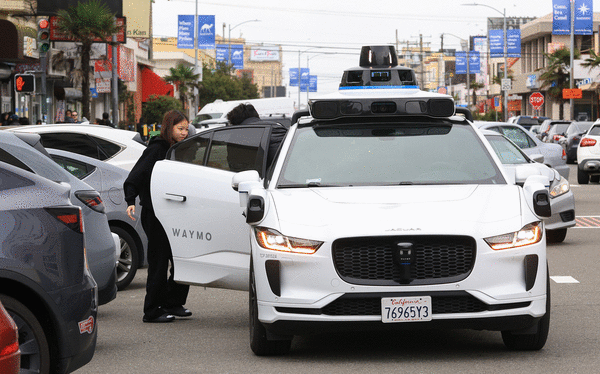
Self-driving cars such as Waymos could soon roam the streets of Chicago under new legislation proposed in Springfield.
A bill filed last week would authorize autonomous vehicle pilot programs in a handful of Illinois counties, including Cook, before opening the door to statewide legalization of self-driving cars in three years.
The proposal from state Rep. Kam Buckner, a Democrat from Chicago, comes as self-driving car company Waymo has been trying to make inroads in Illinois. The company operates in San Francisco, Los Angeles, Phoenix, Austin, Atlanta and Miami and has announced plans to expand to a plethora of other cities worldwide.
State officials say legislation is likely needed to allow self-driving cars in the Land of Lincoln. Several legislative attempts last year went nowhere.
In an interview Monday, Buckner, who is also the speaker pro tempore of the Illinois House, said the state has a responsibility to “lead, not react” to the advent of autonomous vehicle technology.
“We can’t afford to get caught flat-footed,” he said, acknowledging that the filing of the bill is no guarantee it gets passed this year. “It’s about creating a thoughtful framework that balances innovation with safety, accountability, labor protections and the legitimate concerns of folks in the litigation space as well.”
Waymo, which is owned by Google parent company Alphabet Inc., said it “strongly supports” the proposed legislation.
“We’re excited to one day offer our service to its residents and visitors,” a company spokesperson said. “Our technology can make Illinois’ roads safer and transportation in the state more accessible.”
Buckner’s proposed legislation would allow self-driving car pilot programs in Cook County, Sangamon County — where the county seat is Springfield, the state’s capital — and Madison, St. Clair and Monroe counties, which are in southwestern Illinois outside St. Louis.
Under the law, someone seeking to operate an autonomous vehicle in Illinois would need to submit an application for approval from the Illinois Department of Transportation, which would also have the authority to revoke or suspend that authorization. IDOT declined to comment on pending legislation.
AV systems must be capable of operating in compliance with motor vehicle laws and regulations, except if IDOT issues an exemption.
The law would also require AVs in Illinois to be covered by motor vehicle liability coverage or insurance.
Under the proposed legislation, the transportation department could legalize autonomous vehicles statewide three years after the bill takes effect — so long as pilot programs were successful.
Buckner, who has experience as a major player in legislative negotiations on transit issues, said he’s “really in awe” of the technology and acknowledges that riders would have to adjust to it.
He said Chicago’s often-volatile wintry weather conditions and how the autonomous vehicles would function around various infrastructure issues, such as construction projects, need to be addressed in order for them to operate safely in the city.
“Painted lane markings, potholes, construction zones, temporary traffic controls. They’re all common and they’re more common in Chicago than most places, even though we’ve got two seasons, winter and construction,” said Buckner, acknowledging that self-driving cars must share the roads with “human drivers, with CTA buses, with snowplows, with first responders, with … people walking and people riding their bikes.”
“It’s important that we have a robust conversation about it now and not get left behind,” Buckner said.
Waymo said in December that its vehicles can operate in conditions such as freezing temperatures and hail but that it was “validating our system to navigate harsher weather conditions,” the likes of which are common in Chicago.
Advocates for self-driving cars in Illinois are likely to face concerns about safety and the cars’ ability to drive through midwestern snow and ice.
The bill is facing scrutiny from the Illinois Trial Lawyers Association, whose president, Timothy Cavanagh, said in a statement that Illinois should “pump the brakes on this dangerous bill,” citing some recent safety incidents involving Waymos.
“The bill fails to protect passengers that may utilize the technology, those that would share the roadways with AVs, and the public at-large,” Cavanagh said in a statement.
Waymo says its own data shows that its cars are safer than cars driven by humans, saying its vehicles are involved in 10 times fewer crashes that cause serious injuries, and 12 times fewer crashes involving pedestrian injuries.
But recent high-profile safety incidents involving Waymos have drawn scrutiny from critics.
In San Francisco, residents raged against Waymo when one of the company’s cars struck and killed a bodega cat in the city’s Mission District last fall.
Waymo also faltered during a massive power outage in the same Bay Area city in December as self-driving cars froze, blocking intersections when traffic lights went out. More recently, federal regulators opened an investigation into the company after one of its vehicles struck a child, who suffered minor injuries, near a school in Santa Monica.
Regarding that crash, Waymo said the child “suddenly entered the roadway from behind a tall SUV.” The Waymo vehicle “braked hard” before the collision, the company said, arguing that a human driver would have struck the child at a higher speed. Waymo has said it is responding to the power outage incident by updating its fleet to better respond to outages and improving its emergency response protocols.
In Illinois, unions have also expressed some concern that legalizing autonomous vehicles could open the door to technologies that would threaten their members’ jobs. Waymo, meanwhile, has argued it brings jobs to new markets.
The Illinois Drivers Alliance — a union coalition trying to organize Uber and Lyft drivers statewide — slammed the proposed legislation in a statement to the Tribune, saying Illinois “should be investing in drivers — not fast-tracking questionable policies that replace real people with unproven, unpredictable robots and rip away hard-earned money out of drivers’ pockets and put it into Silicon Valley.”
Buckner said Illinois “has always shown that we have the ability to be pro-innovation and pro-people at the same time.”
“And so I think it has to be the same posture with this bill,” he said.
©2026 Chicago Tribune. Visit at chicagotribune.com. Distributed by Tribune Content Agency, LLC.









Comments