Supreme Court for now allows Trump to plan new mail ballot rules. California to sue again
Published in Political News
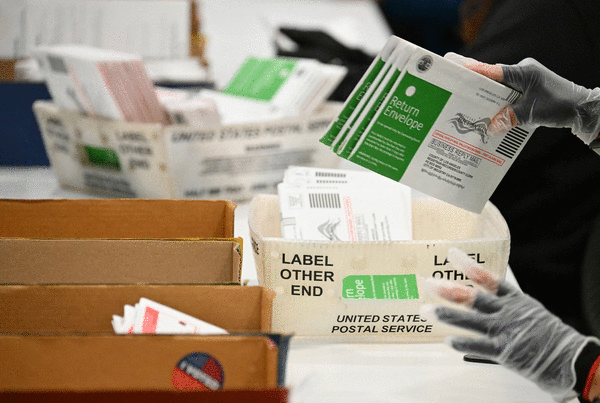
WASHINGTON — The Supreme Court cleared the way Monday for President Donald Trump to continue seeking new limits on the use of mail ballots, though their implementation remains in dispute as the November election rapidly approaches.
California leaders immediately noted the limits of the high court ruling and said they would file a lawsuit to prevent Trump’s desired changes from taking effect.
“The Supreme Court just let the Trump administration move ahead (for now) with its plan to disenfranchise voters across the country. California will be suing AGAIN to block these Orwellian rules from being implemented,” Gov. Gavin Newsom said in a statement.
Acting by a 6-3 vote, the court’s conservatives granted an emergency appeal from Trump’s lawyers and set aside a lower judge’s order that blocked federal agencies — including the Department of Homeland Security and the U.S. Postal Service — from advancing new federal regulations on states and their use of mail ballots.
Trump called for those regulations in a March executive order directing Homeland Security to compile its own lists of eligible citizen voters in each state and the Postal Service to restrict its processing of mail ballots to those submitted by individuals on those Homeland Security lists.
The high court’s ruling allows those agencies to move forward with their work to comply with Trump’s order, but reaches no conclusions as to the legality of those pending rules.
“The Court’s disposition of this application does not mean that any measure taken by the Government to implement the Order will necessarily be lawful. On that score, time will tell,” the high court wrote.
The unsigned order spoke for the six Republican appointees. The three liberals, all Democratic appointees, dissented in two separate opinions.
California officials stressed that the court’s ruling does not allow final implementation of the rules requested by Trump.
California Attorney General Rob Bonta, who helped lead the coalition of states challenging Trump’s order, called the ruling “somewhat disappointing” but “purely procedural” and far from the final word on the issue.
“It doesn’t address the merits. And we think that when the merits are addressed — and we will bring a lawsuit to address the merits of this case — that we will prevail, because the president has zero authority to determine the time, place and manner of elections, and he is through an executive order trying to exert a very significant amount of authority,” Bonta said.
He said the court found the state’s lawsuit was not “ripe” to bring because there was no final Postal Service rule in place implementing new controls on mail ballots. He said the Postal Service issued a final rule Friday — and “now that the final rule’s in place, we’ll sue, and we’ll start from the beginning.”
The 95-page new rule implements parts of Trump’s executive order by requiring a new design for mail ballots and the envelopes they go in, as well as for how data is collected from them by the federal government.
Bonta said his office expects to sue again within days. He expects a lower court will block the Trump-ordered changes again, and for that ruling to stand through November. He said if the high court does weigh in again before the midterms, he expects it to acknowledge that the president has no authority to dictate election policy.
Dean Logan, registrar-recorder and county clerk for Los Angeles County, also said the issue is far from settled.
“As we approach the issuance of the first ballots for the November General Election, it is important to recognize that these regulations are still subject to active litigation and interpretation,” Logan said in a statement to The Times. “In response, we will intensify our voter outreach and educational initiatives to ensure individuals are fully informed and aware of any adjustments to the voting process.”
The Supreme Court found in part that the lower court order blocking the agencies from working toward Trump’s order was invalid because that work had yet to cause any harm to the states that sued, including California.
It wrote that Trump’s executive order “is an internal directive from the President to his subordinates mandating that certain agencies pursue certain policies. It neither requires nor forbids anything of anyone outside the Executive Branch.”
About 30% of the nation’s voters — and 80% of Californians — cast their ballots by mail in 2024. Trump, however, has long maintained that voting by mail leads to fraud, including voting by noncitizens.
With the court’s ruling Monday, Homeland Security may compile state-by-state lists of citizens who are 18 and over and eligible to vote. However, California and other states “are not required to use the Lists,” the court said.
The Trump administration has acknowledged potential law enforcement applications for the lists and warned state election officials across the country that they could face legal consequences if they don’t work to ensure that noncitizens aren’t able to vote in their elections.
Such warnings from the administration were mentioned by Justice Sonia Sotomayor in her dissent as evidence of the harm suffered by the states already, and reason for the lower court’s ruling halting implementation to hold.
She wrote that the administration has acknowledged that a state’s “refusal to consider” the Homeland Security lists “could conceivably, depending on the circumstances, be relevant evidence of an intent to violate, or to facilitate the violation of, the federal laws prohibiting non-citizen voting.”
She also made the limits of the majority’s ruling clear.
“Today’s decision does not address whether the President’s attempts to interfere with States’ administration of the November 2026 elections are lawful,” Sotomayor wrote in a dissent joined by Justice Elena Kagan. “Nor does it suggest that the Executive Branch has any constitutional or statutory authority to implement the President’s directives. Instead, today’s decision merely postpones adjudication of those challenges.”
Justice Ketanji Brown Jackson, in her own dissent, also noted the limits of the majority’s ruling and criticized it for failing “to explain when, exactly, is the right time to bring a meritorious election-rule claim challenging unconstitutional interference with electoral processes.”
Jackson wrote that the ruling “needlessly injects chaos and uncertainty into the upcoming midterm elections. It also lets another shoe drop in the Kafkaesque nightmare that our precedents have been steadily creating for certain plaintiffs who seek to bring election-related challenges.”
Trump’s executive order said it was aimed at “ensuring citizenship verification” in federal elections. California and 22 other Democratic-led states sued a few days later and said Trump sought to use the Postal Service to impose new restrictions on voting by mail. They also argued the Constitution gives states and Congress the power to regulate elections, not the president.
A federal judge in Boston and 1st Circuit Court agreed with the challengers and blocked Trump’s executive order from taking effect for the November elections.
The case on appeal was Trump vs. California because Bonta was a leader of the Democratic state attorneys who sued.
Logan, of Los Angeles County, said the Trump administration’s “ongoing efforts to modify the electoral process amid an election cycle are deeply troubling and frustrating,” and that one of the“ most significant risks we face” as a result is “the possibility of voter confusion and diminished participation — outcomes that run counter to the principles of free and fair elections.”
“Our team is dedicated to minimizing any adverse effects on voters, and we will work diligently to safeguard their ability to make their voices heard and ensure their votes are properly recorded,” Logan said.
_____
©2026 Los Angeles Times. Visit at latimes.com. Distributed by Tribune Content Agency, LLC.































Comments