Time is running short for Congress to reverse a looming ban on hemp-derived THC products
Published in Political News
With less than four months until a federal ban on most hemp-derived THC products is set to take effect, time is running short for lawmakers supporting the hemp industry to roll back the strict new rules.
A new bipartisan bill introduced Wednesday is the latest effort in Congress to replace the ban with a new framework to regulate and tax hemp-derived cannabinoid products at the federal level.
Meanwhile, Minnesota’s top cannabis regulator said hemp THC products will remain available in the state whether the federal ban takes effect or not. Minnesota has its own legislation regulating the hemp market.
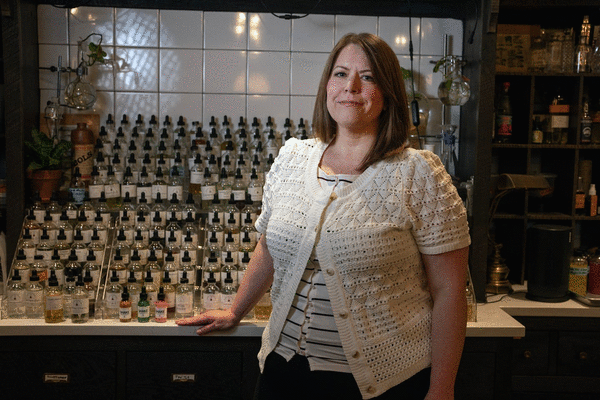
Like hemp business owners across Minnesota and nationwide, Leah Kollross is waiting nervously.
Kollross founded the Minneapolis hemp-derived THC beverage and edible maker 23rd State with her husband, Kasey, around the time she was diagnosed with multiple sclerosis in 2023. She has been forced to rethink the future of her business after Congress passed the ban last fall.
“I have products ready for launch,” Kollross said. “However, I’m not confident in actually bringing them to market yet until I know what’s happening with this (ban).”
Hemp beverages have become a lifeline for Minnesota breweries amid slumping alcohol sales. Brewers in the state reported more than $5 million in revenue from THC beverages in 2025, said Bob Galligan, director of government and industry relations for the Minnesota Craft Brewers Guild.
The Hemp Beverage Alliance estimates the national hemp THC drink market more than doubled in size in 2025 over the previous year, based on an analysis of sales data shared by 26 hemp beverage brands.
A report from Whitney Economics found retail sales of THC beverages topped $1 billion in 2025. In Minnesota, the sale of hemp-derived THC products generates millions of dollars of tax revenue annually.
The new federal rules ban products with more than 0.4 milligrams of THC, the primary compound in cannabis that produces a high, per container. It’s a standard so strict that many products containing the popular nonintoxicating cannabinoid CBD – as well as trace amounts of THC – likely won’t be able to meet it.
But Minnesota law explicitly permits hemp edibles containing up to 5 milligrams of THC per serving or 10 milligrams per container for canned beverages, far exceeding the new federal standard.
The Trump administration has not provided guidance to states on how it intends to interpret or enforce the new law, said Minnesota Office of Cannabis Management Director Eric Taubel.
Even if the federal ban goes into effect, Taubel said he expected the state to continue regulating hemp-derived cannabinoid products, as it has since they were first legalized in Minnesota in 2022. THC-infused beverages, edibles and topicals won’t disappear from store shelves overnight, though the number of retailers carrying them will likely decline, he said.
The real question, Taubel said, is whether hemp business owners will decide it’s still worth it to continue operating when the federal government treats their products as a Schedule I drug, the same as recreational cannabis.
That classification brings with it a much higher federal tax burden, an end to out-of-state sales and lost access to many banking services, such as the ability for customers to pay with credit or debit cards.
“Individual businesses will make decisions about (whether) they pivot fully into hemp and leave some of the other stuff behind,” Taubel said. “Or do they fully get out of the hemp business?”
While many congressional Democrats and a substantial number of Republicans say they want to reverse the federal law changes, time is rapidly running out to pass new legislation.
The U.S. Senate is scheduled to be in session for fewer than 30 days between now and Nov. 12, when the new rules take effect, while the House has even less time. It’s unclear how high of a priority reversing the ban is for many lawmakers.
Minnesota U.S. Rep. Angie Craig, the top-ranking Democrat on the House Agriculture Committee, has introduced a bill with Kentucky Rep. Andy Barr, a Republican, to establish a federal regulatory system for the hemp industry, the latest effort to stave off the ban.
The Lawful Hemp Protection Act would task the U.S. Food and Drug Administration (FDA) with regulating hemp, ban the marketing of hemp-derived products to children, impose a federal tax on hemp and require that products be produced domestically.
The bill would also establish a limit of 1% THC content for hemp products and restrict their sale to those age 21 or older.
In a statement, Craig said the legislation would bring “regulatory clarity” to the hemp community, calling the ban “short-sighted.”
U.S. Sen. Amy Klobuchar, the likely DFL nominee for Minnesota governor, introduced a bill earlier this year with Sen. Rand Paul, R-Ky., that would allow states and tribal governments regulating hemp products to opt out of the federal ban and continue to allow interstate sales between them. Like multiple other bills that would delay the ban’s implementation, Klobuchar’s legislation has yet to move forward.
Despite the looming law changes, demand for hemp business licenses remains high in Minnesota. Since April 1, the OCM has received more than 330 hemp business license applications, the vast majority from prospective retailers, covering nearly 700 locations, according to OCM spokesman Josh Collins. The Holiday chain of convenience stores alone accounted for 276 retail sites.
Jason Dayton, co-founder of the Trail Magic brand of hemp-derived THC beverages, said the potential end to sales across state lines is the biggest threat to his business. The brand is sold in Target stores across the country and it now accounts for roughly 60% of sales at the Minneapolis Cider Company’s taproom in northeast Minneapolis, which Dayton also owns with a business partner.
“That’s where you’re going to see a huge impact in Minnesota,” Dayton said. “Our ability to export outside the state, but also the loss of out-of-state brands coming to Minnesota.”
Desi High, a hemp beverage company founded by Divya Maiya, makes THC-infused drinks with traditional South Asian flavors like masala chai that are sold in Minnesota and several other states. With an uncertain future, Maiya said she’s trying to move as much product as she can before the ban takes effect.
“We’re just a baby company trying to grow in this volatile, confusing time,” Maiya said. “My goal right now is to sell as much inventory as I have available and kind of pause, hold, and see. But it’s really tricky because we can’t expand.”
_____
©2026 The Minnesota Star Tribune. Visit startribune.com. Distributed by Tribune Content Agency, LLC








































Comments