Commentary: Trump Accounts are here. Now families need more than a deposit slip
Published in Political News
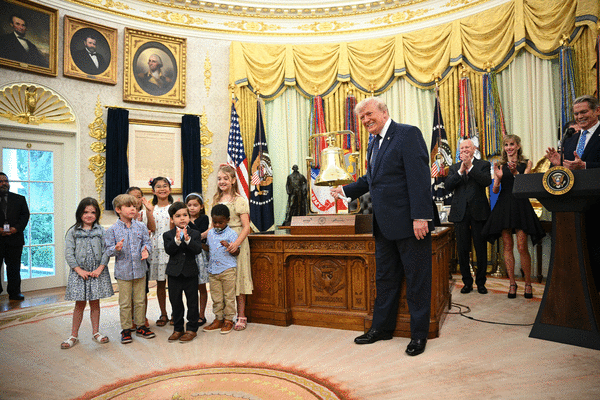
When Leslie Moreno-Roacho’s son Zaiden became the first child in New Mexico to receive a state-funded Baby Bond, she told a local television reporter the deposit was “a ticket to opportunities. The opportunities I never had.”
On July 4, millions of American families were handed the same kind of ticket. Most had no idea how to use it.
That day, the federal government began opening “Trump Accounts” for every U.S. citizen born between 2025 and 2028, depositing $1,000 in each child’s name and allowing families, employers and others to contribute up to $5,000 a year. The program builds on a quieter wave of state experiments. Connecticut launched the country’s first publicly funded Baby Bonds in 2023, with deposits projected to grow to between $11,000 and $24,000 by age 18. New Mexico and other states are advancing their own.
That convergence is itself remarkable. A federally backed children’s investment program now extends, in modified form, an idea long championed on the left — that intergenerational wealth-building cannot wait for adulthood. In a country starved of bipartisan policy wins, this is one. But opening the account is only the first step.
An account creates access. It does not ensure action.
The case for these programs begins with what wealth actually does.
“The essence of wealth is functional. … Its real value is what it can do for you,” said Darrick Hamilton, The New School economist who first proposed Baby Bonds.
For millions of families, that function has been out of reach. The typical Black family holds just 15% of the wealth of the typical white family, and the average wealth gap between white and Hispanic families exceeds $1 million per household. You cannot pass down what you were never allowed to build.
The research is striking. Education researcher William Elliott III of Washington University has found that a child with as little as $1 to $499 set aside for higher education is roughly three times more likely to enroll in college, and more likely to graduate, than a child with no account at all. Even small accounts shift expectations.
The harder question is what happens next. A widely cited 2014 meta analysis found that the conventional financial literacy programs typically paired with these accounts produce only small, fading effects on behavior. Knowing how to balance a checkbook or monitor a credit score is important, but it isn’t enough. Real financial capability — understanding how money grows, how time compounds choices, how everyday decisions connect to long-term outcomes — has to be built and reinforced over years, not delivered in a one-hour module.
Stanford University economist Annamaria Lusardi argues that “financial literacy is as important as the ability to read and write.” Like reading, financial literacy has to be taught early and practiced often. If every American child is now going to have an investment account before they say their first word, the country needs a financial-capability infrastructure that grows alongside them.
Critics will note, fairly, that $1,000 cannot close a million-dollar wealth gap. They are right. But the value of these accounts was never only the dollars deposited. Elliott’s research suggests the deeper return is psychological and behavioral: An account, however small, changes how a family imagines a child’s future. The challenge now is making sure that imagination is matched by knowledge.
Some of that work has already begun. Dell founder Michael Dell and his wife, Susan, are funding additional $250 deposits in qualifying ZIP codes through Trump Accounts. Universities, nonprofits and research centers are starting to study how to design the family-side supports these programs need. Far more effort — public, private and philanthropic — will be required if these accounts are to deliver on their promise.
When Moreno-Roacho called her son’s account a ticket, she was right. But a ticket only takes you where you want to go if you know how to use it.
If we get this part right, the children who opened accounts at the start will not just inherit a deposit. They will inherit the knowledge to grow their investment — and one day, the ability to hand it down.
____
Arellana Barela Levenson is founder and CEO of Cultivar Communities. Frank Arce, Ed.D., is the assistant dean for admissions and financial aid at the Harvard Graduate School of Education.
___
©2026 Chicago Tribune. Visit at chicagotribune.com. Distributed by Tribune Content Agency, LLC.






























Comments