When a congressman beat a senator unconscious, America confronted the limits of free speech
Published in Political News
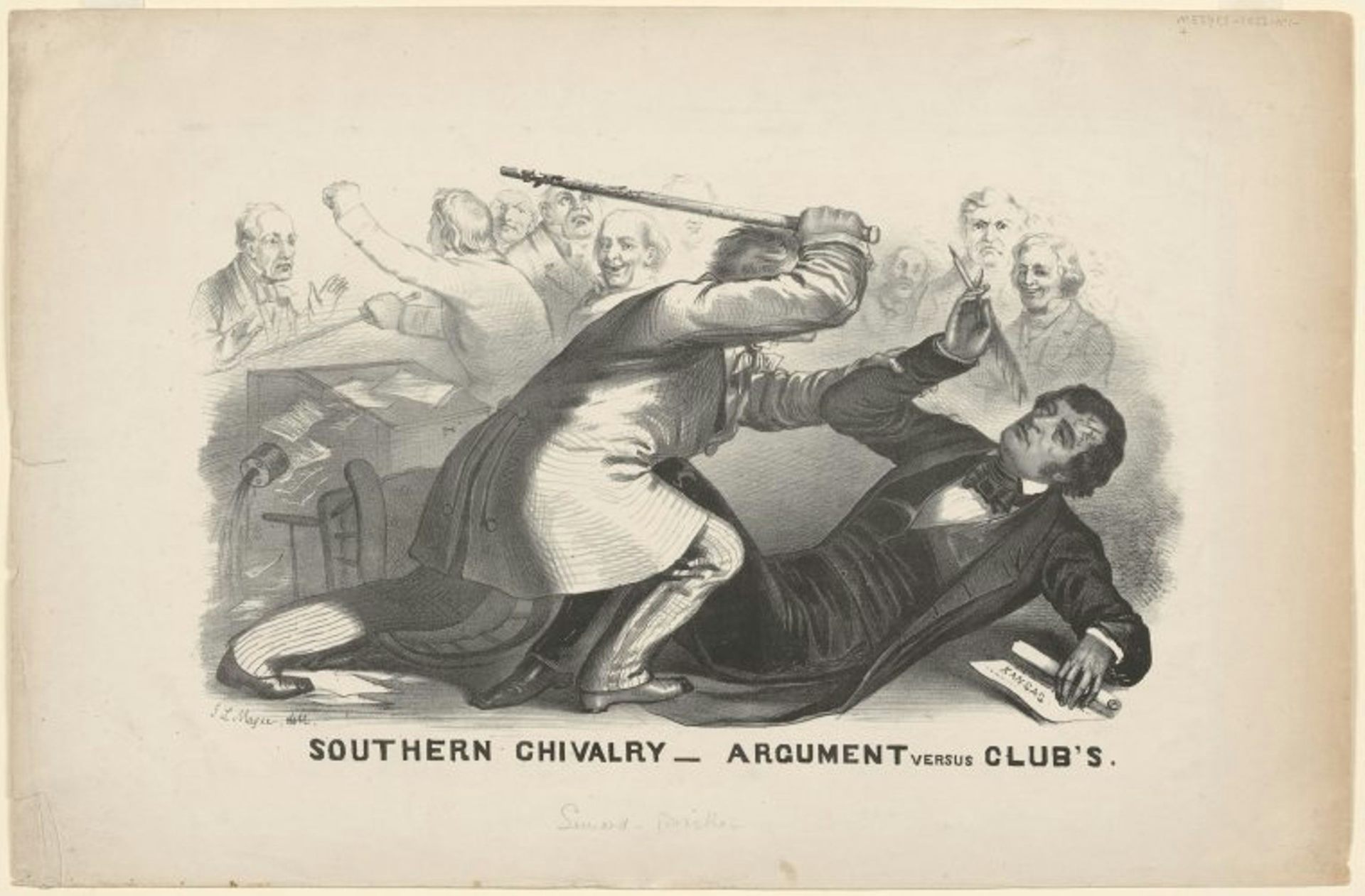
On May 22, 1856, Preston Brooks strode into the United States Senate chamber and beat Sen. Charles Sumner unconscious with a cane. Brooks, a South Carolina congressman, was retaliating for a speech Sumner had given condemning slavery and personally insulting a relative of Brooks.
Though lasting only a minute, the beating had far-reaching consequences. It pushed Americans one step closer to civil war.
And, as I discovered while researching my book “The Man Behind the Cane: Preston Brooks, Political Violence, and the Road to the Civil War,” it sparked a nationwide debate over free speech, political violence and the relationship between the two.
Northerners denounced the caning as an attack on Sumner’s right to free expression. Even if they thought Sumner’s abolitionism too radical – as most white Northerners did in 1856 – they believed a U.S. senator had the right to say what he wanted without violent reprisal.
Visual images of the caning reflected the Northern take on free speech. In John Magee’s political caricature, “Southern Chivalry – Argument Versus Club’s,” Brooks wields a sturdy stick against a defenseless Sumner, who is clutching a pen in one hand and a rolled-up speech in the other. Winslow Homer’s print “Arguments of the Chivalry” depicts Sumner writing at his desk as Brooks prepares to strike.
Homer’s headline captured the message of both depictions: “The Symbol of the North is the Pen; the Symbol of the South is the Bludgeon,” which is a quote from a speech by antislavery activist Henry Ward Beecher.
Defenders of Brooks insisted any abolitionist speech was too incendiary to deserve protected status. Brooks’ hometown newspaper in Edgefield, South Carolina, berated Sumner for “licentiously prostituting the principle of freedom of speech,” reflecting the widespread conviction among white Southerners that free speech had limits.
The argument between supporters of Brooks and Sumner was not isolated to the caning incident. Societies throughout history have punished language deemed blasphemous, seditious, inciting or slanderous. In most times and places, authorities have hewed more to slaveholders’ conception of free speech as a limited privilege than to abolitionists’ assertion of an absolute right. In the United States, the idea of free speech as virtually inviolable became mainstream only in the 20th century.
To pro-slavery Americans, abolitionist words warranted violent responses because such words were themselves tantamount to violence.
Alexander Stephens, future Confederate vice president, justified the caning by saying, “I have no objection to the liberty of Speech, when the liberty of the cudgel is left free to combat it.”
Another Southern politician wrote to Brooks, “Address your arguments to the Skin, to the physical sensibilities.” And one of the many replacement canes given to Brooks bore the revealing inscription “Use Knock-Down Arguments.”
Slaveholders were collapsing the distinction between words and physical violence. Language could constitute violence, and an act of violence could be a counterargument.
This logic has resurfaced in our own time, but instead of slaveholders using it to maintain white supremacy, today it is more often deployed to designate certain types of expression, such as burning crosses or displaying Nazi symbols, as hate speech against marginalized communities. It has also appeared in the increasing moves by the Trump administration to label dissent as terrorism.
While most Northerners in the 1850s continued to value freedom of speech over violence, the caning convinced some that they must respond in kind.
One Minnesota newspaper editor hoped that “every Northern member will fully arm himself, and if necessary plant a cannon by the side of his desk to be used as the most effectual argument in favor of Free Speech.”
It was increasingly difficult to keep rhetorical and physical violence separate as the slavery conflict heated up.
This was a new phase in the history of free speech. While abolitionists and increasing numbers of Northerners fought for an expansive idea of free expression, publishing pamphlets and newspapers and submitting petitions to Congress, slaveholders tried to suppress antislavery language.
Terrified that abolitionist words might lead to rebellions by the enslaved, slaveholders feared for their survival. As prominent abolitionist Frederick Douglass recognized, “Slavery cannot tolerate free speech.”
Political reformer Lydia Maria Child described a growing threat: “A slaveholding community necessarily lives in the midst of gunpowder and, in this age, sparks of free thought are flying in every direction.”
Responding to those sparks of abolitionist free thought with violent repression, including acts such as the Sumner caning, slaveholders’ violence fueled the rise of the new Republican Party. The Republicans articulated their opposition to slavery with their slogan of “free soil, free speech, free labor, free men.”
Brooks and his kind ultimately brought about their own demise by provoking Northern outrage – outrage that ultimately led to war once the slaveholding South seceded.
Who gets to say what to whom? Are there any words that can justify violence? These questions polarized the country after the caning. In new forms, they continue to confound American politics 170 years on.
This article is republished from The Conversation, a nonprofit, independent news organization bringing you facts and trustworthy analysis to help you make sense of our complex world. It was written by: Paul Quigley, Virginia Tech
Read more:
Slavery’s brutal reality shocked Northerners before the Civil War − and is being whitewashed today by the White House
How a newspaper revolution sparked protesters and influencers, disinformation and the Civil War
Think the US is more polarized than ever? You don’t know history
Paul Quigley received funding from The Carnegie Trust for the Universities of Scotland.














































Comments