Housing bill sent to Trump, starting countdown to enactment
Published in Political News
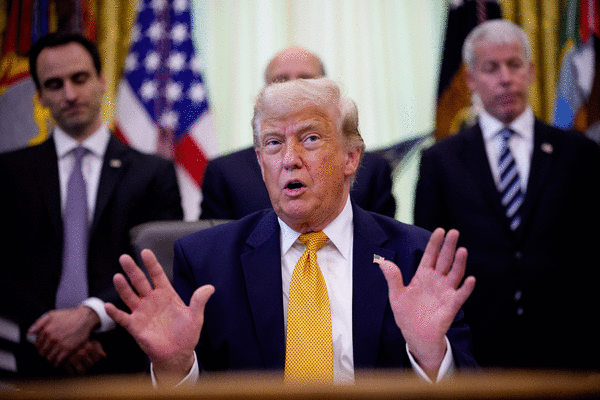
Speaker Mike Johnson, R-La., on Monday formally transmitted to the White House the bipartisan housing package that President Donald Trump refused to sign last week.
That triggers a 10-day clock, excluding Sundays, for Trump to either sign or veto the bill; if he does neither, it will become law without his signature by July 10.
The House cleared the bill on Tuesday after Senate passage a day earlier, both with veto-proof majorities. Even so, Trump had previously given the bill his ringing endorsement, and Johnson and other congressional leaders anticipated a high-profile signing ceremony Wednesday in Statuary Hall.
But Trump abruptly canceled the event about 90 minutes beforehand, saying he would not sign the housing legislation until the Senate clears a separate election security measure that would require voters to prove citizenship to register and bring photo ID to the polls.
The election bill does not have the necessary 60 votes to pass the Senate, though other options are under consideration, which could assuage Trump and the measure’s House backers, such as attaching it to a must-pass bill like the annual defense authorization bill.
Johnson met with Trump on Thursday afternoon, where he persuaded Trump to urge his supporters to end their House floor blockade over the voter ID issue, and allow key bills like the NDAA and appropriations measures to come up for votes. Subsequently, Johnson told reporters he’d send Trump the housing bill, erasing some doubts as to the popular bill’s fate.
Johnson put a finer point on it during an appearance on Fox’s “Sunday Morning Futures” program. “I’m sending it to him on Monday and it will become law,” he said, adding that he prefers a Trump signature to simply running out the 10-day clock.
“I certainly want him to take the biggest, boldest marker that he has and do that big Trump signature proudly on that legislation, because we’re delivering for the people and that’s what he wants to do,” Johnson said Sunday.
If Trump ends up deciding to veto the bill, an override seems likely given the large margins by which it sailed through both chambers — 85-5 in the Senate and 358-32 in the House. However, any newfound opposition from Trump could put pressure on Republicans to flip their positions and vote to sustain a veto.
Despite his previous endorsement of the measure, Trump had also said it wouldn’t do much to lower costs and that he didn’t want to give Democratic supporters like Massachusetts Sen. Elizabeth Warren a win. Trump has called alleged election misconduct a “national emergency” that’s more important than housing, arguing lower interest rates would do more to reduce housing costs.
In remarks to reporters on Monday, Trump didn’t commit to signing the measure but didn’t rule it out, referring to the housing package as a “big yawn” compared with the voter ID legislation.
“The housing bill is a bill that can get through. They worked on it long and hard. It’s very bipartisan. That means the Democrats like it,” Trump said. “I think, it’s maybe, probably more that way they’re getting things I wouldn’t necessarily agree to.”
Campaign fodder
Still, Republicans and Democrats are eager to highlight the bill, which takes some modest steps to increase the supply and lower the costs of homes and rental units. as an answer to a top affordability concern for voters. Housing is the single largest expense families face, according to the Bureau of Labor Statistics, accounting for about one-third of household budgets.
The housing legislation would streamline regulations to bolster the construction of affordable housing in part through increasing a cap on banks’ investments; change rules to boost manufactured housing; encourage localities to ease zoning rules; and more. It also includes a modified version of a Trump priority to curb large investors’ ability to buy single-family homes.
The holdup on the housing bill threatened to cause collateral damage to other legislation. For instance, the House passed, 414-2, on Thursday a bill that would help protect senior from financial scams.
Its fate was at least temporarily put in jeopardy due to a pledge by Sen. Ruben Gallego, D-Ariz., to block House-GOP led bills from Senate passage by unanimous consent until Johnson sent the housing bill to Trump.
Gallego is the lead Democratic co-sponsor of his chamber’s version, so it might have put him in a tough spot to object when his co-author, Sen. Bill Hagerty, R-Tenn., seeks unanimous consent to clear the House bill as expected.
____
(David Lerman and John T. Bennett contributed to this report.)
©2026 CQ-Roll Call, Inc., All Rights Reserved. Visit cqrollcall.com. Distributed by Tribune Content Agency, LLC.


















































Comments