Supreme Court will decide if 'criminal aliens' can be held indefinitely while they fight deportation
Published in Political News
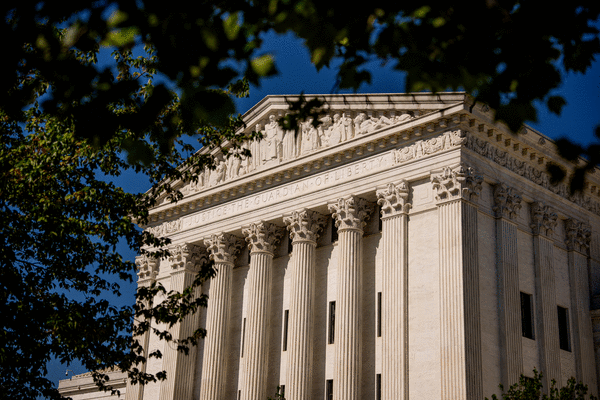
WASHINGTON — The Supreme Court agreed Monday to hear a Trump administration appeal and decide if "criminal aliens" may be held indefinitely while they fight deportation.
The case to be heard in the fall could give the administration more power to arrest and hold immigrants, including green card holders, who have criminal records.
The government's lawyers say immigration laws call for deporting noncitizens with "aggravated felonies" on their records. And in such cases, they say these people may be held for months or even years while their claims are before the immigration courts.
Judges have been split on whether noncitizens fighting deportation have a right to a bond hearing and a chance to go free if they pose no risk to public safety.
The 2nd Circuit Court of Appeals in New York ruled for a pair of green card holders who faced deportation to the Dominican Republic and Jamaica. Both had been convicted of assaults that were characterized as aggravated felonies under the immigration laws.
However, the appeals court said their "prolonged detention" was unconstitutional if they were given no bond hearing and no chance to go free.
They were represented by the American Civil Liberties Union, whose lawyers urged the court to turn down the appeal.
"For the first time in this litigation, the government argues that civil detention 'does not implicate any fundamental rights' and so the Due Process Clause affords the detained men no protections—substantive or procedural," they wrote.
In the past, they said the Supreme Court had accepted the "bedrock principle" that detained persons may have a right to seek their release on bond.
One of the two men had left this country and returned to Jamaica, the ACLU lawyers said. But Solicitor General D. John Sauer urged the court to rule on the issue.
The detained men "have no procedural due-process right to a bond hearing on whether they are a flight risk or danger to the community," he told the court. "Individualized findings about flight risk and danger are irrelevant" under the immigration laws which called for "mandatory detention based on their aggravated-felony convictions alone."
_____
©2026 Los Angeles Times. Visit latimes.com. Distributed by Tribune Content Agency, LLC.





















































Comments