Commentary: Outrage over Justice Alito's Son distracts from real scandals
Published in Political News
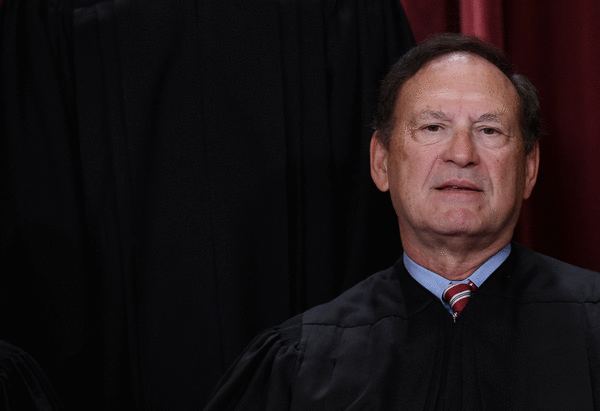
Supreme Court Justice Samuel Alito cannot participate in any cases involving the Treasury Department because his son Phil works as an attorney there. Justice Amy Coney Barrett has two adopted children from Haiti, so she should be disqualified from hearing an ongoing case involving Temporary Protected Status for Haitians. Chief Justice John Roberts must disqualify himself from cases argued by attorneys from the firms where wife Jane, a legal recruiter, has made placements.
Each of these assertions is wrong as a matter of common sense — and of law. Nevertheless, critics are inventing or overstating scandals, often against the justices whose decisions they oppose, as the public becomes increasingly frustrated with the results of many high-profile cases. But spotlighting tenuous or unfounded allegations makes meaningful reform that much harder to achieve. If everything’s an outrage, then nothing is.
Phil Alito had for some months been working as an attorney-adviser in the Treasury when NOTUS broke the news on May 28. That time overlapped with the Supreme Court’s consideration of a major Treasury-involved case on tariffs, where in the end, a majority of justices (though not Alito) held that President Donald Trump overstepped his authority when he imposed the levies on dozens of countries.
Indignation that Alito had not recused himself ensued, but he didn’t need to under the court’s legal and ethical framework: A Supreme Court spokesperson confirmed his son had not worked on anything tariff-related.
If a case where Phil had direct involvement ever did reach his father’s desk, I’m confident Alito would recuse. Why? Because he’s done it in the past. When Phil was working as an aide on the Senate's Permanent Subcommittee on Investigations in 2016, one of its subpoenas was challenged all the way to the Supreme Court. As Alito’s colleagues dismissed the challenge, a court order stated that the justice “took no part” in considering it.
And — despite some hand-wringing online — no reasonable person would expect Barrett’s personal experience with Haitian adoption to impair her ability to review cases on the immigration status of Haitians or the Department of Homeland Security’s authority in that realm. Such a standard is as weak as suggesting Justice Sonia Sotomayor, who frequently visits family and friends in Puerto Rico, has a permanent bias in all cases stemming from disputes on that island.
Then, there’s the story of Chief Justice Roberts’ wife Jane, who gave up her career as a law partner 20 years ago and went into legal recruiting, specifically to mitigate potential conflicts for her husband. Having the last name “Roberts” in legal circles might raise an eyebrow, of course. But placing a limited number of attorneys at firms employing thousands — which also have a mixed record of success before the court — does not meet the threshold for mandatory disqualification each time those firms represent clients before the justices.
Federal law states that justices must disqualify themselves “in any proceeding in which his [or her] impartiality might reasonably be questioned.” The Supreme Court in 1988 interpreted that to mean a violation occurs when an objective person, aware of the relevant circumstances, doubts a justice can remain impartial. That standard means someone accusing a justice of an ethics violation must do more homework and less speculating. (Again, there’s no reason to believe the younger Alito was involved in the tariffs case, but my homework was filing an open records request with Treasury to see if there’s any more to learn.)
Several other supposed ethics scandals in recent years have been even less credible. You may recall “Venmogate,” in which Justice Clarence Thomas’ former clerks paid one of his aides to help organize a holiday party — far from immoral. In 2017, Justice Neil Gorsuch sold his partially owned Colorado vacation home to the CEO of elite law firm Greenberg Traurig, but the idea that this was some kind of bribe made zero sense. The CEO does not work on Supreme Court cases, and the firm has more than 3,000 attorneys across 50 offices and represents groups on both the left and the right. Back to Alito, his wife inheriting mineral rights after her father’s 2012 death hardly means the justice’s integrity is compromised in all cases involving oil and gas companies.
Will Alito’s votes more likely reflect the wishes of fossil fuel companies than, say, those of Sotomayor’s? Yes. But they were always likely to. That doesn’t make him biased. It makes him politically conservative, which under the Constitution disqualifies him from absolutely nothing.
If progressives don’t want Alito to hear cases involving the Treasury Department, or energy or climate cases for that matter, they should spend their time not on pithy posts or baseless demands for recusal but on convincing Congress to pass laws that strip the court’s jurisdiction to hear challenges on those issues. That’s allowed under federal law, the Constitution and even Supreme Court precedent.
Congress should also tackle the real ethics issues, starting with prohibiting justices’ acceptance of gifts — like tuition for a grand-nephew or a major discount on a luxury motor home to name a few of Justice Thomas’ infamous perks. Lawmakers can create a third branch inspector general’s office to review justices’ compliance with ethics rules.
The public’s lack of faith in the Supreme Court is understandable. But it’s essential to distinguish between philosophical disagreements and genuine ethical misconduct. Persistent focus on the employment of justices’ family members or their non-germane life experiences only serves to distract from the necessary work of reform.
____
This column reflects the personal views of the author and does not necessarily reflect the opinion of the editorial board or Bloomberg LP and its owners.
Gabe Roth is the founder and executive director of Fix the Court, a nonprofit group that advocates for reforms of the federal court system.
©2026 Bloomberg L.P. Visit bloomberg.com/opinion. Distributed by Tribune Content Agency, LLC.
















































Comments