Editorial: Why the Supreme Court's Voting Rights Act ruling matters
Published in Political News
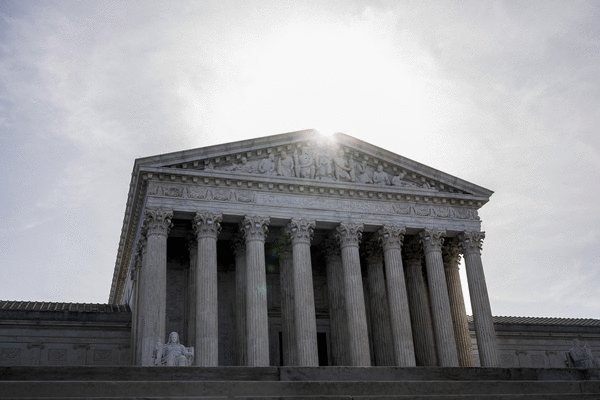
The Supreme Court, in a 6-3 decision, has struck down Louisiana’s newly created majority-Black congressional district, narrowing the scope of Section 2 of the Voting Rights Act of 1965. The ruling is consequential not only for Louisiana but for how the nation understands representation, race and the future of redistricting.
At its core, Section 2 was designed to ensure that minority voters have an equal opportunity to elect candidates of their choice. For decades, courts have interpreted that mandate to require the creation of majority-minority districts in certain circumstances, particularly where voting patterns are racially polarized. The court’s ruling signals a shift, one that places tighter limits on when and how race can be considered in drawing congressional lines.
The majority’s reasoning reflects a growing skepticism of race-conscious remedies. It emphasizes that redistricting must prioritize traditional districting principles: compactness, contiguity and respect for political subdivisions over explicit racial targets. In doing so, the court suggests that the Constitution does not permit race to be the predominant factor, even in the service of remedying past discrimination, unless strict conditions are met.
The dissent, however, warns of the real-world consequences. Without the ability to draw districts that reflect cohesive minority communities, it argues, minority voters may find their influence diluted, spread thin across multiple districts where their voices carry less weight. This tension between colorblind principles and the realities of racial voting patterns is not new, but the court has now clearly tilted the balance.
For Maryland and other states, the implications are immediate. Legislatures and mapmakers will need to reassess how they approach redistricting. The legal threshold for creating majority-minority districts is now higher, and the risk of litigation on both sides has increased. Some districts across the country may be challenged, redrawn or eliminated altogether.
The political impact is equally significant. Congressional representation could shift in subtle but meaningful ways, particularly in states where minority populations are geographically concentrated but politically fragmented. The decision may also intensify debates over fairness in representation, as communities question whether maps reflect voters or whether voters are being reshaped to fit maps.
This moment calls for moral clarity. The principle that every citizen’s vote carries equal weight remains foundational. But equality in theory does not always produce fairness in practice. The challenge ahead is to reconcile those truths to ensure that redistricting neither entrenches racial divisions nor ignores the lived realities of communities whose political voice has historically been marginalized.
The court has spoken. Now the responsibility shifts to lawmakers, advocates and citizens to navigate what comes next, carefully, lawfully and with a commitment to both justice and democratic integrity.
_____
©2026 The Baltimore Sun. Visit at baltimoresun.com. Distributed by Tribune Content Agency, LLC.





















































Comments