Lutnick urges boost for trade enforcement at BIS
Published in Political News
WASHINGTON — The Commerce Department says it needs additional funds in fiscal 2027 to enforce export controls and prevent the diversion of semiconductors to China and other foreign adversaries.
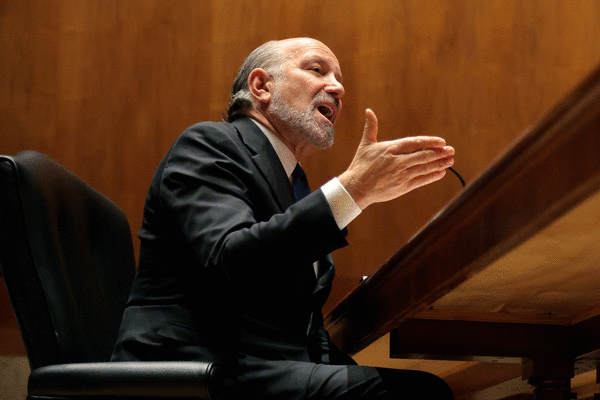
Testifying Thursday before the House Commerce-Justice-Science Appropriations Subcommittee, Commerce Secretary Howard Lutnick said investment in new law enforcement agents at the Bureau of Industry and Security would pay for itself through increased export enforcement fines.
His testimony comes one day after the House Foreign Affairs Committee advanced a slate of bills related to export controls, including for advanced chips.
In its fiscal 2027 budget proposal for BIS, the Commerce Department asked for funding to add 290 export enforcement agents and 23 support specialists for export enforcement. That ask comes with a nearly $152 million price tag.
Lutnick told the committee that “BIS is the frontline and our key defense from China trying to get our best chips and our best technology” and that agents not only “stop these companies, but then we fine these companies and make way, way more revenue for the United States of America.”
“These agents are massively economically and intellectually important to the United States,” he said.
Artificial intelligence chips, such as those made by Nvidia, have been the subject of much back-and-forth between industry, the Trump administration and Congress.
Nvidia CEO Jensen Huang is a close ally of the administration, which has opened the door for the export of some advanced chips to China, though not Nvidia’s most advanced model.
Lutnick told the Senate Commerce-Justice-Science Appropriations Subcommittee on Wednesday that none of the company’s H200 chips have yet been sold to China.
On Thursday, Lutnick emphasized BIS’s goal to prevent adversary nations from acquiring the highest level chips and said the Trump administration “continuously” discusses “each and every product.”
Broadband funds
Lutnick did not commit to a timeline for guidance from the department’s National Telecommunications and Information Administration on how states can use the remaining $21 billion in non-deployment funding under the Broadband Equity, Access and Deployment grant program.
The guidance was originally expected in March but has not yet been released.
The funding is part of the Trump administration’s ongoing changes to the grant program. Last year, NTIA required a new round of proposals based on new guidance that removed a previous preference for fiber-optic cable broadband.
Lutnick and others in the administration have touted the results as saving taxpayers money, though critics say the change favored satellite internet like that provided by Trump ally Elon Musk’s Starlink and could result in worse quality of service with higher long-term costs.
Subcommittee Chairman Harold Rogers, R-Ky., asked Lutnick about guidance for Kentucky’s $700 million in remaining funds.
Lutnick called leftover funds a “high-class problem” and pointed to listening sessions NTIA held to hear from stakeholders about potential uses for the funds.
Lutnick said NTIA is still “sorting through” comments from the listening session and “we’re going to come out with a plan … to go out and now do new and exciting things with that money in the model of the statute that you’ve given us.”
Rep. Andrew Clyde, R-Ga., commended the administration for the updated program and said the funds left over after deployment “should be able to go back to the Treasury or simply be unspent.”
The statute that created the BEAD program lists some uses including mapping, adoption and affordability programs, as well as a catchall for “any use determined necessary” by NTIA to support the program.
©2026 CQ-Roll Call, Inc., All Rights Reserved. Visit cqrollcall.com. Distributed by Tribune Content Agency, LLC.




















































Comments