Gov. Newsom blasts Trump's climate rollback: 'reckless decision' will cost lives
Published in Political News
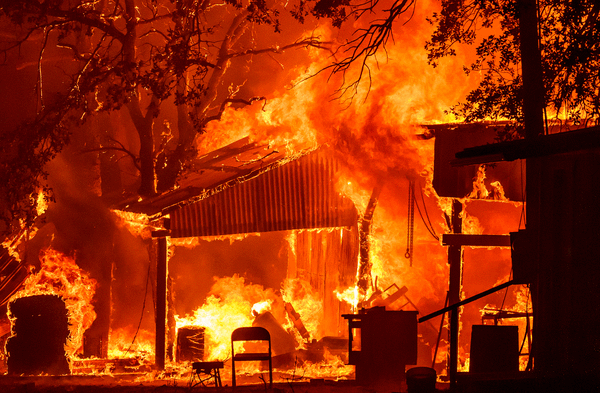
California Gov. Gavin Newsom blasted the Trump administration on Monday over its decision to repeal the Endangerment Finding — widely considered the legal foundation for much of U.S. climate policy regulating greenhouse gas emissions for nearly 20 years — asserting that the move will worsen climate-driven extremes.
The criticism came two months after the administration moved to eliminate the legal framework and on the day the decision was set to take effect.
“Today, as we’re near Earth Day, we are reminded that the Trump administration is taking America down a dangerous path — ignoring science, embracing climate pollution, and breaking the law,” Anthony Martinez, a spokesperson for the governor said in an email.
“If this reckless decision survives legal challenge, it will mean more deadly wildfires, more extreme heat deaths, and more climate-driven floods and droughts — all while Trump’s political appointees, many of whom were handpicked by the oil and gas industry, dismiss the overwhelming science that has protected public health for decades.”
Rescinding the Endangerment Finding opens the door to broad deregulation. Legal experts, including those at Venable LLP, have said the move could create a period of uncertainty around compliance with federal climate rules, even as existing state-level regulations remain in effect while courts consider legal challenges to the repeal.
In 2009, following Massachusetts v. Environmental Protection Agency, which led the Supreme Court to require the EPA to determine whether greenhouse gases from vehicles qualify as air pollutants, the agency concluded in what became known as the Endangerment Finding that six key greenhouse gases, including carbon dioxide and methane, harm public health and the welfare.
When the Trump administration, which has long embraced a “drill, baby, drill” approach and consistently backed fossil fuel development, decided to repeal that legal basis in February, states including California quickly responded with a joint lawsuit in March seeking to block the move.
While one extreme event is difficult to link directly to climate change, more frequent and intense extreme weather patterns fall within the scientific consensus on changing climate trends. Recent examples include Hurricane Helene in North Carolina in 2024, the snowstorm in Texas in 2021, and prolonged droughts in California in 2021 and 2022, which were followed by a dramatic whiplash to flooding conditions in 2023.
“We could expect to see the kind of climate change impact we’ve already seen in California and in the Sacramento region, intensifying some of those effects that are already familiar to many residents,” said Frances Moore, an associate professor of environmental science and policy at the University of California, Davis, in September, warning against the repeal.
_____
©2026 The Sacramento Bee. Visit sacbee.com. Distributed by Tribune Content Agency, LLC.

















































Comments