Supreme Court to hear arguments on agency authority over violations
Published in Political News
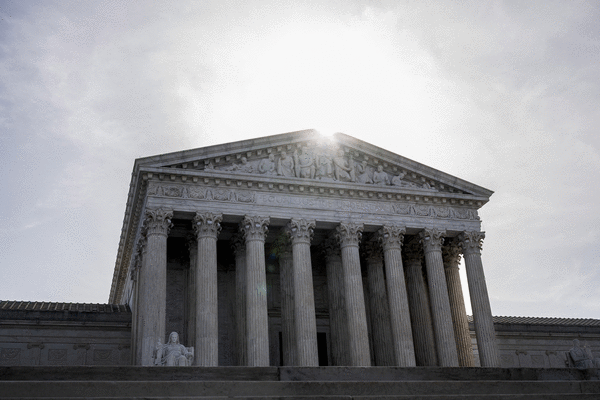
WASHINGTON — The Supreme Court is set to hear oral arguments Tuesday in a case that could shrink Congress’ power to let agencies internally decide legal and regulatory violations, as two telecommunications giants challenge the Federal Communications Commission’s power to impose forfeitures.
AT&T and Verizon have contested determinations by the FCC that they violated consumer privacy rules and owed $57 million and $47 million, respectively. They argued that the FCC process, which Congress created in 1960, violated the constitutional right to a jury trial.
The parties in the case and legal experts said a decision in favor of the companies could wipe out the processes dozens of agencies use to adjudicate legal violations.
Daniel Lyons, a nonresident fellow at the American Enterprise Institute and law professor at Boston College, said the case, combined with other recent Supreme Court rulings restricting federal agencies, could result in a shift from internal agency judges to more time-consuming, costly cases in federal courts.
“In the short run, the policy impacts of this will be really significant. Agencies will wind up doing a lot less than we as a society expected them to do over the last 20-30 years,” Lyons said.
Under current law, the FCC issues determinations about potential violations of law and regulations. Companies can either challenge those findings at a federal appeals court or seek a jury trial by waiting until the Justice Department files a lawsuit to collect the funds.
Congress first gave the FCC forfeiture authority in 1960 against the broadcasters and telecommunications companies the agency supervises, according to court documents.
In 2024 the FCC issued forfeiture notices for alleged violations of data privacy rules to AT&T, Verizon and others for incidents where third parties could gain access to users’ location data from aggregator companies who had contracts with the carriers. The companies then challenged the notices in federal appeals courts, rather than waiting for a DOJ suit to collect the money.
The U.S. Court of Appeals for the 5th Circuit threw out the FCC forfeiture against AT&T, finding the law violated the company’s 7th Amendment right to a jury trial. The U.S. Court of Appeals for the 2nd Circuit ruled the other way in Verizon’s challenge, upholding the proceedings against the company.
The companies argue in court filings the Constitution doesn’t allow Congress, or federal agencies, to set up a process where a company can face legal liability without going through a jury trial first. The FCC finding brought negative press coverage and reputational harm, and could be used against the company in other agency proceedings, the companies argued at the court.
“Congress empowered the earliest administrative agencies to investigate and make tentative recommendations when hearing private disputes, not to issue binding judgments with the force of federal law,” the companies argued in a combined brief at the Supreme Court.
The Trump administration has defended the FCC process at the Supreme Court, arguing that the FCC’s process isn’t binding, but a notice to a company that they may, in the future, face legal liability. Just a finding of wrongdoing alone doesn’t impose an obligation for a company to pay, the administration said in a brief.
“Congress went beyond the constitutional minimum by directing the Commission to issue a notice of apparent liability and provide an opportunity to respond in writing,” the brief said.
Thomas Berry, director of the Robert A. Levy Center for Constitutional Studies at the Cato Institute, said at a Federalist Society press event last week that may not pass muster with the justices.
Berry, whose group filed an amicus brief on the side of the companies, pointed out that the FCC’s findings can be used as evidence against the companies in other proceedings.
“My prediction is that the Supreme Court is going to be skeptical that you can get around the 7th amendment with that argument,” Berry said.
Lyons said the case could expand a Supreme Court case from two years ago, known as SEC v. Jarkesy, which found the Securities and Exchange Commission could not use internal administrative judges to seek civil penalties for securities law violations. Congress could not give the agency the authority to seek money damages without providing for jury trials, the court said in that decision.
Dozens of agencies have some form of internal adjudication, Lyons said, and the Supreme Court’s decision in Jarkesy disrupted proceedings at agencies including the IRS and the FCC. Lyons said that a ruling further restricting agencies could reverberate across the government.
Lyons also said that to comply with a ruling that expands Jarkesy, Congress would have to create “a lot fewer independent agencies and a lot more enforcement agencies.”
That would mean agencies set up to create rules then enforce them in federal courts, he said, rather than the structures Congress created in recent decades with internal courts and administrative law judges.
Lyons said that could set the foundation for a healthier government overall over the long term, if Congress steps up to legislate more and provide resources to agencies and courts to deal with the change.
“If it means less justice overall, where agencies can’t do their job and Congress doesn’t step in, that’s a bad thing,” Lyons said.
Several outside groups, including former FCC commissioners, defended the agency process in a brief in the case, arguing Congress should have leeway in deciding how and when to set up a jury trial.
“Per Congress’s intentional design, the FCC’s enforcement procedures allow the FCC to build a record prior to de novo enforcement in the district court. Indeed, Congress accounted for the right of regulated entities to contest the penalty through litigation when it drafted the forfeiture procedures,” the former officials said.
The cases are Verizon Communications Inc. v. Federal Communications Commission and Federal Communications Commission v. AT&T.
©2026 CQ-Roll Call, Inc., All Rights Reserved. Visit cqrollcall.com. Distributed by Tribune Content Agency, LLC.















































Comments