Editorial: A welcome ceasefire in Iran, but what next?
Published in Political News
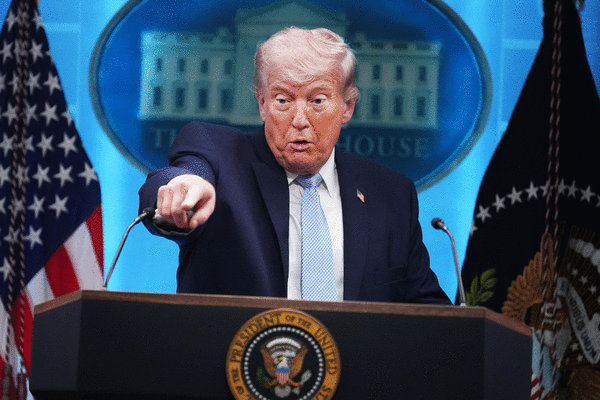
Given the charged and, at times, apocalyptic rhetoric coming from the White House in recent days — particularly President Donald Trump’s warning that a “whole civilization will die tonight” — absent a deal, the newly announced two-week ceasefire between the United States and Iran is a welcome development.
But it is only a pause. The central question remains: What will it take to achieve a durable peace?
A measure of realism must guide what comes next. U.S. leadership should recognize the limits of unilateral military action against one of the world’s oldest civilizations, deeply rooted, culturally distinct and historically resilient. Calls for “unconditional surrender,” “regime change” or even the framing of a “fragile peace,” as articulated by Vice President JD Vance, risk oversimplifying a far more complex reality.
The focus should instead turn to practical pathways for de-escalation: restoring stability in the Strait of Hormuz, ensuring the safe flow of global energy supplies and pursuing agreements grounded in mutual, if uneasy, interests.
Domestically, both political parties face their own constraints. Republicans must contend with polling that suggests the conflict was unpopular from the outset, while Democrats risk overreach if criticism of the administration is perceived as aligning with Iran, a country viewed unfavorably by many Americans across the political spectrum.
Meanwhile, the costs of this conflict extend well beyond the estimated $45 billion already incurred. Strategic alliances have been strained, including those within NATO. The long-term implications of weakened alliances, particularly in deterring broader geopolitical threats, could far exceed the immediate financial toll.
What matters now is not assigning blame but shaping what comes next. Decisions must be guided not by domestic political pressures or rhetorical positioning, but by clear-eyed assessments of national interest, allied stability and global security.
That may require broader international participation, particularly from European nations with direct stakes in Gulf energy flows. It may even demand unconventional approaches, including limited cooperation between long-standing adversaries, to stabilize critical infrastructure and shipping lanes.
There is an old adage: The perfect should not be the enemy of the good. In this conflict, perfection has never been on the table. Even “good” may require difficult, imperfect and unconventional compromises.
If this ceasefire is to matter, it must be more than a pause. It must mark the beginning of a disciplined and realistic pursuit of peace.
_____
©2026 The Baltimore Sun. Visit at baltimoresun.com. Distributed by Tribune Content Agency, LLC.





















































Comments