Hill added $34 billion in unrequested defense program funds
Published in Political News
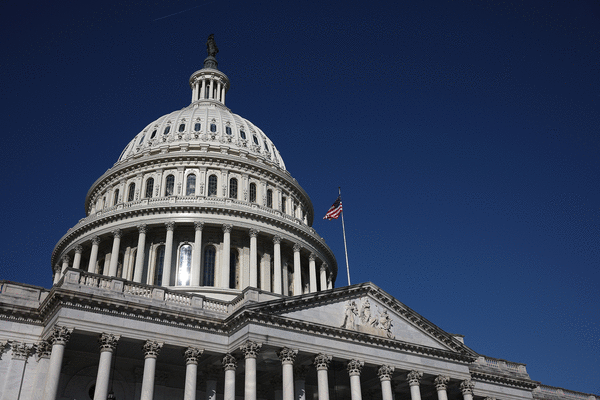
Congress added nearly $34 billion above the president’s fiscal 2026 defense request for more than 1,000 research and procurement programs favored by lawmakers but not necessarily by the military, according to a new report.
The $33.97 billion in a fiscal 2026 omnibus spending law is a dramatic surge in appropriations for what are known as program increases in the defense budget, according to the report and database, which are due out Thursday from Taxpayers for Common Sense, a nonpartisan group that monitors federal spending.
By comparison, the fiscal 2024 and 2025 totals for such programs were lower — at $21 billion and $14.95 billion, respectively.
Congress has a duty to shape, not just rubber stamp, budget requests. But the cost of the additions is mounting each year, while no audits have assessed how many of them have yielded useful weapons. Moreover, the process of choosing the projects is inscrutable to the press and public, while the names of the projects’ proponents are mostly undeclared. And the spending regularly goes to entities that have bankrolled congressional campaigns, raising ethical questions, critics say.
The chairs and ranking members of the House and Senate Defense Appropriations subcommittees did not, with one exception, immediately respond to requests to comment on the issue as a whole or on whether they would support publishing the names of the funding infusions’ congressional sponsors or back auditing the programs.
A spokesman for the Senate’s Defense panel chairman, Sen. Mitch McConnell, R-Ky., pointed out the fiscal 2026 omnibus and previous laws state that funding increases must be competitively awarded unless competitions occurred in prior years.
But critics have questioned the extent to which that in fact occurs.
McConnell, like some other members, has openly publicized his success at adding funds for unrequested projects. For fiscal 2026, these included roughly $1 billion the Army did not request to turn the Blue Grass Army Depot in Kentucky, whose previous missions have shrunk, into a factory for manufacturing propellants for munitions.
More than $134 billion
Most of the program increases listed in the omnibus’s Defense joint explanatory statement are not by themselves that expensive in the context of the nearly $839 billion Defense portion of that bill.
The vast majority of the funding items in fiscal 2026 cost $15 million or less, according to the new report, which was shared exclusively with CQ Roll Call.
But with roughly 1,000 such increases each year, even relatively modest funding boosts add up to substantial sums.
The funding surge in recent years has attracted little attention, perhaps because it has become the norm, albeit an increasingly expensive one.
In fact, the $34 billion in fiscal 2026 defense program increases cost more than the fiscal 2026 budgets for the Department of Agriculture or Treasury or Labor.
The topline of the Defense spending bill was $8.4 billion above the request, so appropriators covered most of the cost of their unrequested program additions by finding subtractions to other requested programs, including readiness accounts.
The total in defense program increases since fiscal 2022 comes to more than $134 billion, the taxpayers group has found.
“That’s a huge amount of money going out the door with virtually no transparency or public debate,” said Gabe Murphy, policy analyst with the taxpayers group.
‘De facto earmarks’
Program increases are distinct from so-called Congressionally Directed Spending in the Senate and Community Project Funding in the House, which are the formal earmarks that are not competitively awarded but are instead directed toward designated nonprofit organizations or local governments.
The congressional sponsors of formal earmarks are listed in tables in committee reports. Not so with program increases, which the taxpayers group calls “de facto earmarks.”
The $34 billion in program increases in the latest Defense spending bill is more than double the cost of formal earmarks in all the nondefense fiscal 2026 spending bills combined, the new report said.
The $34 billion total includes funding that members added above the requested amount for a program — or, more commonly, funding for a program the Defense Department’s top leaders never sought at all, even if far-flung military labs sometimes may have pushed for them.
The spending increases are also, for the most part, not slated for systems that U.S. generals and admirals sought in their “unfunded priorities lists” of items that are important but did not make the president’s request. Nearly 90 percent of the additions were not responses to something on one of these so-called wish lists.
Congressionally directed spending has produced success stories, including combat drone programs, the first of which, the Predator, was launched via an earmark, not in response to a Pentagon budget request.
But it is not clear today to what degree the unrequested program increases are leading to useful weapons.
That is partly because of the opacity of the process, critics say. The funds are inserted by lawmakers — mostly anonymously — with virtually no public debate.
“The solution is basic transparency,” Murphy said. “Lawmakers should welcome the opportunity to justify their proposals and identify themselves as sponsors, unless of course they have something to hide.”
Competition
The program increases, unlike formal earmarks, must be competitively awarded. But in practice this does not always happen for several reasons.
In some cases, the recipient is merely chosen by the Appropriations Committee — or the House or Senate in the case of a floor amendment — and the recipient institution, such as a lab or university, then may or may not parcel out the funds via a competitive process.
The Competition in Contracting Act (PL 98-369) allows some exceptions to competition, as when there is only one company that can successfully perform the requirement or the cost of the competition is not justifiable as a share of the funding.
Sometimes Congress’ intended recipient of a program increase is made clear before or after enactment of a spending bill via communications with Appropriations Committees, even though the recipient’s name is rarely stated in the bill or report, insiders have said.
In this instance, a competition may be held after the funds are enacted to decide how to allocate the funds, but only one company might compete. The wording of many of the funding lines suggests they are referring to a proprietary technology with only one manufacturer.
Even though the sponsors of program increases are not listed in committee reports and generally are never disclosed, unlike the practice for formal earmarks, some lawmakers issue press releases touting appropriations “wins” for their constituents.
On occasion, these releases name the recipient in their state or district even before a competition has occurred.
Campaign cash
The defense program increases are inserted by members of both parties.
For example, in the fiscal 2026 bill, the Navy research appropriations table shows $9.6 million for “underwater electromagnetic theory and ocean hydrodynamics research” — money that was not in the Navy budget request and does not appear to be part of any list of unfunded priorities.
Neither the intended recipient nor the sponsor of the Navy funds is stated in the committee report.
But Rep. Debbie Wasserman Schultz of Florida, a senior Democratic appropriator, announced in a statement last month just after the omnibus cleared that she had “secured” over $1 billion in defense and nondefense appropriations, including “delivering” defense money for South Florida.
Included on the list was the Navy research program and a disclosure of where the money was going: “$9 million to support research at Nova Southeastern University for U.S. Navy testing into ocean hydrodynamics and maintaining coastal seabed stealth.”
The initiative received about $3.5 million in fiscal 2024 and nearly $5 million in fiscal 2025, exemplifying how a program once begun by Congress is often sustained.
The university contributed $7,388 to Wasserman Schultz’s campaign between 2019 and 2024, the taxpayer group’s report said.
The school also hired lobbyists from the Cormac Group in 2023 and 2024, and individuals associated with that group gave $8,750 to Wasserman Schultz’s campaign in the 2024 cycle.
“When we see companies and their lobbyists contributing to lawmakers who then secure program increases that benefit those companies, we know we have a problem,” said Murphy.
In a similar vein, the fiscal 2026 omnibus shows $10 million for the Army to conduct research on “rapid advanced deposition,” an additive manufacturing technology.
The Army did not request the funding in any public way.
Here too, the sponsor and intended recipient of the ostensibly competitive funds were not stated in the tables.
But Wasserman Schultz’s press statement points to her success in obtaining “$10 million to support Florida International University’s research into rapid advanced deposition.”
The program has been a regular recipient of unrequested additions. It was funded each year since at least fiscal 2022, amassing $55 million in that timeframe.
A spokesman for Wasserman Schultz did not immediately reply to a request for comment.
Quantum leap in funds
Likewise, the fiscal 2026 Defense spending measure contained $12.5 million in Air Force research funding for “quantum entanglement distribution,” with no further explanation.
The sponsor of that funding or where it is being required to be spent is only known because Rep. Elise Stefanik, R-N.Y. touted it in a press release last month. Her statement noted the money is going to the Griffiss Institute in Rome, NY., which describes itself as a “nonprofit talent and technology accelerator” for the Pentagon.
In this example, too, it was not the first time the program had netted funding not sought by the military. From fiscal years 2024 through 2026, the program appears to have gotten about $30 million.
In fiscal 2026, that quantum computing program was just part of a larger haul for Stefanik and her region.
The headline of last month’s press release was: “Stefanik Delivers More Than $541 Million in Defense Wins for Upstate NY, Secures $329 Million for Air Force Research Lab in Rome, NY.”
Stefanik’s spokesperson did not immediately reply to a request for comment.
©2026 CQ-Roll Call, Inc., All Rights Reserved. Visit cqrollcall.com. Distributed by Tribune Content Agency, LLC.




















































Comments