Lisa Jarvis: The White House can't hype away healthcare sticker shock
Published in Op Eds
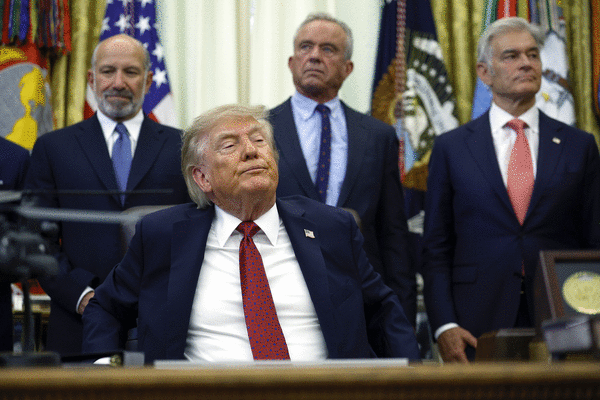
Any genuine efforts to lower high U.S. prescription drug prices should be embraced. But President Donald Trump’s latest deal with drug manufacturers to lower those prices, announced Monday, falls far short of the “real relief” from ballooning healthcare costs he has promised.
The broader and harsher reality is that U.S. healthcare costs are poised to rise next year at the steepest rate in more than a decade — and the president’s own policies will keep costs increasing for years to come.
The nine new drug pricing deals signed this week with midsized pharma companies, including Astellas Pharma, UCB, and CSL Ltd., appear to follow a similar formula to the 17 earlier pacts forged with big pharma. Companies are spared tariff pain if they offer their medicines to Medicaid at the same cost paid by peer countries (also known as a “most favored nation” approach), sell some products at a discount on the direct-to-consumer website TrumpRx, and invest in homegrown research and manufacturing.
The president recently credited that strategy for a 3.1% year-over-year decline in prescription drug prices. It was the biggest drop in average prices since the 1960s — and a welcome reversal after years of steadily rising costs.
But assessing whether Trump’s deals deserve credit is made difficult by the fact that no one — including Congress, whom Trump again this week called on to codify the pacts — seems to know their precise terms.
And there’s plenty of reason to wonder about their heft. Medicaid, for example, has always enjoyed the steepest discounts on most medicines. That raises questions about the size of the savings that could be captured through Trump’s “most favored nation” strategy.
Moreover, the opaque nature of Trump’s deals makes it nearly impossible to measure their impact as new drugs are launched. Nobody can say if prices will be meaningfully lower in the U.S., or if companies will simply find workarounds. (Two obvious ones would be to charge more abroad, thus resetting the floor for negotiations, or to delay a drug’s launch in peer countries until these short-term pacts expire.)
So credit for that drop in drug prices more likely goes to forces that predate Trump’s second term. For example, the recent arrival of generic competition for several top-selling medicines has helped drive prices down, as has the implementation of a Biden-era policy that allowed Medicare to finally negotiate drug prices.
But even if Trump could take credit for the recent decline in drug prices, there’s a bigger issue: drug prices are just a small share of overall healthcare costs. Americans are paying more and more — and getting less and less — for healthcare coverage overall.
The cost of healthcare is expected to surge by roughly 10% in 2027 — the highest increase, by far, in over a decade.
Most Americans get their health plans through their employer — and employers are feeling increasingly squeezed. Although companies typically absorb around 80% of that increase, employees will still find themselves taking on more next year. (Bloomberg is one of many companies making changes to employee cost-sharing.)
Many paychecks will feel lighter due to higher monthly insurance premiums, and people might find themselves on the hook for more when they go to the doctor. Consumers also could pay more at their local pharmacy, especially for expensive specialty medications, and discover their plans no longer cover certain drugs.
All of that undercuts the president’s framing of his latest deals, which he called in Monday’s press conference “the biggest thing to happen in medicine.”
Left unsaid: the Trump administration has pushed through other policies that are likely to further raise costs for everyone. Last fall, Republicans declined to extend Biden-era subsidies that had made Affordable Care Act insurance more affordable, a move that has already led to a rise in uninsured Americans. And Trump’s signature tax bill included massive cuts to Medicaid, which, when implemented at the end of this year, are expected to add millions more to those ranks.
As a consequence, hospitals and doctors anticipate a surge in uncompensated care, a cost that gets passed on to privately insured consumers in the form of higher healthcare prices. That, in turn, will lead to higher insurance premiums. And so the spiraling costs will continue.
Americans shouldn’t be fooled by Trump’s grandstanding over prescription drug deals. Getting real relief for our healthcare affordability woes is a gargantuan challenge that involves reforming many different parts of the system. There’s no magic pill — at any price — that can do that.
____
This column reflects the personal views of the author and does not necessarily reflect the opinion of the editorial board or Bloomberg LP and its owners.
Lisa Jarvis is a Bloomberg Opinion columnist covering biotech, health care and the pharmaceutical industry. Previously, she was executive editor of Chemical & Engineering News.
©2026 Bloomberg L.P. Visit bloomberg.com/opinion. Distributed by Tribune Content Agency, LLC.




































Comments