Noah Feldman: The Supreme Court doesn't care about voting anymore
Published in Op Eds
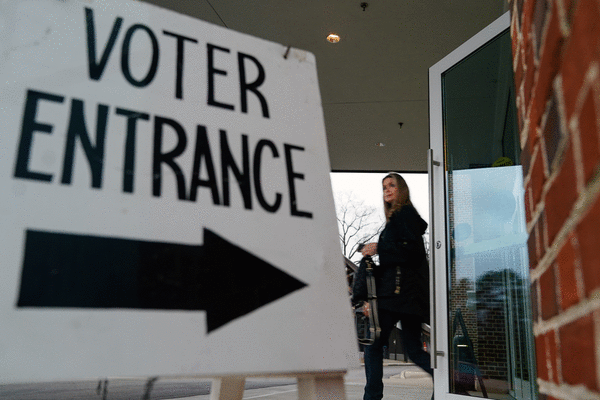
The Supreme Court’s decision this week to allow Alabama to use a congressional map that the lower courts had twice overturned as racially discriminatory marks an important stage in the evolution of the court as an institution — and of the U.S. as a democracy. The ruling sends all Americans, as voters and citizens, a clear message: When it comes to ensuring fair elections, we’re on our own.
For more than 60 years, since its landmark one-person-one vote ruling in 1964 and the passage of the Voting Rights Act in 1965, the court has played a central role in policing the legitimacy of elections. Now the court has effectively abandoned that job. This meaningfully changes the court’s function in America’s constitutional democracy.
As recently as 2021, testifying before the Presidential Commission on Supreme Court Reform, I was able to say confidently that the modern court had three major responsibilities: protecting the rule of law, ensuring fundamental rights to liberty and equality, and overseeing the democratic process.
The first of these is arguably inherent in the existence of the Supreme Court itself. It was formally declared by Chief Justice John Marshall in 1803 in the famous case of Marbury v. Madison. As he put it, “It is emphatically the province and duty of the Judicial Department to say what the law is.” By saying what the law is and applying it to real-world cases, the Supreme Court safeguards the rule of law.
As for guaranteeing fundamental rights, the Bill of Rights points the way. Ever since the ratification of the 14th Amendment in the wake of the Civil War, the justices have played the role of reviewing not only federal but also state laws for conformity with the Constitution.
The court’s record as a rights enforcer can certainly be subject to harsh criticism. Its earliest forays used the 14th Amendment’s protection against the taking of “life, liberty, or property” without due process to strike down wage, hour and working-conditions laws passed by progressive states. The court shamefully failed to enforce the equal protection clause in such cases as Plessy v. Ferguson, the separate but equal decision.
Yet the court also repudiated Plessy in the 1954 Brown v. Board of Education case. And in a long era of rights protection running from then through the 2015 decision legalizing gay marriage, the justices issued rulings protecting criminal defendants, vulnerable minorities, and anyone wanting to speak out under the First Amendment.
The court’s assumption of its supervisory role in the democratic process was the product of the civil-rights era. It began with the courts’ choice to insist on one person, one vote, a decision motivated by the 14th Amendment principle of equal protection of the laws and the 15th Amendment principle of the equal right to vote regardless of race. It was cemented, at least for a time, by Congress passing the Voting Rights Act of 1965, which added statutory authority to the constitutional authority the court had already assumed.
In retrospect, the court’s role as supervisor of democracy was necessitated by the fact that the U.S. lacks a nonpartisan national electoral commission of the sort used by many mature, stable democracies. (It would be great if we had one, but you tell me how our partisan system could produce such a nonpartisan institution.) On the whole, the court performed that function decently. Bush v. Gore (2001) was the most prominent example of a case in which the court exercised its authority in a way that looked partisan.
I volunteered as a litigator on the Democratic side in that case, and that is certainly how I and others of my political persuasion felt at the time. Even that controversial decision, however, could be justified after the fact on the grounds that there was a genuine uncertainty about who was going to be the president, and someone had to make the call. That someone was the Supreme Court.
To be clear, Bush v. Gore was an outrageous abdication of the court’s supervisory function — but from today’s vantage point, the decision looks almost like the product of a golden era. More than a decade later, under the leadership of Chief Justice John Roberts, the court gutted the Voting Rights Act in two rounds, once in 2013 and again last month. Along the way, the court washed its hands of the very power to address the constitutionality of partisan gerrymandering — which, with the help of technology, promises to reduce the number of competitive congressional districts in the U.S. to a dozen or fewer.
In the Alabama case, the court showed its willingness to allow the state to use electoral maps that weren’t even legally in place during the state’s own primaries. The new maps will be rolled out in a special primary in August. A special federal district court (in which two of the three judges were appointees of President Donald Trump) found the state’s map racially discriminatory even after the Supreme Court’s Louisiana v. Callais opinion from May. By a 6-3 vote, the justices blocked that ruling from taking effect.
The state, which means the state legislature, which means a partisan body, gets to draw the districts. This isn’t the fox guarding the henhouse. This is the fox getting to design and build the henhouse from scratch for maximum access.
The court’s abdication of its modern responsibility for supervising electoral democracy seems to rest on the naive belief that democracy will succeed in regulating itself. In an age when the sitting president and his appointees still refuse to acknowledge the legitimate outcome of the 2020 election, that belief isn’t just self-deluding, it’s self-destructive.
The Supreme Court’s conservative majority seems to have forgotten that the judiciary’s legitimacy depends on the structure of the democracy it serves. History will eventually teach the court that lesson. The process by which that happens, however, is unlikely to be an edifying one.
____
This column reflects the personal views of the author and does not necessarily reflect the opinion of the editorial board or Bloomberg LP and its owners.
Noah Feldman is a Bloomberg Opinion columnist. A professor of law at Harvard University, he is author, most recently, of “To Be a Jew Today: A New Guide to God, Israel, and the Jewish People."
©2026 Bloomberg L.P. Visit bloomberg.com/opinion. Distributed by Tribune Content Agency, LLC.









































Comments