Despite Minnesota Gov. Walz's order, Boundary Waters mine debate isn't over
Published in Science & Technology News
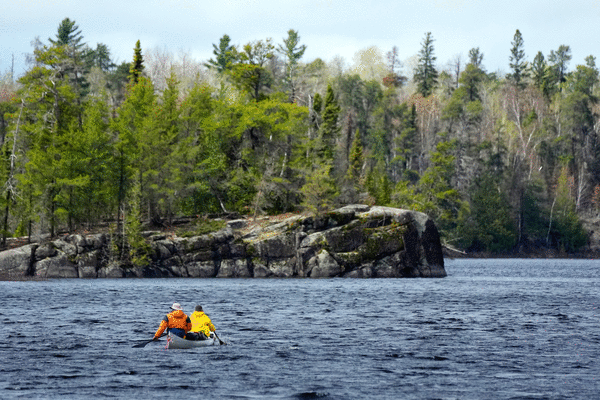
AFTON, Minn. — Gov. Tim Walz on Tuesday attempted to end the debate over whether to mine copper and nickel on the doorstep of the Boundary Waters Canoe Area Wilderness. A new executive order bars new leasing of state minerals there and throws up roadblocks for existing leaseholders.
“As far as my administration is concerned, the fight for the future of the Boundary Waters is over,” Walz said at an event on a land preserve in Afton. “The verdict is in, the decision’s been made, we will protect this place forever.”
The reality, though, is that “forever” might end on April 4, 2027.
That date is 90 days after Walz leaves office, the expiration date for any of his executive orders that are not extended by his successor. The state’s next governor will either be Republican state House Speaker Lisa Demuth or Democratic Sen. Amy Klobuchar.
Walz’s announcement is just the latest in the long face-off between mining proponents and conservationists over the Twin Metals mine, a proposal to extract copper, nickel and other metals underground in Lake County.
Local politicians and labor representatives in the region have long been supportive of the mine on the shores of Birch Lake, between Babbitt and Ely. Some taconite mines across the Iron Range are idled, and a modern mine excavating critical minerals could be a lifeline for families there, they say.
But environmentalists, Ojibwe tribes and outdoor enthusiasts fear the potential for acid mine drainage because the sulfide ores that contain copper and nickel are different from the iron ores that have long been mined in Minnesota. Handled incorrectly, sulfide ore and tailings could create sulfuric acid.
Walz was urged to act, he said Tuesday, because the latest blow in this yearslong dispute had added urgency to the issue. In April, Congress passed a reversal of a Biden-era mining ban in the watershed of the Boundary Waters; President Donald Trump signed the legislation.
Lawmakers used the Congressional Review Act to revoke the former mine ban, three years after it was enacted. That had never been done before and means a future president can’t reinstate the ban.
Walz called this move an “unprecedented power grab by the federal government.”
Long before this maneuver, different federal administrations have tossed the political football of Twin Metals back and forth.
The U.S. Forest Service declined to renew two leases for the project in 2016, at the end of President Barack Obama’s tenure. The agency also launched a study on the risks of mining in areas where water flows to the Boundary Waters and implemented a mining moratorium.
Two years later, officials in the first Trump administration renewed the leases, and then canceled the study. Requests from the Star Tribune and others for the study that had been compiled to that point were met with blacked-out pages.
Under President Joe Biden, the study was revived and, in 2022, the newest verdict was in: it was impossible to guarantee that a hardrock mine near the Boundary Waters wouldn’t pollute the wilderness, even with safety measures in place.
That conclusion led to the Biden administration’s decision to again cancel Twin Metals’ leases and put a 20-year mining ban in place. While the ban has been overturned, the leases are still in limbo in a pending federal lawsuit. Twin Metals filed suit over the issue in 2022.
The U.S. Department of Interior is expected to update the court on the status of the case in October.
Mine opponents have largely turned to the state to continue their fight against this mine. And it’s clear that Twin Metals, owned by the Chilean mining company Antofagasta, isn’t backing away from the project either.
In a statement, Twin Metals spokeswoman Kathy Graul pointed out that the Minnesota Department of Natural Resources concluded last year that the state’s existing water regulations were fit to handle a copper-nickel mine on the doorstep of the Boundary Waters.
“This morning’s executive order by the Walz administration directly contradicts these independent findings and unnecessarily hinders the responsible development of Minnesota’s natural resources,” Graul wrote in an email.
But that issue, like so many questions over this mine, is still being litigated in court.
_____
©2026 The Minnesota Star Tribune. Visit startribune.com. Distributed by Tribune Content Agency, LLC






Comments