Commentary: Major news outlets and Democrats are pretending weather isn't affected by climate
Published in Science & Technology News
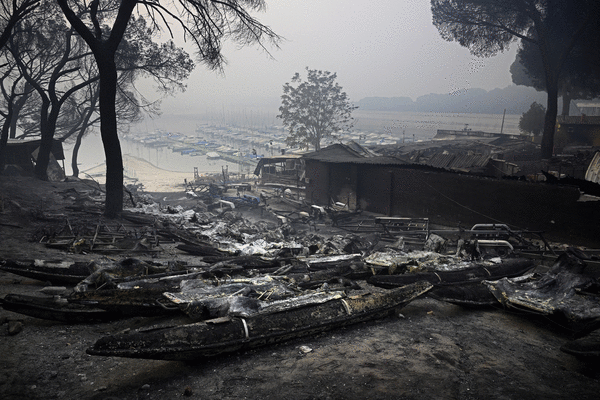
Along with ongoing coverage of the latest bombings and missile and drone attacks in Iran and the oil-rich Gulf states, extreme weather events are also providing lead segments on evening news programs this summer. What you don’t see in much of the TV coverage, at least not since the beginning of President Donald Trump’s second term as president, is any mention of climate change. Without that link, watching people like ABC’s David Muir on “the most watched newscast in America” ask network meteorologists to explain the conditions — but never the causes of their nightly footage of burning, flooding landscapes and traumatized people — is excruciating.
This self-limited reporting on the American networks — in sharp contrast with the BBC and other international TV news outlets, as well as some print and digital publications in the U.S. — also runs counter to an increasingly robust science that can now attribute to what degree climate change is driving individual extreme weather events including floods, droughts, fires and storms. Until very recently, many scientists said this was simply not possible — and climate change skeptics continue to emphasize the uncertainty of causation in specific disasters. But the accuracy of this “attribution science” is confirmed in a newly released report from the National Academies of Sciences, Engineering, and Medicine.
Instead of adding this information to their reporting, however, news outlets like CBS and the Washington Post (both owned by Trump supporters) have fired their climate reporting teams. Even National Public Radio, as part of its cutbacks, has gotten rid of its chief climate editor along with its climate team.
If fearfully reduced media coverage of an expanding crisis with warlike casualty figures isn’t bad enough, many establishment Democrats are now practicing “ climate hushing” in response to Trump’s pro-oil climate denial, playing down the disasters around us this summer to avoid a backlash in November’s midterm elections, on the logic that swing voters are more likely to be alienated by climate talk than won over.
The brutal early-summer heat dome over Europe led to a wave of excess deaths across 27 countries, according to European sources — estimated at 10,000 to 14,000 killed. A similar heat dome is now breaking records across the U.S. from Bismarck, North Dakota, (105 degrees) to Miles City, Montana (115 degrees). This as wildfire smoke from Canada and Minnesota blankets much of the nation. Such pollution is thought to contribute to nearly 16,000 deaths each year, according to a 2024 Yale study. Texas is experiencing its second summer of torrential rains and deadly flooding.
The West Coast is facing a marine heat wave similar to the one that began in 2013 and killed off 95% of Northern California’s kelp forests in a blow to the industries and cultures associated with them. At the same time, 85% of the world’s coral reefs continue to experience heat-related bleaching. The National Oceanic and Atmospheric Administration reports the ocean is the hottest it’s been since accurate measuring began in the 19th century. This is resulting in increased coastal disasters such as Super Typhoon Bavi, which hit Guam and another U.S. territory, the Northern Mariana Islands, on July 5 before killing dozens of people in the Philippines.
We’re losing a climate war that we should, by now, be winning. With technological advances, global market forces have shifted dramatically in favor of a rapid transition off fossil fuels to now cheaper, cleaner solar, wind and other carbon-free energy systems.
While all nations are hurt by the U.S.-Israeli war on Iran — and the blockade of oil tankers in the Strait of Hormuz — those like China and Spain that have already invested in the clean energy transition have suffered less from oil and gas interruptions. Meanwhile, the Trump administration has promised a French company a billion U.S. taxpayer dollars to cancel its offshore wind projects along the U.S. East Coast and pledge to invest instead in oil drilling (and spilling and global warming).
Coal and oil were great energy systems for the 16th and 19th centuries. But we know how to do better for less today. We don’t have to continue overheating our planet or leave deadly floods and choking wildfire smoke as this generation’s legacy. The only thing stopping us is politics. By defending democracy and using its tools, we the people can still win the climate war — even if today’s politicians and TV networks won’t admit it’s happening.
____
David Helvarg is the executive director of Blue Frontier, an ocean policy group, and co-host of “ Rising Tide: The Ocean Podcast.” He is the author of “ Forest of the Sea: The Remarkable Life and Imperiled Future of Kelp.”
©2026 Los Angeles Times. Visit at latimes.com. Distributed by Tribune Content Agency, LLC.






Comments