Twin Cities plays major role in plan to protect endangered rusty patched bumblebee
Published in Science & Technology News
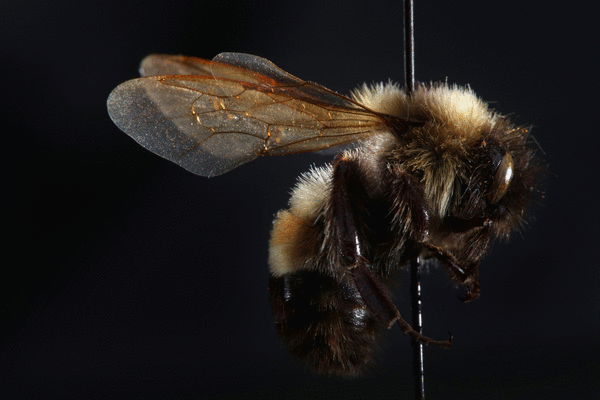
A long-awaited critical habitat plan for Minnesota’s fuzzy, chubby and endangered rusty patched bumblebee may be delayed for a few months longer.
The Trump administration has asked a federal judge for another extension in completing the court-ordered plan, which could provide an extra layer of protection for the nearly extinct bees in urban areas of the Upper Midwest.
The proposed plan highlights the importance of the wildflowers, parks and yards in the Twin Cities metro, which has become one of the last great refuges for the diminished bee. Finalization of the plan was originally due in January.
Lawyers for the U.S. Fish and Wildlife Service told the court on Thursday that the government’s final review of the plan has been held up because of a backlog caused by the shutdown last fall. It will be finished by the end of May, they said.
U.S. District Court Judge Amy Berman Jackson will decide whether to grant the extension in the coming weeks.
The delay has frustrated environmental groups and pollinator advocates, who have been fighting the service to finalize the habitat plan since the bees were first listed as endangered in 2017.
“Frustrated to say the least,” said Lori Ann Burd, a lawyer for the Center for Biological Diversity and the group’s environmental health director. “They seem to be pushing it back and pushing it back. I just hope that they’re not using this delay period to weaken the proposal."
When the Fish and Wildlife Service added the bees to the endangered species list, the agency took the unusual step of saying it would not designate critical habitat. The bees were being killed primarily by pesticides and disease, not a loss of habitat, the agency argued.
Environmental groups sued in 2021, saying the agency’s own findings showed that habitat loss played a role in the decline by compounding the problems the bees faced from pesticides and disease.
The judge agreed and in 2023 ordered Fish and Wildlife to adopt a critical habitat plan.
The plan has been under review ever since.
Rusty patched bumblebees were abundant throughout Minnesota, the Midwest and the eastern United States as recently as the 1990s. The population of burly social bees, named for a reddish brown spot on their coats, started collapsing around the year 2000. That’s about the time a class of pesticides called neonicotinoids became ubiquitous on corn and soybean fields in the U.S.
No single cause for the collapse has been found. But Fish and Wildlife Service scientists believe the bees have been decimated by a combination of pesticides, disease, climate change and the fragmentation of their habitat.
By the 2010s, the rusty patch population had fallen by 90%. The bees had been eliminated from more than 99% of their historical range.
They’re now only typically spotted in a handful of major metro areas in the Upper Midwest, usually in suburban backyards or city parks near the Twin Cities, Rochester, Madison, Milwaukee or the northern Chicago suburbs.
The proposed plan would classify a total of 1.6 million acres as critical habitat for the bees. About a third of that, more than 560,000 acres would be in the Twin Cities metro.
That designation would typically not affect private development.
What it would do is require federal builders, or any developments that use federal dollars, to consult with Fish and Wildlife before moving dirt to make sure there are plans to protect any rusty patched bumblebees.
Most federal projects inside critical habitat move forward without any modifications, according to Fish and Wildlife. Sometimes the work schedules of projects are changed to not disrupt endangered species during sensitive nesting or mating seasons.
The proposed plan does not include any rural areas in its critical habitat. The agency wrote that it decided to only include lands that were at least 0.6 miles away from any “intensive” agricultural operations where pesticides could kill the animals.
The bees also need plenty of wildflowers to forage, as well as access to abandoned burrows left behind by field mice and other small critters to nest. They need the leaves, sticks and other debris from trees or forest edges to cover themselves up in the winter.
Agency biologists selected the areas where rusty patches both have what they need to thrive and have been spotted in recent years, said Tam Smith, a wildlife biologist for Fish and Wildlife.
“These are the best-known remaining populations, and the bees are there for a reason,” Smith said.
The fact that they’re surviving in places like Minneapolis and St. Paul is a testament to the push homeowners and cities have made in recent years to protect pollinators by planting more native wildflowers and reducing the use of pesticides, she said.
The proposed plan has been posted on the Federal Register for months, gathering some 62,000 comments. The agency could make any number of changes to the proposal before finalizing it.
Environmental groups such as the Center for Biological Diversity generally supported the proposed plan but asked the agency to go further, especially to include rural lands where the bees had once been so common as critical habitat.
“What’s mind-blowing to me is this plan says that an endangered species would have a better chance surviving in Chicago than in any rural area,” Burd said. “It effectively says that agricultural lands are dead zones for rusty patched bumblebees, which is incredibly sad.”
The proposal had the support of some powerful agricultural advocacy groups, including the National Corn Growers Association.
Keeping the critical habitat at a distance from large-scale agriculture “creates a strong practical approach that will allow species protection and agriculture to successfully co-exist,” wrote Kenneth R. Hartman, the association’s president.
_____
©2026 The Minnesota Star Tribune. Visit startribune.com. Distributed by Tribune Content Agency, LLC






Comments