Vaccine rates fall again among Washington kindergartners; K-12 numbers steady
Published in Health & Fitness
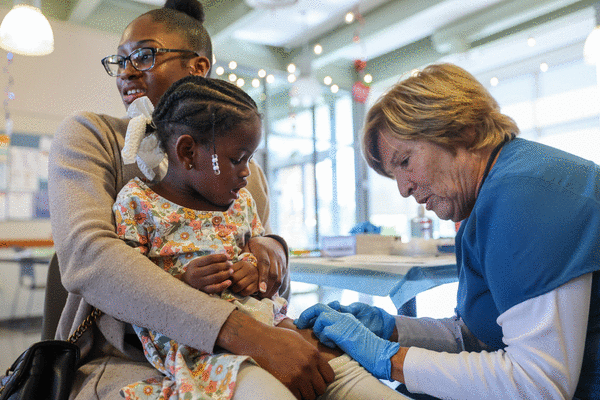
SEATTLE — Even as fewer Washington parents chose to have their kindergartners vaccinated last year, the overall percentage of K-12 students receiving required shots held steady.
According to recent data from the state Department of Health, about 90% of all students met vaccine requirements during the 2025-2026 year, less than 1% higher than the prior year. Seattle-area pediatricians are pleased the vast majority of kids in the state are protected against common childhood diseases like chickenpox, whooping cough and measles, but they worry that more kids are also opting out of the state mandate altogether.
The trend, reflected nationwide as well, is almost certainly linked to the federal government’s ongoing efforts to spread uncertainty and misinformation around vaccine science, local doctors and public health scientists say.
“Those have led to people having vaccine safety concerns and some confusion about what's recommended,” said Meredith Cook, senior epidemiologist with the state Department of Health’s Office of Immunization. “That has resulted in lower vaccine confidence or increased vaccine hesitancy, and we really see that fueling some of those declines in coverage.”
Kindergarten students, meanwhile, were again less vaccinated last year than they were the year before, and higher exemption rates were reported than in the overall K-12 group. It’s not uncommon for the broader K-12 population to have higher vaccination rates in general, Cook said, but since kindergartners are also the youngest, “it does make sense they would be more heavily impacted by those recent declines in vaccine confidence,” she added.
Among kindergartners, vaccination rates fell below the state’s overall average at about 87% — lower than they’d been for that age group in seven years.
The percentage of total students who opted out of the state’s vaccine requirement rose from 3.9% to 4.5% last year, increasing sharply especially among those citing religious reasons, the data shows. Exemption rates hit just above 5% for kindergartners.
“It's something we'll be continuing to monitor closely over the next few years,” Cook said.
State vaccine teams are also keeping an eye on measles-mumps-rubella shots, as parts of the country battle the worst measles outbreak in 30 years. In Washington, 56 measles cases have been recorded in 2026 so far, mainly in Clark and Snohomish counties, and among unvaccinated children.
“For many people, measles has really leapt out of the textbook and into our communities in a way that folks are completely unfamiliar with,” said Dr. Beth Ebel, a pediatrician at Harborview Medical Center who hears all sorts of vaccine-related concerns from patients.
While slightly higher MMR rates were reported last year among K-12 students overall, hitting the 95% herd immunity threshold for measles, rates among kindergartners dropped for the fifth year in a row. About 90% of the state’s youngest students got their MMR vaccines, and about 3.7% — or more than 3,000 children — received exemptions from those shots.
Ebel hears from many families who fear for their own children who are too young to get vaccinated, or have medical conditions preventing them from getting immunized.
“We usually vaccinate at around 12 months of age with their first measles vaccine, and so for those little ones, we protect them by protecting the people around them,” Ebel said.
Nationally, kindergarten vaccination rates also inched down last year, while the percentage of K-12 students with exemptions rose to an all-time high of 4.2% — or 155,000 kids, according to federal data. It’s the fourth year the national average exemption rate has reached a record.
Vaccination rates also fell for specific diseases, including for polio, the combination shot against diphtheria, tetanus and pertussis, and the first dose of the vaccine against chickenpox. That was not the case in Washington, where rates either stayed the same or ticked up slightly.
The state’s K-12 vaccine rates are generally high, Cook said, but she pointed out they also haven’t rebounded since the 2020-2021 school year, which recorded Washington’s peak immunization rate at about 92%. Epidemiologists expected them to climb back up after COVID-19 disruptions, she said, but they haven’t. Instead, COVID vaccines became politically charged, leading to growing skepticism around vaccine science and reigniting debunked debates around other shots, too.
“There are some success stories out there bucking the trend,” Cook said. “But overall, we are experiencing these challenges with decreasing vaccine confidence.”
What the numbers say
Although a slightly higher percentage of K-12 students received their required shots last year, the total number of vaccinated students actually crept down.
This is perhaps due to a decline in school enrollment and changes in how many schools reported data, according to the state health department. The health department received vaccination data for about 15,000 fewer students, in both public and private schools, for the 2025-2026 school year compared to the prior year.
The data shows fewer students were considered up-to-date with vaccine requirements; out of compliance (did not submit vaccination paperwork); or conditional (documentation was in progress). But the number of children seeking exemptions outpaced all three groups, underscoring a worrisome public health direction.
During the last academic year, Yakima County reported the highest K-12 vaccination rate in the state, with just over 96% of students protected against common childhood diseases. Douglas and Franklin counties also recorded rates over 94%.
In King County, almost 92% of all students were up to date with required shots last year, compared with about 91% in Snohomish County and 92% in Pierce County.
Pend Oreille County had the lowest overall rate with about 69% of students vaccinated, followed by Jefferson, Wahkiakum and Stevens counties, where enrollment ranges from 300 to 7,000 students.
Only a handful of counties in the state have seen kindergarten measles vaccine rates over 95% for the last several years. Last year, just Garfield, Adams, Yakima and Douglas counties hit herd immunity levels for measles; in King County, about 92% of kindergartners received MMR shots.
Of the state’s 39 counties, more than half recorded kindergarten measles vaccine rates under 90%, including Clark County, where there have been 19 measles cases so far this year.
MMR exemption rates were highest in Stevens County, where almost a fifth of kindergartners were not protected from measles.
“The trend of these exemptions is worrisome,” Ebel said. “When we fall below that level, which we are in many contexts, just one child or adult can spread measles through the whole community.”
—Seattle Times data reporter Manuel Villa contributed to this story.
©2026 The Seattle Times. Visit seattletimes.com. Distributed by Tribune Content Agency, LLC.








Comments