What are somatic workouts?
Published in Health & Fitness
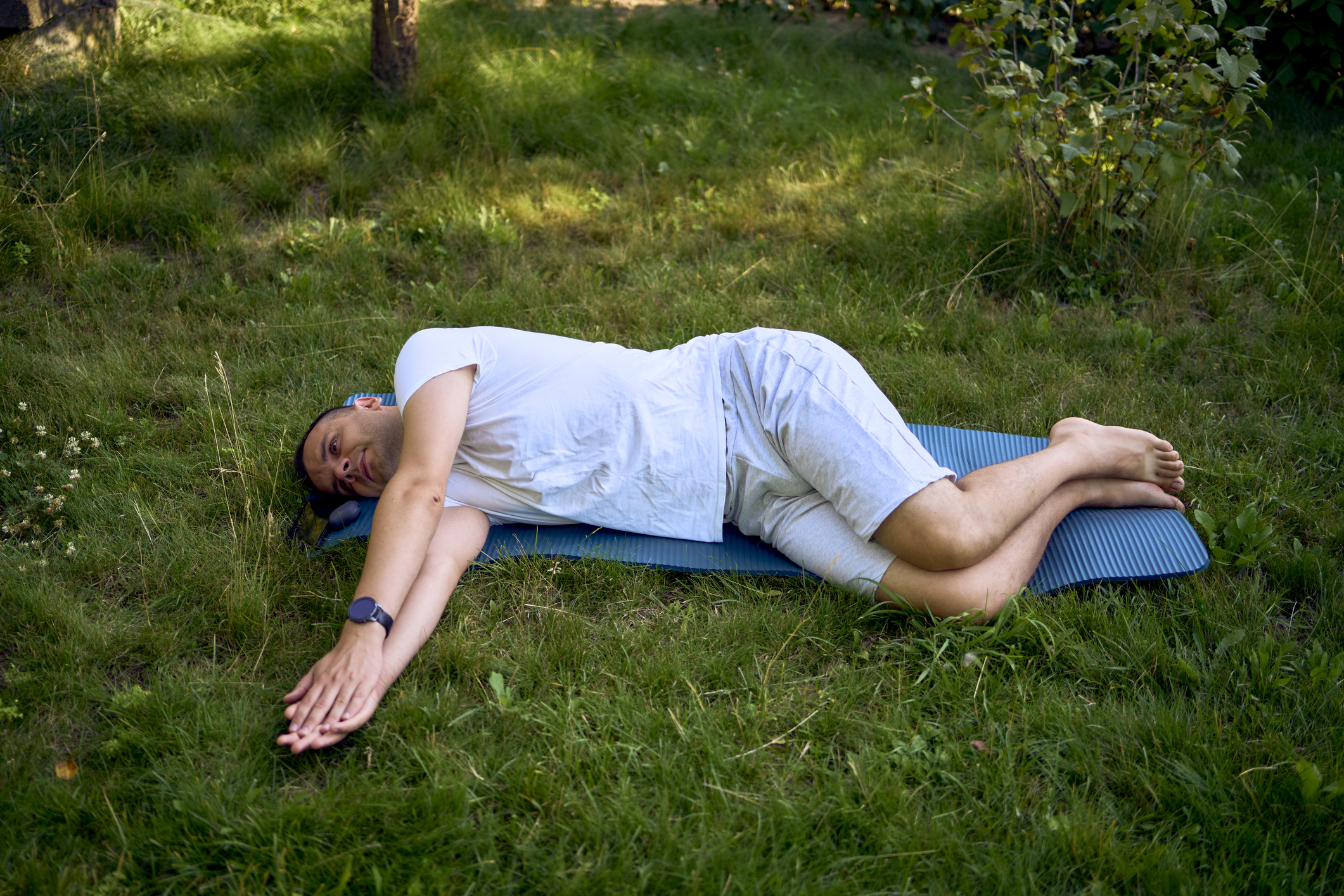
Huffing and puffing at the end of a workout, you’re spent. But somehow, you realize you’re still holding tension in your muscles. How can that be?
There’s a lot to be said for conventional exercise and its ability to rev up our cardiovascular system as well as strengthen and stretch our muscles. But a distinctive approach to movement called a somatic workout can complement those efforts, helping release tension you don’t know you’re storing.
Somatic exercises involve paying attention to internal sensations and responses during physical movements. Why is this important? Many of us move in ways that aren’t ideal for our bodies, leaving us prone to injuries or chronic pain.
But somatic workouts make people more aware of how their body can move more optimally, “and those bad habits start to disappear,” says Dr. Mercedes von Deck, an orthopedic surgeon at Harvard-affiliated Cambridge Health Alliance.
“You can’t imagine how much better you feel when all your muscles aren’t fighting each other,” says von Deck, who has practiced and taught a type of somatic exercise called the Feldenkrais Method for several decades. “This seeps into your mood and view of the world - it all comes together. It’s one of those things that words don’t describe well enough.”
Deep roots
Becoming trendier in recent years, somatic exercise has existed in various cultures for centuries. While many people haven’t heard the term, most are well aware of practices that incorporate somatic elements, such as yoga, tai chi, and Pilates. When a variety of such motions are done together, they compose a somatic workout that harnesses the mind-body connection.
Somatic exercise is also aligned with a form of mental health counseling called somatic therapy, which explores how the body expresses deeply painful experiences and applies mind-body techniques to promote trauma recovery.
“It goes back to patterns you’ve been holding, physical and mental,” von Deck says. “Your body has certain memories, and you can’t think your way out of them. These movements can help liberate you.”
Array of benefits
We may be used to hearing “no pain, no gain,” von Deck says, but somatic therapies tell us that slogan isn’t in our best interests. As with yoga, tai chi, and some forms of Pilates, somatic exercises can overlap with traditional fitness approaches. But the execution usually differs drastically.
“In exercise class, you’re trying to build muscles or cardiovascular stamina, and often you’re using a lot of force,” she explains. “But you may not be moving yourself in the most efficient manner — just trying harder and harder, thinking it will get you there. With somatic workouts, you do the movement, and sense it; that retrains the brain to control the movement.”
Research suggests this type of body awareness can lower levels of the stress hormone cortisol, von Deck says. Somatic exercise also appears to offer additional benefits, reducing pain and muscle tension, calming anxiety, and improving range of motion, sleep, and energy. A small study published in June 2025 in the Journal of Bodywork and Movement Therapies suggested that older adults who took part in a twice-weekly, hourlong online somatic movement program were able to move their spines more easily after 10 weeks.
Combination of components
Somatic workouts incorporate various elements. These include body scanning - mentally focusing on each body part in turn and noticing how it feels, without judgment - as well as breath awareness and micro-movements. The latter are tiny tilts, rolls, or shifts done slowly enough that you can feel every phase of the motion. Micro-movements “comprise parts of more complex functions, but they’re broken down so they seem unusual,” von Deck says. “Your brain gets this knowledge of how different parts of your body move to do the larger thing.”
Here’s an example of a simple somatic movement, and one that’s particularly helpful for people who have difficulty getting out of bed:
1. Lie belly-down on your bed with your head facing to one side and your arms bent next to your head. Bend one knee and draw your leg up next to your torso.
2. Slowly slide your knee along the bed several times, several inches in each direction.
3. Notice how that single movement ripples through your pelvis, spine, ribs, and shoulder blades.
4. End with your bent leg at rest next to your torso, and notice what feels different.
How to try it
You don’t need any equipment — or even much space — to try a somatic workout. Here are some beginner-friendly tips.
(Maureen Salamon is executive editor of Harvard Women’s Health Watch)
©2026 Harvard University. For terms of use, please see https://www.health.harvard.edu/terms-of-use. Distributed by Tribune Content Agency, LLC.









Comments