Nurses take on bigger roles amid healthcare strain
Published in Health & Fitness
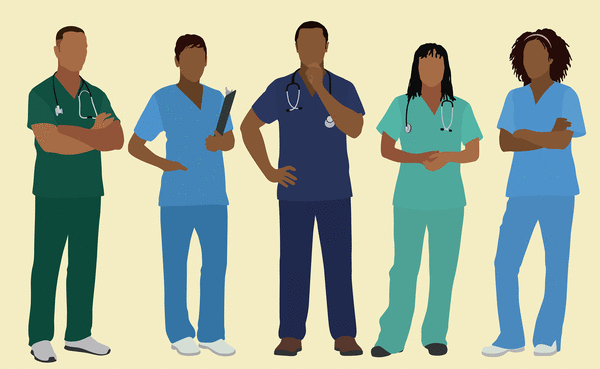
As nurses continue navigating burnout, staffing shortages and an increasingly complex healthcare system, their role has never been more critical.
Johns Hopkins School of Nursing Dean Sarah Szanton sat down with The Baltimore Sun to discuss the evolving demands of the profession, the growing need for nurses beyond the bedside and why the future of healthcare may depend on how the next generation is trained and supported.
From her early career, making house calls in West Baltimore, Szanton rose to lead U.S. News & World Report’s top-ranked school for its master’s and doctor of nursing practice programs.
As the school’s fifth dean, Szanton says she emphasizes developing students’ advocacy skills to influence policies that improve healthcare. The interview has been edited for clarity and brevity.
What contributions do nurses make every day that deserve recognition?
One of the most underappreciated contributions nurses make is their ability to see the full picture. Nurses constantly connect what is happening in people’s lives to what is possible across systems, whether that means helping a family understand a difficult diagnosis, identifying barriers to care before they become crises or coordinating across teams to improve outcomes.
That 360-degree view is what makes nursing so essential. Nurses understand people, systems and solutions all at once, and translate between them every day. Much of that work happens quietly through communication, problem-solving and relationship-building, but it shapes the future of health in profound ways.
How can Hopkins and other schools help resolve a local and national nursing shortage?
The demand for nurses continues growing faster than the systems designed to train and support them, because the healthcare needs of our communities continue to grow. We are caring for an aging population, managing rising rates of chronic disease, addressing mental health needs and responding to longstanding inequities in access and outcomes. We need to build a stronger pipeline to practice, which means expanding clinical opportunities, increasing access to faculty and training environments and continuing to rethink how we educate the next generation.
Johns Hopkins School of Nursing’s competency-based education prepares students to demonstrate real-world clinical and communication skills and move more effectively into practice. We have also shortened our Master’s Entry into Nursing (our RN program) from five semesters to four.
At the same time, financial barriers are more significant. Recent student loan policy changes created real challenges for graduate nursing students already carrying undergraduate debt. Added financial pressures risk limiting who can afford to enter or advance within the profession at the very moment the country needs more nurses, educators and healthcare leaders.
What trends are you seeing among students entering the field?
The role of nurses is expanding far beyond traditional settings, creating demand in community health, policy, research, education and technology. At Hopkins, graduates show strong interests in population health, Black maternal health, mental health and health equity. Many matriculating students have backgrounds in research or are making career changes, bringing valuable perspectives into nursing. Across these pathways, there is a shared commitment to providing person-centered, holistic care and to improving health for individuals and communities.
How is Hopkins working to better prepare graduates for the challenges of modern healthcare?
We’ve implemented a competency-based education focused on ensuring students can demonstrate the clinical, communication, and decision-making skills they need in practice. That approach allows us to create more meaningful clinical opportunities and better prepare graduates for the realities of modern healthcare.
Our innovative “Outside Track” which prepares nurses with clinical opportunities outside of traditional hospital settings. We want students to understand the realities of care in communities, policy, leadership, public health and systems change. Modern healthcare requires nurses who can navigate complexity, communicate across systems and help shape solutions, and our programs are designed to prepare graduates for that broader role.
How are nursing schools addressing resilience, mental health and career sustainability?
Burnout is one of the most serious threats facing the profession. We’d be doing our students a disservice if we didn’t prepare them for that reality.
We start by normalizing the conversation early, reducing stigma and opening the door for students to seek support. Resilience-building and self-care are treated as professional competencies, not afterthoughts. Students learn to recognize the signs of burnout in themselves and their colleagues and practice boundary-setting and reflective techniques that carry into their careers.
We also invest in real-time support structures through counseling services, peer support groups, and faculty trained to notice when a student is struggling. We recognize that nursing burnout requires sustainable workforce policy solutions, not just individual coping strategies. To this end, our students learn about power and how to change the policies where they work and live. Beyond graduation, we prepare students to advocate for themselves, recognize unhealthy work environments and build careers that evolve with them. Ultimately, a nurse who knows how to care for themselves is a safer, more effective clinician and far more likely to stay in the profession.
How does your program recruit and support students from underrepresented communities?
Research confirms that patients receive better care when nurses reflect their communities and understand their lived experiences. That’s why we intentionally partner with community colleges, HBCUs, tribal colleges and high schools in underserved areas to connect with students early in their journey toward nursing.
Once enrolled, we focus on removing the barriers that most often cause underrepresented students to leave. This includes underrepresented students of all racial backgrounds, including first-generation white students as well. Our support system includes financial aid and emergency funding, dedicated academic coaching and mentorship by nurses and faculty who share similar backgrounds — all designed to support persistence through graduation and into the workforce.
What would you want potential future nurses to understand about the rewards and the realities of the profession today?
I would want them to know that nursing is one of the few professions where you can directly change lives while also helping shape the future of health. The realities are challenging. Healthcare is complex, communities face enormous challenges and nurses often navigate difficult moments alongside patients and families.
But the rewards are equally profound. Nursing offers the opportunity to lead, to innovate, to advance knowledge and to translate that knowledge into real-world impact. Nurses shape policy, strengthen communities, drive research and build new models of care for the future.
At its core, nursing is a profession grounded in science, driven by purpose and essential to where healthcare goes next.
____
©2026 The Baltimore Sun. Visit at baltimoresun.com. Distributed by Tribune Content Agency, LLC.








Comments