'Victorian Psycho' team Zachary Wigon and Jason Isaacs talk murder, madness
Published in Entertainment News
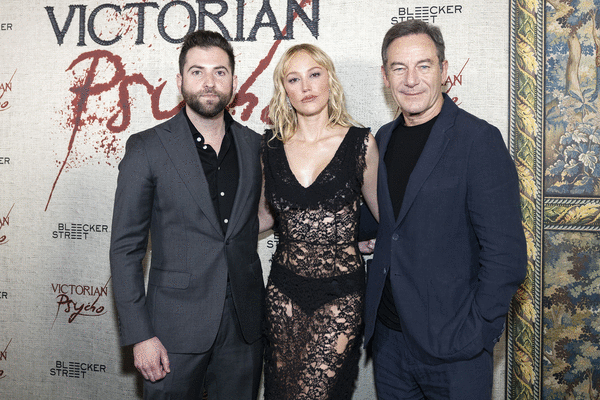


ANAHEIM, Calif. — Director Zachary Wigon’s new horror thriller, “Victorian Psycho,” like many movies, is adapted from a book. In this case, though, the film adaptation began before the book of the same name was even published.
“I’m always curious about meeting new writers,” Wigon says on a recent video call to discuss the film that stars Maika Monroe, Jason Isaacs and Ruth Wilson. “So a number of years back I read a great, great novel called ‘Mrs. March,’ which Virginia [Feito] had written.
“It was her first novel, and it had a very distinctive, very cinematic quality,” he says of the Spanish novelist. “It was sort of like a Patricia Highsmith, Shirley Jackson, Hitchcockian kind of story.”
Wigon reached out to Feito, and in their conversation they talked about working together on an original film in the future.
“Eventually, we hit on an idea we liked,” Wigon says. “Early on, she mentioned, ‘You know, I’m writing my next novel. It’s going to be called “Victorian Psycho.”‘ I said, ‘Please let me read it when it’s ready.’”
Five months into the original screenplay idea, Feito said she had a draft finished and asked if Wigon wanted to see it.
“She sent it over, and as I was reading it I was deeply struck by the novel’s unique and bizarre and resonant tonal register, which was simultaneously really funny, really angry, unnerving, scary, grotesque,” he says.
“I had never read anything that blended tones like this before; it was so strange and unusual,” Wigon says. “Basically it’s one wild set piece after another.
“I called Virginia, and I said, ‘We have to make this movie. Let’s put the other thing on hold. We have to do “Victorian Psycho.”‘
“And to my happiness, she said, ‘Yes, let’s do it,’” he says of Feito’s agreement to adapt her own novel for the screen.
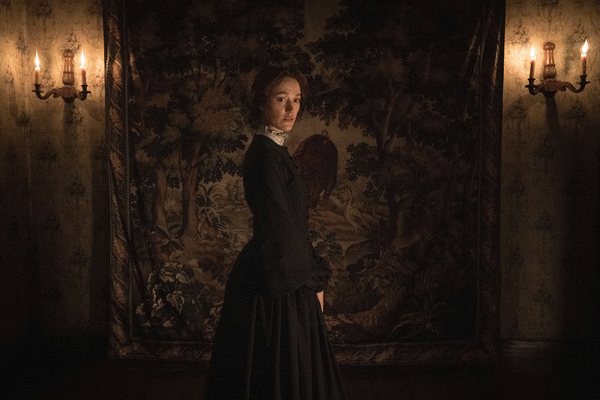
“Victorian Psycho” tells the story of Winifred Notty, a poor governess who goes to work for the aristocratic Pounds family at their isolated country estate on the Yorkshire Moors.
Winifred is “mad” in the Victorian sense of the word, and she’s prone to violent outbursts when disappointed in her hopes and dreams. As played by Maika Monroe, she’s alternately terrifying, laugh-out-loud funny, and touchingly tender.
The Pounds family — Jason Isaacs and Ruth Wilson as the parents, Evie Templeton and Jacobi Jupe as the children — are mad in their own aristocratic ways. Their careless cruelty can cut to the core.
In separate interviews edited for length and clarity, Wigon and Isaacs talked about the appeal of “Victorian Psycho,” Monroe’s impressive performance, and the different kinds of crazy explored in the film, which opens in theaters on Friday, Nov. 13.
Q: Jason, what was your reaction to your first read of the screenplay?
Jason Isaacs: My initial reaction was skepticism. Honestly, I thought, ‘This is not going to work. What is this: Is it horror? Is it comedy? I don’t get where the suspense is. What’s the tone of this thing?’
Any time I think something isn’t going to work or is unplayable, I start to get interested and go, “Is that because I’m scared of it or because it’s not actually good?” There was this young director. I watched his other film [2022’s “Sanctuary”]. I thought, “Well, it’s really good, but there’s only two people in it, so what would make you think he could pull this off?”
I went to meet him, and he was so confident that he understood the tone of the piece, but he was a young guy. It may be false confidence, you know? But I really liked him, and I was intrigued by this notion.
Q: So what tipped the scales for you?
Isaacs: A few times in my professional life I’ve taken a swing at something that felt like it could be a disaster but could be a triumph. They’ve turned out in equal numbers, but it’s always exciting. So I jumped on board. Maika came on board as our leader, as it were, and she kind of set the tone in many ways.
But still, Ruth and I were questioning ourselves all the time. Are we doing crazy over the top or is this too realistic? Am I making this scene too naturalistic now? And Zach would say, ‘I’ve got you. I’ve got you. This is where you need to be. And it turns out he was right.
I mean, it’s pretty empirical. Horror and comedy, the two genres, you can’t hide. You can hide in drama. People either laugh and scream or they don’t. And they do in this film, and I feel quite vindicated. I was rewarded for stepping out of my comfort zone and trusting a young director.”
Q: It’s interesting that you and Ruth struggled to identify the tone for your characters.
Isaacs: I tried to give [Wigon] a lot of choices in the edit. I know Ruth did, too. You don’t want to go so far over the top that the whole thing becomes a comedy sketch. [Viewers] aren’t going to be invested. Nobody is going to stay with you for an hour and three-quarters.
But on the other hand, this is a kind of heightened reality of grotesque horror comedy. So you have to be slightly bigger than life. And that’s fun, frankly, because 99.9% of the time as an actor you’re trying to be as naturalistic as possible so that it’s a bit like the audience is looking through a keyhole at the real world.
Q: Zach, you spent a lot of time with the character Miss Notty in making the film. How did you come to feel about her?
Wigon: I have a lot of sympathy for her and a lot of sadness for her, to be totally honest with you, because she’s in an impossible position. She desperately wants to belong. She desperately wants to be accepted. And she is constitutionally incapable of ever achieving this. She’s in a basically hopeless Sisyphean position. It’s never going to happen for her. It can’t.
And then, to add insult to injury, she’s never going to be accepted because she’s mad, and yet the folks who she is seeking to be accepted by are themselves part of the society that she recognizes as mad. So to answer your question, that’s where I go when I think about Winifred. At the bottom, it’s tremendous sadness.
Q: Jason, how’d you come to understand the Pounds family who are, I guess, to be generous about it, they’re eccentric –
Isaacs: Very generous. [He laughs]
Q: – and Miss Notty, who it’s fair to say is clearly mad.
Isaacs: Well, apparently not [clearly mad] to Mr. Pounds. To the audience, you go, “Well, this is a crazy person. We have access to her craziness as an audience.” But [the Pounds family], they don’t have access to know that this woman who’s come into their midst is unusual.
And then bit by bit, the audience goes, “Wait a second. This family’s really [bleeped] up.” Maybe [the Pounds family] wouldn’t notice so much because they have their own social mores which are completely bizarre.
You don’t have to look too far in the modern world to find people who have such status around them that the world rearranges itself around their needs and idiosyncrasies. And it’s a million times more so in the Victorian era.
Q: Let’s talk about Maika and how you cast her, Zach.
Wigon: I have been a fan of Maika’s for a very long time. Funnily enough, two of my favorite contemporary horror movies are “It Follows” and “Longlegs.” And I also think her performance in “Watcher” is exceptional.
In Maika’s screen persona, she has this kind of internalized quality about her where you know that there’s something very intense happening in her head. You don’t know what it is. There’s an opaque quality to her psyche, which makes you lean in. You really want to know what she’s thinking because something’s going on, but you don’t have access.
I thought that would be great for a serial killer. Because the whole industry of books and documentaries and fictional films about serial killers, it’s all about: Why are they this way? What makes them tick? It’s a great mystery. So there was that.
But the other thing that came into it was that the character on the page was written in a very expressionistic register, both in the novel and in the screenplay. And that wasn’t something I had seen Maika do before. I love giving actors the opportunity to travel somewhere new because I find that they relish the opportunity to flex a new set of muscles in a role.
With that in mind, I was reading about Maika, and I read that her favorite actor is Jack Nicholson. And, of course, the performance in “The Shining” is the ultimate example of an impressionistic psychopathic performance, so I thought that is absolutely perfect.
Q: Jason, did you know Maika before the film?
Isaacs: No, I didn’t know her work, and so I gave myself a brief catch-up. And to my shame, I only watched the horror films. She’s actually got quite a big body of work for a young woman when she’s played a whole variety of things.
It’s very lucky for the filmmakers here that she’s not only a Scream Queen but really, really good at her job. A terrific actress. And I thought her English [accent] was great. But I recognize that thing about being defined by a particular genre when actually she’s done a whole bunch of other things and done them extremely well. I’ve subsequently caught on some of her other work.
Q: I found her mesmerizing to watch, all the little gestures and tics. Were you ever surprised by what she delivered, Zach?
Wigon: I mean, it was just every day. You never want to conceptualize the performance too much in advance. I can heavily conceptualize everything but. So when I’m walking on the set [for the first time] I’ve watched the movie in my head many, many, many times, with the critical exception of the performances.
I have a general idea of the tonal or emotional register of the performance, but that’s the one thing that is left open to explore on the day. Intentionally.
Q: Jason, you have a remarkably long one-on-one scene with Maika at a critical point in the film. Tell me about that.
Isaacs: That one long scene was the scene we had an awful lot of discussion about what was going to happen in it. How far it should go, how extreme it should go. He’s obviously very predatory, sexually predatory. Once we settled what was going to happen, Zach dropped this little bomb on me and Maika and said, “By the way, we’re shooting it in one.”
I said, “Sorry?” He said, ‘We’re not doing any coverage. It’s a single take.” And I went, “But there’s so much to show in it. There’s so many complex reactions and big changes and reveals.” He goes, “Yeah, it’s going to be a challenge.”
And I’d say I absolutely loved it. I know Maika did too because with the scene – I don’t know how long it is, but longer than you ever get to do in film – it’s like a play. I mean, “fun” is an odd word for a scene that has so many disturbing moments in it, but for Maika and I, it’s one of the things that reminds me how thrilled I am to be an actor.
You know, sometimes it’s just a job. Sometimes it’s entirely invigorating, and this was one of those days.
Q: I didn’t realize it was a single take when I watched it.
Isaacs: Well, you shouldn’t. Sometimes you recognize single takes because directors are doing it for a flourish, a self-referential flourish. In this instance, Zach, I think felt that he wanted you to have such an intense, unbreakable moment with these two people, and feel the tension build and the walls closing in, that to cut away would give you some relief.
Q: Zach, you’ve mentioned Brian De Palma as a main visual influence on your filmmaking. How so?
Wigon: I think he moved the camera unlike anyone who’s ever made movies. There’s a visual beauty to the way that his eye works. He’s able to find the most unusual and striking angles but always in service of the story.
In other words, he’s always coming up with these deeply expressionistic modes of composition and camera movement, but they never feel flashy or showy. It always feels like it is conveying something that is integral about what the story needs to be.
Q: Tell me about casting Jason and the other Pounds family members.
Wigon: I thought Jason would be able to do the sort of haughty, patrician aspect of the character that the role clearly called for. But at the same time what I’m looking for in any actor, and all of these actors are able to do it, is I’m looking for a body of physical tics and gestures, sort of a vocabulary of visual things that they’re able to do that are living underneath the surface of what the character is presenting to the world.
And Jason has a great physical repertoire. In this, he’s wearing a fake moustache, and he’s got a wig. He loves the physical play of looking in the mirror and seeing someone other than himself staring back.
Q: Jason, between this role and “White Lotus,” you’ve had two striking roles as a father in the last year or so.
Isaacs: When I was young, I played a lot of soldiers, a lot of policemen, a lot of villains. Then you get to an age where you play a lot of fathers. Play a lot of people with dead children. My friend Reed Birney goes, “You wait, the next phase is the Alzheimer’s phase. I played six characters with Alzheimer’s last year.”
So I don’t know how [Mr. Pounds and Timothy Ratliff in “White Lotus”] compare. I like to think that none of the characters compare to each other at all. I think Tim really loved his kids, and was brokenhearted by what was facing them. And in his despair and catastrophe he was facing and the kind of drug-induced madness that came upon him, he thought the best way to protect them from what was going to happen to them was to kill them.
Which in the end he couldn’t do because he loved them too much. I don’t think Mr. Pounds loves his children. I think it’s a different era. Tim is my age. We’re those people who took notice of our children. Mr. Pounds is a Victorian man, and they took no notice of their children. They’re just assets. The boy to be educated, the girl to be married off and forgotten about.
©2026 MediaNews Group, Inc. Visit ocregister.com. Distributed by Tribune Content Agency, LLC.









Comments