Mary McNamara: In a world full of con artists, fraudsters and liars, why can't we quit Elizabeth Holmes?
Published in Entertainment News
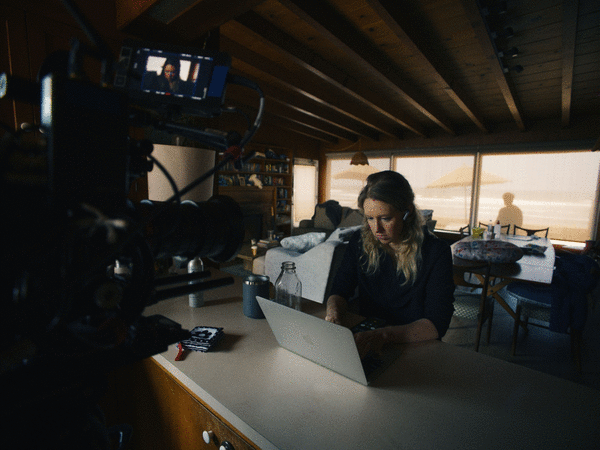
LOS ANGELES — Would we care so much about Theranos founder and convicted fraudster Elizabeth Holmes if her eyes weren’t so darn big and blue? If her hair wasn’t blond and invariably (possibly strategically) mussed? If she wasn’t always romantically involved with a man whose motives appear so questionable?
Nathan Fielder and Lance Oppenheim’s hit doc “You Can See Everything” is delighted to raise more questions than it answers — about Holmes’ continued claims that she did nothing wrong, about the motivations of her weaselly but apparently beloved current partner Billy Evans, about the nature of truth, lies and videotape (or in this case documentary filmmaking).
What it does not question is why, after a decade’s worth of coverage including countless news articles and TV specials, a dozen books, an Alex Gibney doc and an Emmy-winning Hulu miniseries, Americans, despite their notoriously evaporating attention span, remain so enthralled by Holmes.
The nontraditional nature of the doc, beginning with the deadpan, satiric Fielder as its interviewer and the meta-twist of involving Amanda Seyfried, who won an Emmy for her portrayal of Holmes in “The Dropout,” certainly contributes to its success. And Evans, with his bizarre nude scene and jittery need for control has emerged as a tantalizing potential villain.
But it’s Holmes, with a mien and manner that’s spawning yet another round of memes and Halloween costumes, who’s the main draw.
If she is addicted to fame, mendacity, theatrical performance or whatever pathology some attribute to her, we are addicted to her.
The eyes, the hair, the weird boyfriends (Evans replaces Sunny Balwani, former president and chief operating officer of Theranos, also serving time for fraud), the ability to spend 15 minutes arguing about the wording of a sentence rather than address the documented facts of her crimes.
Tales of charming fraudsters, cheaters and con artists are historically fascinating to the American audience. But few, if any, have gotten the high-profile attention Holmes has received. Not the CEOs behind the 2008 financial crisis, not the key players in the Enron scandal, not WorldCom Chief Executive Bernie Ebbers. Only Bernie Madoff, whose Ponzi scheme defrauded 40,000 investors, comes close in terms of attention.
But not the fascination. “You Can See Everything” is as much about the fascination as it is the woman who inspires it. Fielder himself is reluctantly mesmerized, initially with the unlikely nature of the project — who on earth invites a film crew into their home mere days before Mommy goes to prison? — and then, it seems, with Holmes herself.
Evans makes it immediately clear that the couple hopes to use the documentary to directly counter what they consider the false public perception by showing the world who Holmes really is — the two are in the process of actually resurrecting and rebranding the Theranos technology. And so we are treated, initially, to Fielder looming like a jaded specter at the feast as now working mom Holmes peers at her laptop, cradles her infant, reads to her toddler, cavorts on the beach with Evans and generally responds to her upcoming incarceration with the bewildered smile of a Botticelli Madonna.
A smile that stays firmly in place as Fielder tries repeatedly to shake loose a confession, an explanation or even the admission of a misjudgment. Instead she continues to insist that the Theranos technology could indeed have diagnosed multiple conditions from a single drop of blood. She doesn’t understand why she is going to prison when she didn’t do anything wrong.
While Evans fidgets, interrupts, directs and occasionally forcefully ends interviews, Holmes maintains a Buddha-like calm, direct gaze and a spacey air of openness that become increasingly hilarious as she twists Fielder’s simple questions into philosophical and/or etymological diversions. No matter how broad — ”You’ve never lied in your life?” — she does not waver even as the camera closes in to near-ophthalmological levels, as if the truth could be found in the dilation and contraction of her pupils, the shimmering of a well-timed tear.
Cinematographer David Bolin’s choices are bold and powerful, capturing both the unusual access and the unreality of the situation — that access is part of a stated agenda by a couple still hoping to prove Holmes’ innocence as Fielder looks on in various degrees of disbelief.
Still, it is impossible not to wonder if the camera would have remained so long on Holmes’ eyes if they weren’t so very blue. Or if Fielder and audiences would be so interested if Holmes weren’t a young, attractive woman, transformed from the famous black-turtleneck steel of her brief tenure as a startup billionaire into a vision of maternal comfy core so aesthetically at odds with her crimes.
In a way that may or may not be camera-ready intentional.
Watching someone insist on their version of reality in the face of overwhelming evidence to the contrary evokes all manner of emotions: disgust, anger, disbelief, admiration and, of course, doubt. Roy Cohn’s infamous code, which includes “admit nothing, deny everything,” is increasingly employed at the highest levels in this country, but still many Americans find it difficult to understand, or believe, that liars, when caught, will continue to lie.
Our stories of justice, from murder mysteries to tales of thwarted romance, invariably climax not with revelation but with confession. Cornered, the liar finally admits, accidentally or intentionally, the truth; justice prevails and catharsis is achieved.
Deviation from that storyline can be unsettling; repeat any denial often enough and it can, to some, begin to feel sincere. Which it sometimes is. Not every denial is false, not every conviction is just.
The second half of “You Can See Everything” examines the conjugal nature of denial and doubt as Seyfried and Fielder begin to worry that Evans is exploiting the now-incarcerated Holmes. As Fielder’s initially firm belief in Holmes’ guilt and manipulative powers appears to waver, Seyfried wonders if Fielder is in some way falling for her.
This question, like much of the film, raises all sorts of issues about the unavoidable intimacy of documentary filmmaking and the demands of story. As with the New York Times article that is referenced repeatedly in the film, the narrative of “You Can See Everything” underlines the difficulty of navigating the gap between Holmes’ documented actions and the type of person she presents for inspection. (Though anyone who has watched “House,” “Lie to Me” or any detective show knows that continued direct eye contact is the liar’s first tell.)
But it also plays into an archetype we love to hate — the femme fatale. Like Bonnie Parker or “East of Eden’s” Cathy Ames (now enjoying her own renaissance courtesy of Florence Pugh), Holmes’ appearance plays against stereotypes. She seems vulnerable; she is certainly beguiling.
And “You Can See Everything” makes clear, beguilement exists beyond fact or even truth. Even with her fraud thoroughly exposed, even in a documentary where she repeatedly resorts to the obvious trick of focusing on semantics, we remain fascinated. How can she continue to lie? Why would she continue to lie?
After all, she seems so good with her children, and her eyes really are so very blue.
———
(Mary McNamara is a culture columnist and critic for the Los Angeles Times.)
———
©2026 Los Angeles Times. Visit at latimes.com. Distributed by Tribune Content Agency, LLC.










Comments