Movie review: 'The Weight' brings '70s ethos to Great Depression-set survival story
Published in Entertainment News
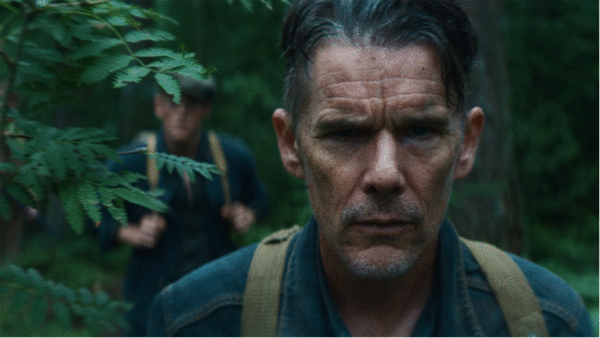
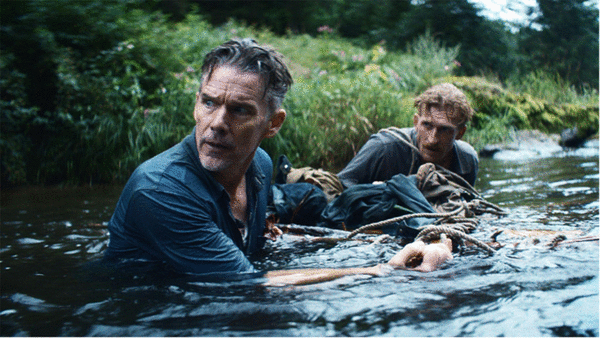


Somewhere in the overlap between William Friedkin’s 1977 action thriller “Sorcerer” and Kelly Reichardt’s 2020 Pacific Northwest pioneer indie “First Cow” lies Padraic McKinley’s directorial debut “The Weight.”
“Sorcerer” is about a group of fugitives driving a load of dynamite across the jungle; “The Weight” follows a group of Depression-era convicts hiking gold through the forest. “First Cow” is about the sweetness of friendship and French pastry in the wilds of Oregon during westward expansion; “The Weight” is about the logical endpoint of boom and bust, the corrupting forces of capitalism that cannibalize their own. Made in the 2020s, set in the 1930s, and inspired by the 1970s, “The Weight” marries the instincts of modern indie filmmaking with a New Hollywood ethos, while bringing an authenticity to the details of the period.
Written by Matthew Booi, Shelby Gaines, Leo Scherman and Matthew Chapman, we follow the story of Murphy (Ethan Hawke), a World War I vet and single father in Eugene, Oregon, struggling to provide for his daughter Penny (Avy Berry), three years into the Great Depression. After an unfortunate run-in with the law, Murphy finds himself in a prison labor camp, building a road, trying to shorten his sentence so he can get out before his daughter is adopted to a new family.
Opportunity presents itself in his foreman Clancy (Russell Crowe), who takes a shine to Murphy after he fixes his car and devises an ingenious way to remove boulders without dynamite. Cuddly but dangerous, Clancy makes a seemingly simple offer to Murphy: he and three friends can earn their freedom if they hike a load of gold out of a mining camp on the eve of President Franklin D. Roosevelt confiscating all gold stockpiles.
The how and why details aren’t that important; the story is merely that the prisoners have to get from Point A to Point B through a rugged forested terrain, under the watch of two intimidating chaperones, Amis (Sam Hazeldine) and Letender (George Burgess). A mining camp servant, Anna (Julia Jones), joins their group as a runaway, and while it seems a straightforward task, the arduous and brutal journey is one that is liable to turn these convicts into criminals.
Murphy’s gang weren’t really outlaws to begin with — he was imprisoned for defending his daughter from some undercover cops; Singh (Avi Nash) arrested for protesting and associations with socialism. Olson (Lucas Lynggaard Tønnesen) was part of a group going after a judge for seizing Scandinavian farms, while the most hardened criminal among them is Rankin (Austin Amelio), who grew up in juvie. But in order to survive the woods, crawling with transient miners, as well as their foreboding escorts, Murphy will have to dig deep into his wartime past, and rely on his own skills and smarts to make out it out intact.
McKinley pours his craft into authentically representing this time, from the perfectly worn denim of the costumes to the refreshingly real and craggy faces of the cast (and thank goodness Hawke and Crowe are respectably aging into their character actor looks). The Bavarian forest beautifully stands in for 1930s Oregon, and cinematographer Matteo Cocco balances the different eras of influence, juxtaposing ‘70s-inspired slow zooms with composed, high-contrast images that hark to early 20th century styles of photography. A score by Latham and Shelby Gaines balances discordant, atonal tones with suspense-driven sound design that captures the creaking noises of the forest and the concealed dangers it holds.
McKinley stages a few bullet-sweating sequences of peril, including a particularly brutal transport of gold bars across a crumbling rope bridge, and an underwater accident exacerbated by floating logs. Both are nail-biters, but you can’t help but think he could have pushed it even further. Tonally, the film is torn between wanting to be brutally bleak, and offering some kind of hope or happy ending for Murphy and his precocious, adorable daughter.
When “The Weight” leans into its nasty, mean and grim moments, it gets at something that seems closer to truth than the saccharine sweet resolution we hope, or fear, is coming. It seems like McKinley wants to deliver a crushing blow, but then feints at the last minute, opting for a more optimistic kind of fantasy.
Politically and culturally, what “The Weight” speaks to is as ugly as the violence that occurs in the mud and fog of the forest, but it ends on an oddly cheery note that doesn’t square with where we’ve been and what we’ve seen. It’s a cutesy ‘70s nod that feels more “Smokey and the Bandit” than “Sorcerer.” The bolder choice would have been to commit to expressing the cutting, even despairing, lessons of this world. We want to see these characters changed by what they experienced, even if it’s dark; we want to see them actually carry the weight.
———
'THE WEIGHT'
3 stars (out of 4)
MPA rating: R (for language and some violence/bloody images)
Running time: 1:50
How to watch: In theaters Sept. 18
———
©2026 Tribune Content Agency, LLC











Comments