Mary McNamara: Harry and Meghan's UK return is the royal family's best PR in years
Published in Entertainment News
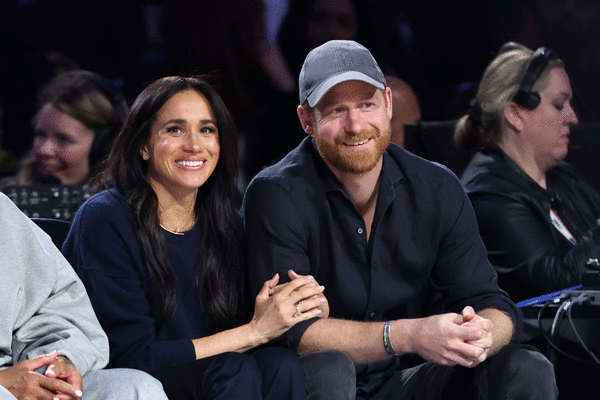
LOS ANGELES — Honestly, it was probably the traffic. Have you ever tried to get into, or out of, Montecito in the summer, or virtually any other time of year? The 101 has long been a bottleneck nightmare as it approaches Santa Barbara and the yearslong project to widen the freeway has only made it worse.
One may be rich and famous enough to skip the queue at a restaurant or Disneyland, but traffic cones and lane closures bow to no man.
The “shocking” news that Prince Harry and Meghan Markle, the Duke and Duchess of Sussex, will be moving back to the U.K. appears to have left many people baffled, their “burning questions” littering the media landscape.
Why would Harry, who as recently as last year said he could not imagine returning with his family to a land where they were so relentlessly dogged by a vitriolic press, and Meghan, an actor who built a Netflix series and business off the fecundity of California’s 12-month growing season, ditch the West Coast for a country where she faced such inarguable racism?
Maybe it was the weather. Meghan is a local girl, but endless sunshine, which initially seems such a blessing and balm to the damp British soul, can soon seem a bit aggressive (especially with the wildfire threats); even die-hard Californians long for a bit of drizzle now and again.
Sussex critics, who are legion, have suggested that the move is simply a capitulation — like so many before them, the couple hoped to take Hollywood by storm and instead saw their Netflix and Spotify podcast deals wither as most of their projects met with, at best, middling success in the marketplace.
Except that’s how the entertainment business works these days, and those deals did pay them millions (the Netflix production deal was reported to be in the $100 million range). It’s not like that Montecito mansion is going into receivership — they’re keeping it, and the place in Portugal, even as they settle into whatever splendid non-royal residence with earth-toned interiors that they have chosen, reportedly outside London. (The Cotswolds has been mentioned, so not exactly a terrace flat in Margate.)
But, the headlines sputter, what about security? And why now? Why so suddenly?
Please. It’s not like the family is fleeing under cover of night like the Colts leaving Baltimore, to hole up in some Airbnb while Meghan researches “good public schools” and Harry obsesses over the U.K. version of Redfin. What may feel like a “bombshell” to the public has, no doubt, been in the works for some time. They don’t seem to be the kind of parents who just spring an international move on their kids. “I know we said we were going to the movies, but really we’re moving to England so get in the damn car.”
Not to mention all the staff, here and in the U.K., that would need to be involved; organic gardens don’t plant or manage themselves. As for security, the Sussexes have been paying for their own for years now.
So while it is great fun to speculate — is it just another example of rich folk fleeing California’s high taxes? Are they worried that David Ellison is going to make everyone move to Nashville? — the answer seems pretty simple and obvious.
Harry may have stepped away from his family and royal duties, but he is still a prince of the realm. That he would never return to the U.K. was always unlikely and his father is 77 and has cancer. It doesn’t take a royal watcher to connect those dots.
Monarchists should certainly greet his return with open arms. Despite the very real tensions and ramifications of Harry’s decision to go public with his and Meghan’s experiences and criticisms, his prodigal son position is, and frankly, has always been, a boon for the Firm.
King Charles and his heir, Prince William, have long wanted, and taken steps to create, a streamlined royal family — one more in keeping with the modern world and the often-conflicting desires of the British public. But the greatest threat they face, at least in terms of public opinion, is not outrage but indifference.
The ink, real and digital, being spilled over the Sussexes return to the U.K. is proof that the public remains very much invested in the state and fate of the British royal family. It certainly makes a nice change from the cancer treatments endured by the King and Catherine, Princess of Wales, and especially all the horrific news surrounding the former Prince Andrew, his ex-wife Sarah Ferguson and their daughters.
(Here’s hoping Meghan gets some grace and credit as a supportive spouse willing to step once more unto the breach before the British press starts blaming her for, I don’t know, the climate crisis.)
William may not be speaking to his brother, but he cannot deny that Harry’s renunciation of his royal duties, and for the last six years, the land of his birth, provided an effective showcase for William’s persona of resolute duty. As any storyteller knows, tension and contrast is what drives audience interest.
Unintentionally, and no doubt painfully, the British royal family has, in modern times, increasingly become a high-profile mirror of its subjects. Dating, marriage, parenting and divorce; illness, scandal and tragic loss are all universal experiences. As is, alas, racism. Harry and Meghan’s departure reflected both the larger struggle Black Brits and Americans face and the no-contact rifts that increasingly divide many families.
Perhaps their return, for whatever reason, will offer a way forward, proof that calling out bigotry can lead to change and that even the most publicly broken family bonds can heal if that’s what the family wishes.
And though it rains a lot in the Cotswolds, the traffic will no doubt be an improvement.
———
(Mary McNamara is a culture columnist and critic for the Los Angeles Times.)
———
©2026 Los Angeles Times. Visit at latimes.com. Distributed by Tribune Content Agency, LLC.








Comments