'Tony' review: A food critic finds flaws in the new Bourdain biopic
Published in Entertainment News
Anthony Bourdain’s memoir “Kitchen Confidential: Adventures in the Culinary Underbelly” gave a human face — and heart, and soul, and sense of humor, and often-foul mouth — to the previously unsung heroes of restaurant kitchens. Bourdain “didn’t want to ‘rip the lid off the restaurant business,’ ” as he noted in a new preface six months after the book's 2000 blockbuster publication. He loved the subculture of that intense industry, and he wanted to hold up a mirror — to let those who inhabited it feel seen, through his own experiences, in a way that was “entertaining and true.”
“This is for the cooks,” he wrote.
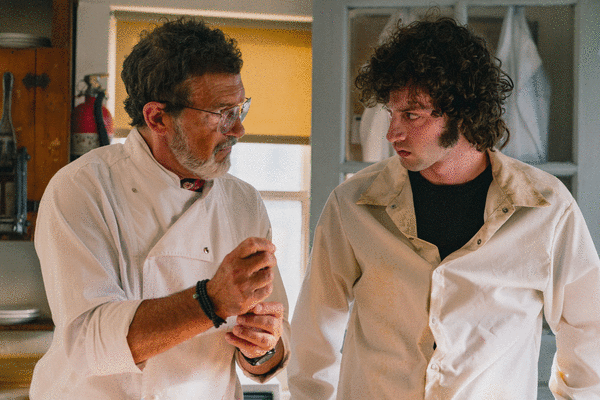
The film “Tony” is trying to do a lot. Loosely based on early chapters in “Kitchen Confidential,” it wants to be a nostalgic-but-fun summer movie; a look at rough-and-tumble kitchen culture; and a coming-of-age story about late-teenage Tony, one that depicts the beginnings of his love for cooking, cooks, food, women, alcohol and drugs, with intimations of the trouble to come.
“Tony” takes huge liberties with Bourdain’s account of his start in the restaurant world working at a touristy seafood spot in Provincetown, Massachusetts. Things get compressed, romanticized, melodramatized and wholly imposed. He did follow a girl to Vassar College, but not, still lovelorn, to P-town. He didn’t sleep in a hammock on a chef’s porch, awakened morning after morning with a bracing bucket of seawater; he got a summer share with friends, and they swam, drank, smoked joints and did the things that young people first out on their own do, or at least did in the 1970s.
Young Tony was, in his own later words, “spoiled, miserable, narcissistic … (and) badly in need of a good ass-kicking,” as the Kitchen Confidential" epigraph for “Tony” notes. Mop-topped, sulky Dominic Sessa captures this well — though it seems that even at this nascent stage, the Bourdain charm would’ve been more in evidence. Tony did start out as a resentful dishwasher, but he wasn’t obnoxious enough to go around saying, vastly prematurely, that he was a writer, as the Tony in "Tony does.
The bit where Tony gets burned, then watches a veteran cook pick up the same hot pan with bare, scarred hands: an indelible scene in the book, and great in “Tony.” Bourdain revered the truly piratical cooks he encountered in Provincetown, and his writing in “Kitchen Confidential” honors their skills, thievery, lust and deep weirdness. He masterfully builds the real-life character of chef Howard Mitcham — “wild, unruly white hair, a gin-blossomed face, a boozer’s gut,” a seafood expert “totally without pretension” — in just a handful of paragraphs. Antonio Banderas plays the character most analogous to Mitcham in the film, the chef/owner who inspires/mentors/splashes buckets of water on Tony; the script renders him a kindly cliché who's also, for some reason, overtly religious.
Stavros Halkias also deserves a more fleshed-out and funny part here, and Leo Woodall’s portrayal of a bad-boy cook is given a moral overlay as a “sin-eater,” which doesn’t make sense given his bountiful bad impact. (The sex scene featuring Woodall and a newlywed bride out behind the restaurant is a “Kitchen Confidential”-based one, though it happened with a head chef, not one of Tony's fellow workers.)
Was Bourdain himself a sin-eater for us all? Is this another aspect of his story that “Tony” is trying to address? It’s not at all clear. In the film’s kitchen, he hesitates when he’s first offered a white-powder pick-me-up; subsequent (and frequent) use is part of a summertime montage, and there’s a brief, arbitrary scene of Woodall shooting up on the beach. The intended audience for “Tony” knows what this portends, but it feels forced. The casual way it is all treated, however, feels just as heart-sinking as the (many) references Bourdain makes to drug use in “Kitchen Confidential.”
If something seems cheesy in “Tony,” it was likely added in to create drama. Provincetown clambakes are mentioned in “Kitchen Confidential,” but it’s about the inspirational, total joy of making and eating simple, great food out on the beach, not an improbable plot device. Bourdain didn’t engineer a pop-up-style upmarket menu for the factual Flagship (aka the Dreadnaught in the book); fire happens in restaurant kitchens, but didn’t there, then, as if punishment for his hubris. The love interest, played by Emilia Jones, also falls into the plot-device category; who women actually are doesn’t matter here.
That’s Hollywood, folks. A truer-to-life “Tony” — with Bourdain’s burgeoning fascination with the real characters of restaurants taken from the page to center stage — would’ve been great. But for that, one can and should read — or reread — “Kitchen Confidential,” a book that’s vivid, wild, funny, full of heart and, now, foreboding.
———
'TONY'
1.5 stars (out of 4)
MPA rating: R (for pervasive language, drug use, and sexual content/nudity)
Running time: 1:46
How to watch: In theaters nationwide Aug. 21
———
© 2026 The Seattle Times. Visit www.seattletimes.com. Distributed by Tribune Content Agency, LLC.










Comments