What it takes to screen 'The Odyssey' on 70 mm film at Twin Cities theater
Published in Entertainment News
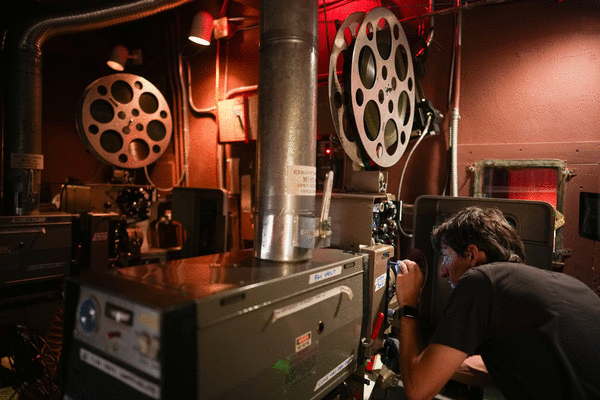
MINNEAPOLIS — At one movie theater, a worker might just press “play” on what is basically a computer attached to a projector, and turn their attention elsewhere until “The Odyssey” concludes three hours later.
Not at the Heights Theater.
At the Heights, which uses two film projectors from the 1960s for special screenings like Christopher Nolan’s latest epic and other classic movies, there is “somebody scurrying around in the dark with a flashlight and sweating over literal millimeters of detail, putting that much work into showing the same movie,” said David Sotelo.
Sotelo, that scurrying somebody, is the newest projectionist to carry on the Columbia Heights cinema’s century-old tradition of showcasing movies on 35 mm and 70 mm celluloid.
He knows the job might sound silly in the digital age, but old-school film is having something of a pop-culture moment. “The Odyssey” is as big of an event movie as there is, and it’s driving discussions about theatrical formats at a time when box office numbers are in pre-pandemic form, with Gen Z leading the charge.
“It’s a little strange to have people coming up to you to ask about different formats and aspect-ratio differences,” Sotelo said. “But it’s happening more frequently because of these big releases. It’s the best feeling.”
Film projection largely became a thing of the past more than a decade ago, when movie studios cut off production of film prints. But the format has retained a heartbeat thanks to big-name directors like Nolan, Quentin Tarantino and Greta Gerwig occasionally putting new releases on celluloid.
The Heights Theater is a single-screen venue that turns 100 years old this fall, and was acquired last year by the operators of Chicago’s Music Box Theatre. It is one of three cinemas in the metro area that still have 70 mm film projectors working alongside digital counterparts.
The venue has capitalized on “The Odyssey” as a sort of launchpad to show more film screenings. Before Nolan’s latest premiered there on 70 mm film, the theater screened a series of classics in the same format, such as “2001: A Space Odyssey,” as appetizers. The 1989 “Batman” is next on the marquee after “The Odyssey” concludes its Heights run Aug. 13.
Those shows did good business for the Heights, general manager Jeremy Marder said, and the mission is to further develop the audience for film.
“Showing things on film is coming back into vogue and many theaters are trying desperately to find projectors they once threw out,” Marder said. “We want to demonstrate why these formats matter.”
Despite coming of age in the digital world, Sotelo, 33, has spent most of his adult life as a projectionist. He learned the trade at a student-run theater at Florida State University and turned pro at an Alamo Drafthouse in Austin, Texas.
By 2015, the number of projectionist jobs in the U.S. had dwindled to less than 5,000, after theaters transitioned to digital formats, according to a report from the Information Technology and Innovation Foundation. The COVID-19 pandemic then forced thousands of theaters to close permanently, and audiences got cozy with streaming services.
Sotelo had to pivot to copy editing for work. He moved to Minneapolis last year with his partner and found a rare opening at the Heights. He joined the venue in early July.
Now, he’s back in the booth and feeling optimistic for the first time in years that this niche interest could expand somewhat.
Sotelo doesn’t knock digital formats. But he said film offers a level of clarity, color, contrast and brightness through a photochemical process that digital can’t.
“It’s a long piece of plastic, but having that much detail and color and having a soundtrack printed on it and having all this information packed into 35 mm of width is just crazy,” he said.
On a recent Friday, Sotelo began prepping for a matinee of “The Odyssey” about an hour in advance. He popped open the heads of both film projectors (nicknamed Glen and Shelly) and gently used a rag, a toothbrush and a couple bursts of compressed air to rid the insides of any dust or mud – which could otherwise appear onscreen as little shadows.
With a 173-minute runtime, “The Odyssey” comes in five film reels, each weighing about 65 pounds. Sotelo must hoist each one more than 6 feet off the ground to attach them to a projector. He then must thread the strips through the machine, making careful adjustments to ensure the picture is in frame and the film is taut.
He swapped his contact lenses for glasses because he can’t afford to blink and miss the visual cues onscreen, which most audience members never notice, to change the reels over.
During the show, Sotelo will run both projectors. He will switch the reels in and out and rewind them. He will watch and listen for audio or visual problems. If he so much as scratches a reel, he won’t sleep afterwards.
The booth is dark, hot, cramped and noisy. The job is “absolutely” stressful, but worth it.
“Being able to put on shows in a unique way that audiences can’t replicate at home is exciting,” Sotelo said. “Being able to see movies in this format, in a way that is shared with others ... feels worthwhile.”
©2026 The Minnesota Star Tribune. Visit startribune.com. Distributed by Tribune Content Agency, LLC











Comments