Gregg Araki, still LA's homegrown punk provocateur, returns to remind us to be bold
Published in Entertainment News
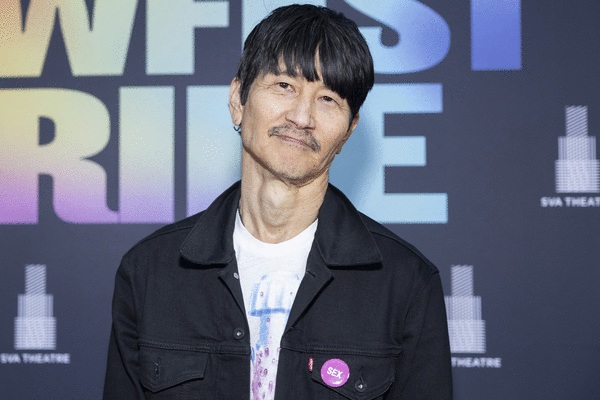
LOS ANGELES — At one of their earliest meetings before shooting "I Want Your Sex" (in theaters July 31), filmmaker Gregg Araki and actor Olivia Wilde got together at the historic Chateau Marmont, the ultra-hip hangout for entertainment's cool crowd. Almost immediately, Araki began making fun of the shamelessness of the place, and before Wilde could feel self-conscious, she came around to laughing too.
"Gregg is so completely un-Hollywood," Wilde recalls during a recent video call, "that even just having a coffee at this place deserved to be remarked upon in a really hilarious way."
Though some actors might have been set back by the moment, for Wilde it helped seal her desire to star in an Araki movie. "I Want Your Sex" is his first in 12 years, marking a brash and welcome return for a key figure from the revelatory New Queer Cinema movement of the 1990s. A recent Criterion Collection box set of Araki's "Teen Apocalypse Trilogy," three of his most influential '90s movies, has helped bring his work — giddy and angry, graphically stylized, playfully provocative and steeped in pop-culture ephemera — to a whole new generation of audiences.
"He's just a different breed," Wilde says of Araki. "There's absolutely nothing Hollywood about Gregg."
Except, of course, that he has long lived in Hollywood itself. Born to a Japanese American family in Los Angeles, Araki grew up mostly in Santa Barbara and returned to L.A. to attend graduate film school at USC and has lived here ever since. All 12 of his feature films, including those not set in Los Angeles, have been shot here. He recently told his manager he doesn't want to take any TV directing jobs that require him to be out of town.
"One of the things I've always loved about L.A. is it's very surreal and kind of cartoon-like," says Araki, a remarkably youthful 66, during a recent interview one afternoon inside the empty theater at Brain Dead Studios on Fairfax before a photo shoot. "The collision between fantasy and reality — the land of dreams and Tinseltown and all that. But then there's also that seedier side. It's just totally unique in that way."
With a shrunken, purple T-shirt of his beloved band My Bloody Valentine wrapped around his slim frame and a signature sweep of black hair with only a slightly graying mustache to belie his age, Araki has a joyful, curious, up-for-anything air people half his years would die for. The tensions of keeping the industry of Hollywood at arm's length while warmly embracing all the contradictions of the city of Los Angeles have long animated him.
"I've never been in a city that feels like L.A., that has the vibe of L.A., that has the visual splendor and squalor," he says. "David Lynch has obviously been a huge influence on me. And he was similar in his vision of the surreal, the dreamlike, the strange, the ugly and the beautiful, all kind of mashed together."
Recently, Araki found out from his mother that his 1993 film "Totally F***ed Up" — which declares Los Angeles "the alienation capital of the world" — had made The Times' recent list of the 101 best L.A. movies, coming in at No. 79.
"She saved it for me," he says with a warm laugh. "She's excited."
Araki feels he has often found himself in the right place at the right time, from the exhilaration of the early '80s L.A. punk scene and seeing a band like X play at the Whisky a Go Go, to turning to filmmaking just as inspirational low-budget movies such as Jim Jarmusch's "Stranger Than Paradise," Wayne Wang's "Chan Is Missing" and Spike Lee's "She's Gotta Have It" were coming out. Araki, like directors Richard Linklater and Todd Haynes, then began a long relationship with the Sundance Film Festival right when the indie boom of the '90s was taking off.
"I Want Your Sex," which premiered earlier this year at Sundance, features an unhinged Wilde as Erika Tracy, an L.A.-based art star whose sex-forward work is by turns cynical and challenging as her fame is fading fast. Cooper Hoffman ("Licorice Pizza") plays Elliot, a recent college grad and low-level studio assistant soon entangled in a kinky affair with his new boss, one made all the more charged by the obvious power imbalance between them.
Araki made the film in part, he says, to reach out to a younger generation and shake them out of their digital-age complacency.
"They're afraid to venture out of their bubble," he says. "They're afraid to take a chance. They're afraid to be uncomfortable."
Being uncomfortable is exactly what made Araki the person he is now: "That is literally my whole life. If it wasn't for me being a 19-, 20-year-old kid and sneaking out to a gay bar for the first time with a fake ID — it was all driven by sex, by curiosity and confusion and all of the stuff that as a young person you feel. I was very specific with Cooper because that character has a lot of me in him when I was that age."
Araki quickly points out that there is also much of himself in Wilde's artist character and some of her most outrageous dialogue comes straight from things Araki has said in his own past interviews.
Wilde, who says she based both her look and performance on "Truth or Dare"-era Madonna mixed with contemporary photographer Nadia Lee Cohen, shot "I Want Your Sex" before production on her own recent "The Invite." Her performance is marked by a startling fearlessness regarding nudity and sexuality and outlandishly revealing outfits.
Wilde found further inspiration in Araki's own fortitude, his steadfastness to his ideals and how it sets him apart from many other filmmakers who parlayed early indie cred into payday careerism.
"Slowly their edges are worn down by the desire for larger houses, bigger pools, whatever it is, and then there are occasionally people like Gregg Araki who aren't affected by the temptation to acquiesce and homogenize," she says. "Why would he start now?"
For those in the know, the movie also has a number of cameos from many familiar Araki collaborators, such as Darcy Marta from the early features "Three Bewildered People in the Night" and "The Living End," Nathan Bexton from "Nowhere" and Michael Hitchcock from "Smiley Face." When James Duval, a veteran of six Araki projects, often as the director's stand-in, arrives onscreen it feels like an applause break for fans to cheer.
"I'm moved by the idea that no matter what time period you're in, people are searching and trying to connect," Duval says during a recent video call from Los Angeles, connecting the dots from "The Doom Generation" to the new one. "Just breaking out and being who you are and not adhering to these labels and not being put in this box — that mentality is in all of Gregg's movies."
Duval, 53, met Araki when he was just a teenager and he credits the filmmaker with setting him on a path to being a professional actor, appearing in movies as varied as "Independence Day" and "Donnie Darko."
Though "I Want Your Sex" is Araki's first feature film since 2014's melodrama "White Bird in Snow," he doesn't see that time as idle. He was first sent the "Sex" script as a spec written by former Vogue sex columnist Karley Sciortino some 12 years ago. He and Sciortino would collaborate on writing Starz's 2019 psychedelic comedy series "Now Apocalypse," directed by Araki and executive-produced by Steven Soderbergh, during the years it took to develop and set up "I Want Your Sex." (Araki and Sciortino share final credit on the script.)
"It's never been a break," says Araki, taking a longer view. "This is something that my old indie buddies like Gus Van Sant will relate to because we work every day. You're constantly trying to get these things going. And the industry is in such a crazy place that it's harder than ever."
The new film includes a series of scenes with just Wilde and Cooper in intimate, sometimes hilarious situations, often trading dialogue back and forth regarding conflicting generational attitudes toward sex and sexuality. While Erika decries "retro sex negativity," Elliot stammers, "My peers have not been well-served growing up in a time where nothing feels safe or OK."
"The movie is purposefully kind of pop, entertaining, funny, sexy and it's 90 minutes," Araki says. "And I just want to provoke a conversation. Just go out with your friends after and just argue about it. Feel however you feel. If you don't want to have sex and you don't care, that's fine. But at least have that conversation with your friends and start communicating about it."
Araki, who now fully identifies as gay (he was for a time in a very public and controversial relationship with a woman), has long presented a fluid and expansive vision of sexuality that defies easy labels.
"My movies have always been on the gamut of the Kinsey scale," he says of how in the past he often tried to avoid labels for himself or his movies. "I feel like that conversation is very subtle and there's times when you need to just be speaking black-and-white terms and say, 'I'm gay' as opposed to saying, 'Sexuality's very complicated.' There's certain arguments or discussions that there's no room for subtlety."
That comes to accepting the legacy of his own films as well.
"I'm thankful for the huge cultural impact that the Queer New Wave had — I'm so proud to be a part of it," he says. "And I understand how important representation is, what that means to a young kid in some red state somewhere. Also as an older person, you're just more comfortable. You figure yourself out more. It's not as much of a struggle anymore."
Even though "I Want Your Sex" explores a relationship between a man and a woman, Araki still considers it a queer movie because their relationship is anything but conventional. It is also why, as a filmmaker, he has often been hard to pin down.
"I think it's literally the punk rock in me," he says. "I can't even describe how important that movement was to me as a young artist, as somebody who was just developing, literally coming out in terms of my sexuality. But in terms of as an artist and as a person, there's this whole alternative path where you don't have to be Black or white or bi or gay or straight — you can just make your own path and do your own thing. That's better than being like everybody else."
Where he once liked to hit the clubs, Araki now mostly stays home with his boyfriend of some 14 years and two small dogs. Though he is reluctant to go into any details about what's next, Araki is still working hard every day, trying to make something new. With his impish attitude and energetic outlook, maturing on his own terms, he seems far off from any sort of valedictory phase.
"It's never easy," he says with a hard-won wisdom. "But it's never been easy."
©2026 Los Angeles Times. Visit latimes.com. Distributed by Tribune Content Agency, LLC.








Comments