In 'Cartwheel,' Amanda Knox tells her story through comedy
Published in Entertainment News

SEATTLE — Quick, guess what Amanda Knox’s Wikifeet rating is.
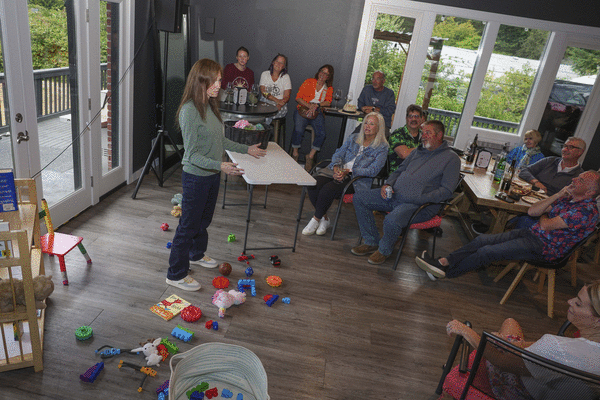
It’s OK to laugh. The whole concept is ridiculous (and the answer is 4.42/5). Which is why it’s the opening idea of Knox’s new solo comedy show, “Cartwheel,” which she performed in its entirety for the first time this month in a Woodinville wine tasting room.
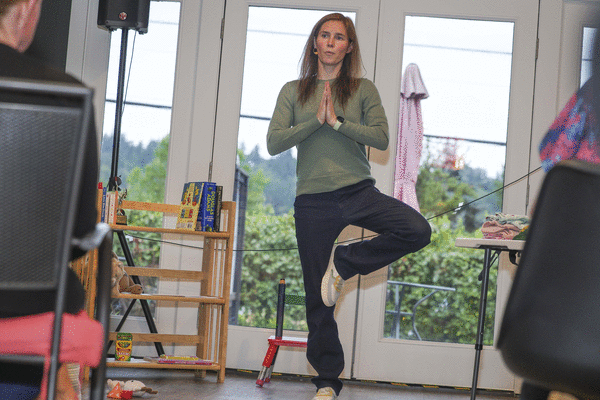
Knox is a compelling, natural stage presence, unspooling this autobiographical story — in a performance space strewn with tiny clothes and stuffed animals — of a goofy Seattle theater kid who ended up in extraordinary legal circumstances that she’s seeing with new eyes since becoming a mom some five years ago.
“I feel a little emotionally hung over from it,” she said in a Zoom call the next morning, sitting in front of a kid’s indoor play structure, a fluffy cat tail meandering intermittently into frame. (The home office was occupied, she said with a laugh.)
She’s “getting her reps in” performing “Cartwheel” in Seattle — you can see her July 30-Aug. 2 at the Rabbit Box Theatre in Pike Place Market — before tackling a longer run at the prestigious Edinburgh Festival Fringe in August.
It’s no surprise that telling this story, no matter how funny this version is (and it is very funny), takes an emotional toll.
Knox’s public-facing story began in September 2007, when the University of Washington junior went to study abroad in Perugia, Italy. Two months later, her roommate and friend, British student Meredith Kercher, was murdered. Knox was arrested for the crime and spent nearly four years in an Italian prison (and became an international tabloid sensation) during a lengthy, labyrinthine trial and appeal process that finally ended when she was fully exonerated by the Italian Supreme Court in 2015.
How do you explain a story like that to your kids? And how do you let an audience know they’re allowed to laugh?
“Motherhood is a great template for talking about things that are both really dramatic and really funny, because being a parent is really dramatic and really funny,” Knox said of the framework for “Cartwheel.” (The title comes from a tabloid story claiming that Knox did a cartwheel in an Italian police station; if you want to know if that’s true you’ll have to see the show.)
And motherhood — both her own and her mother’s — is the through line of “Cartwheel,” which Knox has been shaping with husband and frequent collaborator Christopher Robinson.
Growing from a free-spirited kid into an “Amelie wannabe” young adult, as she puts it, Knox had only ever experienced her quirkiness as a positive. “In 2007, being a whimsical lunatic was hot,” she says in her show, of coming of age in the height of the manic-pixie-dream-girl era. The international media begged to differ.
“The subject of ('Cartwheel') is like, ‘I'm raising a goofy kid, but I was punished for being goofy,’ and the fact that the show is itself goofy is a commentary,” she said. “There are people who are outraged that I'm doing a comedy show and that's kind of the point. I should be allowed to be a full person, and my daughter should be allowed to be a full person, and just because you want to find fault in me and you want me to fail, I don't have to exist in that box.”
In Woodinville, there were a lot of laughs and groans of recognition, often at the hilarities and precarities of motherhood and the very real consequence of raising girls to be friendly and agreeable (and one laugh-out-loud phallic extended metaphor).
Knox has examined her story from multiple angles over the years: her 2013 book “Waiting to Be Heard: A Memoir,” her 2025 book “Free: My Search for Meaning” (which was just named a finalist for the 2026 Dayton Literary Peace Prize), her podcast “Hard Knox” and the documentary “Mouth of the Wolf,” written and directed by Robinson, which came out this year and follows Knox as she confronts her Italian prosecutor.
“I'm a creative person who does self-portraits because that’s how I'm processing my life,” she said. “There's this expectation that if you've gone through something really traumatic that you are going to be this trauma person forever, and that's not who I am. I didn't choose that.”
Telling her story through comedy felt like a natural next step for an innately lighthearted person whose entire adult life has been heavy. When people can turn awkward or painful experiences into a joke, Knox said, it seems like a superpower.
It also taps into theater’s ability to generate empathy. Judging someone from behind a screen or a page is one thing; it’s another to share space with a fellow human being telling you their own story, as only they know it.
Unlike many artists, Knox is building on years of portraiture she didn’t even paint herself, so trapped was she in the media and the public’s obsession with her. (When Kercher’s convicted killer, Rudy Guede, was released in 2021 after serving 13 years in prison, Knox remembers a headline that read: “Amanda Knox’s roommate's killer released from prison.”)
Knox performs this show alone, but she’s joined by her young daughter Eureka’s recorded voice, in all its squeaky post-toddler cuteness, asking questions, challenging her mom and, in a happy recording-booth accident, setting Knox up brilliantly for the line “post-traumatic spaghetti disorder.”
Earlier versions of the show didn't include Eureka so explicitly, Knox said, but she wanted the audience to feel the stakes of the story. “For you to hear that somebody sent me a message saying, ‘I hope your daughter gets murdered’ — that becomes so much more real when you've heard her voice. My daughter is a real person, not an abstract idea, and she's getting death threats because of me.”
To that end, Knox is also using this comedy show to work through some serious anger. If she’s going to be a good mom, she said, she has to address any bottled-up rage, because while she might accept that situation for herself, she’ll never accept it for her children.
“I do well when I articulate to another person who I am, how I feel or what I'm thinking,” she said. “But I’ve had to get back into that because I was deeply traumatized to feel like no matter what I said or did, no one was going to listen to me. I've had to unlearn that by taking risks, and this show is the latest risk I'm taking to feel connected to my life.”
© 2026 The Seattle Times. Visit www.seattletimes.com. Distributed by Tribune Content Agency, LLC.




Comments